Press
Nine arrested in France over death of far-right student
Images
1 / 8

2 / 8
3 / 8

4 / 8
5 / 8

6 / 8
7 / 8
8 / 8
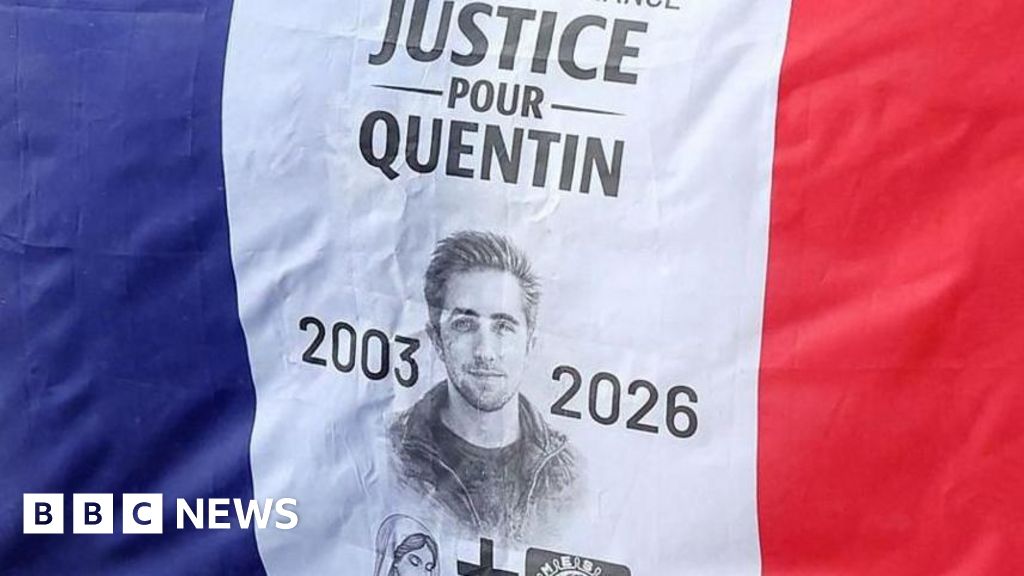
Nine people have been arrested in France following an investigation into the murder of a far-right nationalist student by suspected militants from the far-left.

Those detained include a parliamentary assistant for a deputy from the radical left France Unbowed (LFI) party.

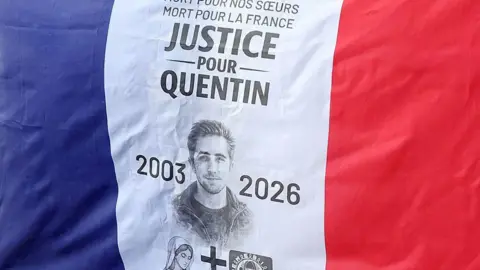
Quentin Deranque, a 23-year-old maths student, died in hospital on Saturday - two days after being beaten and kicked about the head by a gang of masked young men in Lyon.

It happened after a small demonstration by far-right feminists - who Deranque was supposed to be helping protect - at the city's Institute of Political Studies (IEP), commonly known as Sciences-Po.

The arrests confirm what has widely been reported: that those suspected of the murder are far-left militants linked to a banned group called La Jeune Garde (Young Guard).

The most striking news is that among the nine in custody is Jacques-Elie Favrot, a young man who until now has been employed as parliamentary assistant at the National Assembly in Paris for a deputy from LFI.

The murder is putting huge pressure on LFI, on its 70 MPs, and on its veteran leader Jean-Luc Mélenchon, who is a likely contender in next year's presidential election.

On Sunday, Mélenchon said his party had "nothing to do with this story. Those who accuse us are committing a libel.

"We express our consternation, but also our empathy and compassion for [Deranque's] family and friends. We have said dozens of times that we oppose all forms of violence," he said.

On Monday, state prosecutor Thierry Dran told a news conference that Deranque was kicked and punched by "at least six" individuals, and that the post-mortem examination showed fatal damage to his skull and brain.

French Foreign Minister Jean-Noël Barrot said the vessel was departing Marseille after a payment of "several million euros".

Quentin Deranque, 23, died on Saturday after being beaten up on the street by a group of young men.

European nations are asking whether traditional alliances can suffice, or whether they should be diversifying

The Queen's note said Gisèle Pelicot's courage had "created a powerful legacy that will change the narrative around shame, forever".

Ms Pelicot reveals it is "inconceivable" that the man she shared her life with "could have committed these horrors".