yahoo Press
Is Bitcoin's Future Safe as Miners Leave for AI? Analyst Claims Bitcoin Mining Is ‘Unprofitable'
Images

1 / 5
2 / 5

3 / 5

4 / 5
5 / 5
Key Takeaways

Analysts say most Bitcoin miners are now operating at or near unprofitable levels as hash prices fall and costs rise.

Miners are pivoting to AI data centers for higher, more predictable returns.

Concerns have been raised about Bitcoin’s long-term security.

Bitcoin mining is a money-losing business, analysts warn, just as artificial intelligence (AI) data centers deliver richer returns.

American Bitcoin, backed by members of the Trump family, reported a $59 million quarterly loss as its stock plunged nearly 90% from last year’s peak.

At the same time, miners are pivoting away from the blockchain and towards AI infrastructure, where profits per megawatt can far exceed those from Bitcoin hashing.

With miners shifting and AI margins rising, a key question has emerged — if securing the network no longer pays, is Bitcoin still safe?

The pivot gathered pace after Bitcoin’s April 2024 halving cut block rewards in half, which significantly squeezed margins across the sector.

Rising electricity prices and expansive hardware spending have pushed production costs higher, narrowing the gap between mining expenses and Bitcoin’s market price.

JPMorgan estimates average production costs around $92,000 per Bitcoin, with further increases expected in the coming years.

According to data from Hashrate Index, hash price has declined roughly 30% over the past three months.

At the time of reporting, Bitcoin’s price sits around $68,000, cutting miners’ profits compared with when it traded above $100,000 last year.

In contrast, AI offers fixed enterprise customers and multi-year contracts, allowing miners to have a dedicated income.

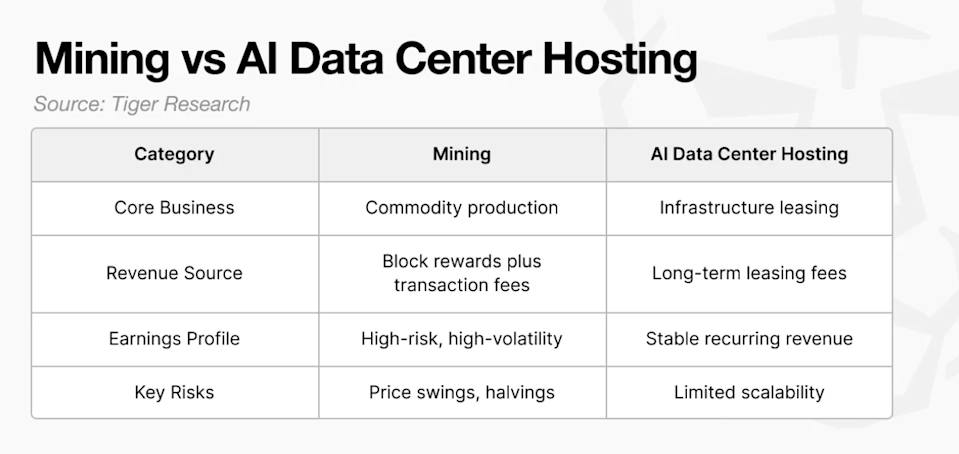
In a recent report from Tiger Research, the firm described the industry as facing a “double squeeze.”

The firm estimated that the average cost to mine one Bitcoin had climbed to a total production cost of $130,000 per Bitcoin.

“These moves reflect a broader trend,” the report said, referring to miners repurposing infrastructure toward AI data center leasing.

“As mining profitability weakens, mining companies are seeking business models better aligned with the AI era.”

Tiger Research added that diversification could ultimately reduce forced Bitcoin selling by stabilizing miners’ cash flow.

“Less competitive players exit or pivot, reducing excess mining pressure,” the report said.

A recent note from brokerage Rosenblatt said most Bitcoin miners are no longer generating meaningful profits from Bitcoin production as falling token prices and shrinking hash prices erode margins.

“With mining revenue now under $0.03 per terahash, economics are unprofitable for all, but the most efficient operators,” Rosenblatt analyst Chris Brendler wrote in a client note, cited by CNBC.

“Bitcoin mining economics have gone from bad to worse,” Brendler said.

The strain is evident in the company’s results.

American Bitcoin, a mining firm backed by members of the Trump family, reported a $59 million fourth-quarter loss as the broader crypto downturn weighed on revenue.

Its shares have also fallen nearly 90% from a September 2025 peak.

Some critics argue that the financial pressure on miners is already showing up in Bitcoin’s network data.

In a series of posts on X, Bitcoin critic Jacob King claimed Bitcoin experienced what he described as the largest short-term hashrate decline on record.

“We’re watching the Bitcoin network unravel in real time. Nearly every metric is contracting,” King wrote.

According to King, the network’s hashrate fell from roughly 1.13 zettahashes per second to around 690 exahashes per second over two days.

“With prices falling and operating costs fixed, many will be forced to sell BTC to stay solvent, accelerating the downward spiral,” he added.

Over the past few months, several high-profile firms have pivoted away from Bitcoin and crypto toward AI infrastructure.

Singapore-based Bitdeer took one of the most radical steps, reducing its corporate Bitcoin holdings to zero after selling its recent production.

The company said it is preserving liquidity to fund AI infrastructure expansion, including deployments of NVIDIA’s latest systems and site conversions in the United States and Europe.

Meanwhile, on Thursday, shares of MARA Holdings announced a partnership with Starwood Capital Group to develop large-scale data centers at its U.S. sites.

The facilities, originally built for Bitcoin mining, will be converted to serve enterprise cloud and AI tenants.

Yet the economics are not straightforward.

Bitcoin mining relies heavily on application-specific integrated circuits (ASICs), optimized for hashing.

AI infrastructure, however, requires advanced GPUs, high-bandwidth memory and complex cooling systems — components whose costs have surged amid global demand.

The buildouts are also significantly more capital-intensive.

Large GPU clusters require billions in upfront investment, sophisticated networking and long maintenance times.

While mining revenues fluctuate daily with token prices and network difficulty adjustments, AI revenue is almost always substantially more to run — despite it being typically contracted.

In other words, while AI may be more profitable — it is not necessarily cheaper.

“It is not a plug-and-play transition,” digital asset custodian BitGo noted.

BitGo said the migration of mining capacity toward AI computing presents both risks and potential benefits for the Bitcoin network.

On the downside, the company warned that redirecting power away from hashing could affect hashrate growth.

“If significant swaths of power capacity are redirected to AI, global hashrate growth could slow, which in theory reduces the marginal cost of attacking the network — even if that cost remains extremely high.”

On top of this, the firm added that capital requirements for AI infrastructure could accelerate consolidation.

If a large group of well-capitalized miners transitioned to high-performance computing, they could use the AI profits to subsidize cheaper mining.

This may push smaller players out of the market, the firm explained.

However, BitGo also argued the pivot may ultimately strengthen the sector, arguing that diversifying revenue could create a “financial floor.”

“AI contracts can provide predictable cash flow that preserves the industrial infrastructure underpinning Bitcoin,” BitGo said.

Top Picks for Bitcoin

Get A Great Offer When You Join These Exchanges

How To Buy Bitcoin With a Credit Card Now

See Our Picks for the Best Crypto Gambling Sites

The post Is Bitcoin's Future Safe as Miners Leave for AI? Analyst Claims Bitcoin Mining Is ‘Unprofitable' appeared first on ccn.com.