huffpost Press
People Aren''t Satisfied With 'Bridgerton' Has Nothing To Do With The Actual Show
Images

1 / 10

2 / 10
3 / 10
4 / 10
5 / 10

6 / 10

7 / 10

8 / 10

9 / 10

10 / 10
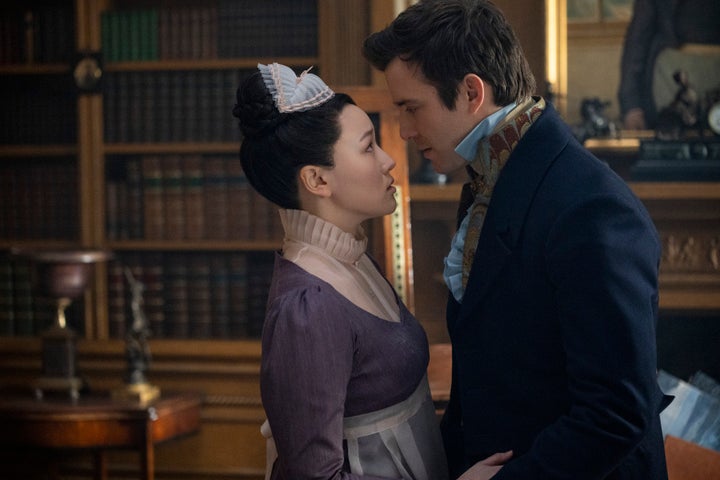
The upstairs and downstairs worlds of Netflix’s “Bridgerton” collide quite literally in the final moments of Season 4’s first half when Benedict (Luke Thompson), the second-oldest and most bohemian brother in the esteemed Bridgerton family, passionately kisses Sophie Beck (Yerin Ha), an illegitimate maid, on the middle landing of the house’s back staircase.

After four episodes of uncharacteristic pining, it seems that Benedict is finally besotted. “The truth is I stay away because you consume me,” he pulls back to tell Sophie while the momentum of an orchestral rendition of Olivia Rodrigo’s “bad idea right?” heightens the heat of the moment. The music fades just as Benedict asks a question that Sophie expects to be a romantic proposal, but proves to be a rakish request. “Sophie,” he whispers, “be my mistress.”

Immediately, the music fades, the heat cools, and Sophie leaves him on the dark staircase to return to her downstairs role. Benedict’s unanswered question and her obvious disappointment serve as the mid-season cliffhanger, and it is reminiscent of the post-carriage marriage proposal of his brother Colin (Luke Newton) midway through Season 3. While Benedict’s request is of a different nature altogether, it does seem to be the only realistic way forward for a cross-class couple during the Regency era. Chemistry and longing aside, a maid will never be a suitable match for a member of the ton.

This is the dose of reality that plagues Benedict and Sophie’s love story, and it is a reminder that “Bridgerton” is not simply a romance. After the first part aired, the show received criticism for this fact. Some argued that the last few seasons have evolved into “ensemble dramas” that have developed a distinctive universe that has left “Bridgerton” “stuck in the matrix,” unable to satiate viewers looking for the same romantic catharsis of a true romance like “Heated Rivalry.” However, “Bridgerton” has never been such a show. It has always strived to situate a steamy romance within a larger social context that parallels aspects of viewers’ own world.

Benedict and Sophie follow this pattern. While the romantic storyline of one of the siblings serves as the anchor of each season, it always exists within a larger social context and the conflict that necessitates because, as Shonda Rhimes constantly reminds viewers, romance is always political. This is just as true in her breakout hit “Grey’s Anatomy” with its “dirty mistresses club” as it is in the extramarital affair that drives her presidential drama, “Scandal.” The reality of what Rhimes is doing simply becomes more apparent as the show evolves, and she builds upon the world Julia Quinn created in the book series.

The first season, which aired in December 2020, captivated viewers during COVID lockdowns with its bold and steamy on-screen sex between Daphne (Phoebe Dynevor) and Simon (Regé-Jean Page). However, even in that season, “Bridgerton” was never about a romance that was entirely removed from reality.

One of the main conflicts in the latter half of that season centers on Daphne not knowing how to get pregnant and Simon purposefully keeping her in the dark. He won’t “spill his seed” inside of her because he has vowed not to continue his family’s Hastings lineage. That season was criticized for downplaying the moment Daphne forces him to come inside of her as anything less than rape. But the show doesn’t shy away from this conflict or the social precarity in which many women of the ton find themselves; they are married to men without understanding the basics of their biology or their natural desire because it would be unladylike to have such knowledge.

Rhimes expands on this theme in the show’s spinoff, ”Queen Charlotte,” which I argued was even more captivating than Bridgerton because of its complexity. It highlights the ton’s sexual politics to explore the roles of both marriage and the monarchy and the way women’s wants are constrained within both and used for political purposes.

The result of the spinoff was that by the time the original show returned for its second season, it had already built empathy for its matriarchs: Queen Charlotte (Golda Rosheuvel), Violet (Ruth Gemmell) and Lady Danbury (Adjoa Andoh). The enemies-to-lovers storyline between Anthony (Jonathan Bailey) and Kate (Simone Ashley) is enriched because of the show’s continued exploration of the link between social duty and personal desire. The show built upon this theme even more in Season 3 when the main friction becomes not if Penelope and Colin will be together but how she will balance wanting a ring on her finger and a pen in her hand.

In other words, is she willing to make the sacrifices required by the realities of marriage?

The second part of Season 4 puts this question in the spotlight. While there is romance and sex, that isn’t the focus. It’s clear that Benedict and Sophie are a Cinderella story with chemistry. It’s clear that the most rakish of the Bridgerton brothers has finally caught feelings. It’s clear that she wants him just as much as he wants her. Instead, the tension is whether or not they can both live with the realities of what it will mean to be together.

Can she trust herself enough to be his mistress and live in his cottage? Will he really be OK with a life entirely separate from society and its diversions? And, most important, how could their decision impact the marriage prospects of Benedict’s unmarried siblings or the lives of any children that could result from all of the sex that he wants to have with Sophie?

To explore these questions, “Bridgerton” adds context through its relationship subplots. Violet has finally found someone to tend her garden, but she is unsure if she wants the commitment required to make such a “gardener” permanent. Francesca is faced with the reality that not everyone gets a happily ever after, and some couples’ endings come far too soon.

In addition to these relevant storylines that bring grief to the forefront of the show in way that will shape Benedict and Sophie’s future, there are also non-romantic subplots about the queen, Lady Danbury, Penelope, Eloise, Hyacinth and Gregory. These less relevant subplots highlight the risk that Rhimes’ shows always run. The longer the shows go on, the more bogged down they can feel because there is less space for the romantic arc that has traditionally anchored the storytelling. With “Bridgerton,” this risk is deeply felt because of the structure of having each season focus on one Bridgerton sibling falling in love.

There’s a romantic notion in world-building that viewers develop their own relationship to the universe created on-screen, and it fosters loyalty to the characters and the larger story being woven. However, when viewers are coming to your story to experience the vicarious spark of two people who can’t help but want each other, subplots can tamp down the fire of that attraction too much.

So, can “Bridgerton” find a balance between its romantic roots and its unique world? And how long will viewers give the show the grace to figure this out if viewers increasingly want the heat of a show like “Heated Rivalry”? Only more seasons will tell, and, one thing is certain, “Bridgerton” will return for a fifth season to put these questions to the test.

“Bridgerton” is streaming on Netflix.

By entering your email and clicking Sign Up, you're agreeing to let us send you customized marketing messages about us and our advertising partners. You are also agreeing to our Terms of Service and Privacy Policy.