yahoo Press
Wall Street Thinks Hard-Hit SNOW Stock Can Gain 40% in 2026. Should You Buy Snowflake Now?
Images

1 / 7

2 / 7

3 / 7

4 / 7

5 / 7
6 / 7

7 / 7
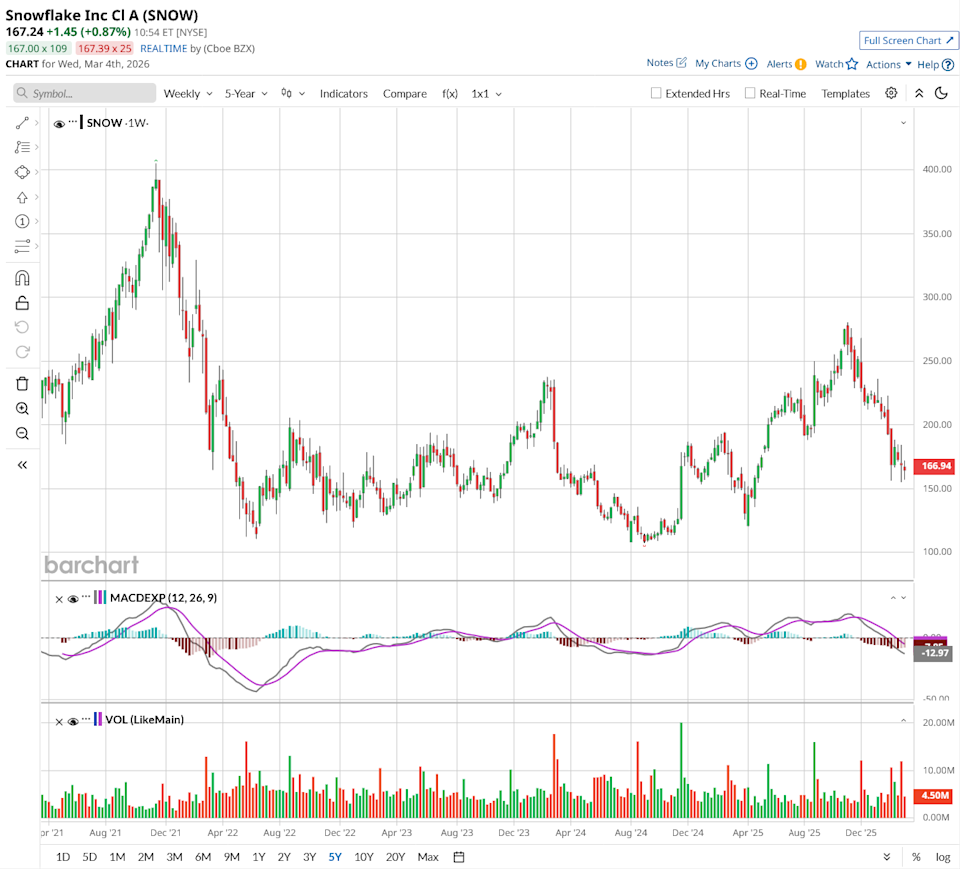
Shares of Snowflake (SNOW) have taken a beating in recent weeks. Valued at a market cap of $57.6 billion, SNOW stock is down over 40% from its 52-week high, but analysts seem to believe it can make those losses back, and then some. The software sector selloff has been broad and, some would argue, indiscriminate.

But one major Wall Street firm says the market is missing the forest for the trees and that the ongoing pullback could be a buying opportunity in the artificial intelligence space right now.

Dear Costco Stock Fans, Mark Your Calendars for March 5

SanDisk Stock Forecast: Can the Rally Continue Into 2026?

Dear Broadcom Stock Fans, Mark Your Calendars for March 4

Markets move fast. Keep up by reading our FREE midday Barchart Brief newsletter for exclusive charts, analysis, and headlines.

Here's what investors need to know.

The recent AI-driven selloff hasn't spared anyone. Evercore ISI analyst Julian Emanuel put it plainly in a note to investors Monday, describing the market's recent behavior as "sell first, ask questions later."

The firm argued that shares have been marked down regardless of a company's “business model, strategy, moats or AI earnings potential.” This blanket punishment may not be fair to all companies caught in the crossfire.

Evercore ISI singled out Snowflake as one of the eight stocks best positioned to benefit from AI adoption. The firm specifically called SNOW stock a "scaffolding" name, alongside Microsoft (MSFT), meaning it sees the company as critical underlying infrastructure for enterprise AI, not just another application riding the hype.

Analyst Kirk Materne said most investors will take a "wait and see" approach but that a real disconnect exists between how the market is treating software stocks and what the fundamentals actually show.

Snowflake is a cloud-based data platform. Think of it as the place where large companies store, organize, and analyze their most valuable data. Its customers pay based on how much computing they consume, not a flat monthly fee.

That distinction matters. As companies push to deploy AI tools internally, they need a trusted, secure foundation to run those tools on.

And the early results from its fiscal fourth quarter 2026 earnings, reported Feb. 25, suggest the bet is paying off.

Product revenue grew 30% year-over-year (YoY) to $1.23 billion.

The company added 740 net new customers in the quarter alone, up 40% YoY.

And remaining performance obligations, basically contracted future revenue, hit $9.77 billion, with growth accelerating to 42%.

"Snowflake sits at the center of the enterprise AI revolution," Chief Executive Officer Sridhar Ramaswamy told investors on the earnings call.

The company also signed the largest deal in its history, over $400 million with a single financial services customer, along with seven other nine-figure contracts in the quarter. By comparison, it signed just two contracts that large in the same period a year ago.

What's fueling the growth isn't just the core data business. New AI products are seeing rapid adoption.

Snowflake Intelligence, an agent-based tool that lets employees ask business questions in plain language, reached more than 2,500 accounts in just three months, nearly doubling quarter-over-quarter. More than 9,100 accounts are now using some form of AI on the platform.

Meanwhile, Cortex Code, a coding agent that helps developers build and automate data workflows, has been adopted by more than 4,400 customers. Ramaswamy described its impact on internal productivity as compressing development cycles that once took weeks into days. One partner wrote to the company that before Cortex Code, they "had been using shovels to dig," and Snowflake "just gave them bulldozers."

That kind of real-world testimonial backs up what Evercore ISI says it is seeing: companies that build early AI protections around "orchestration, secure enterprise guardrails, and agentic execution across siloed data are set to outperform."

Evercore ISI's bullish stance, combined with Snowflake's guidance for 27% product revenue growth in fiscal 2027, targeting approximately $5.66 billion, makes the case that the selloff has created real value.

The data analytics platform also expects operating margin to expand from 10.5% in fiscal 2026 to 12.5% in fiscal 2027, and stock-based compensation is expected to fall from 34% to 27% of revenue: two signs of improving financial discipline.

Analysts forecast SNOW stock to end fiscal 2031 with a free cash flow of $4.68 billion, up from $1.36 billion in 2026. If SNOW stock is priced at 35x forward FCF, which is lower than its current 42x multiple, it should gain 160% over the next four years.

Out of the 45 analysts covering Snowflake stock, 36 recommend “Strong Buy,” three recommend “Moderate Buy,” four recommend “Hold,” and two recommend “Strong Sell.” The average SNOW stock price target is $237.26, about 40% above the current price of about $167. However, the high price target of $325 means SNOW could rise as much as 94%.

However, consumption-based models can be unpredictable. And the company is still early in integrating its recent $600 million acquisition of the observability platform Observe. But for investors with a long-term horizon who believe enterprise AI adoption is accelerating, Snowflake's current valuation after the selloff may offer a compelling entry point.

On the date of publication, Aditya Raghunath did not have (either directly or indirectly) positions in any of the securities mentioned in this article. All information and data in this article is solely for informational purposes. This article was originally published on Barchart.com