Press
First UK government flight for Britons stranded in Middle East departs
Images
1 / 13

2 / 13
3 / 13
4 / 13
5 / 13

6 / 13
7 / 13

8 / 13
9 / 13

10 / 13
11 / 13
12 / 13
13 / 13
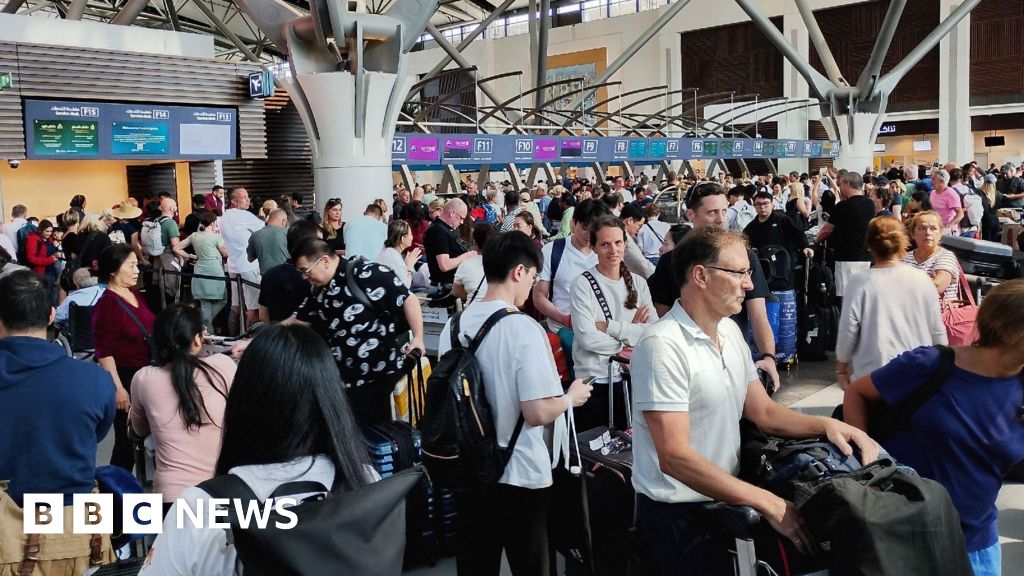
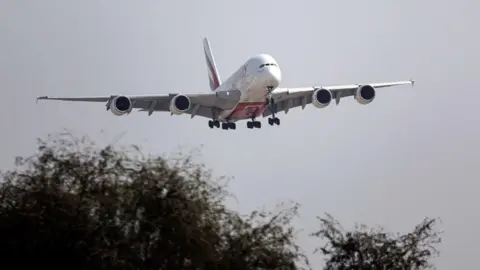
A flight chartered by the government to bring back some Britons stranded in the Middle East has arrived in the UK.

The flight, originally scheduled to leave Oman's capital Muscat on Wednesday, had its departure delayed following some technical issues.

It eventually took off nearly 24 hours late on Thursday night local time, before landing at Stansted Airport at 00:53 GMT on Friday.

Thousands of British nationals remain stuck in the Middle East, after US-Israeli strikes on Iran prompted retaliatory strikes by Iran across the region.

More than 140,000 Britons in the region have registered for updates from the UK government.

Prime Minister Sir Keir Starmer has said more than 4,000 people have arrived back in the UK on commercial flights from the UAE, including "vulnerable Brits".

A further seven flights were due to leave the UAE for the UK on Thursday, he said, adding that the government will lay on additional charter flights in the coming days.

He said British Airways is putting on daily flights from Oman, and the government will keep working with partners to "increase the speed and capacity of this airlift".

Foreign Office minister Hamish Falconer described the situation as "a consular challenge on a scale not seen since Covid" and said there were "no instant solutions".

Britons in Oman will be contacted as soon as the additional government-organised flights from Muscat become available, Falconer said.

However, he said commercial flights becoming available were "by far the most likely and the most rapid routes back to the UK".

In response, Shadow Foreign Secretary Priti Patel criticised the government's position on the conflict, calling Foreign Secretary Yvette Cooper "weak and feeble".

Patel said the US, Cyprus, the UAE and Bahrain felt let down by the UK's lack of involvement.

Cooper had "failed in her duty to stand up for Britain's place in the world" and had not provided the leadership needed to protect military personnel, British bases and British nationals, she added.

On Thursday evening, a plane sent by France to Dubai to repatriate its citizens reportedly had to turn back because of missile fire.

French Transport Minister Philippe Tabarot said the turning round of the French plane underscored the instability in the region and the complexity of safely carrying out repatriation operations.

Those eligible for government flights are being asked to pay for seats. When announcing the initial flight, the Foreign Office said it would prioritise the most vulnerable people, and that only British nationals, their spouse or partner, and children under 18 would be offered a seat.

Foreign Office officials said 141,000 British nationals in the Gulf had registered their presence, of whom 112,000 were in the United Arab Emirates.

Following the missile strikes across the Middle East, airspace remains severely restricted, with flights completely or partially grounded over Saudi Arabia, Iran, Iraq, Qatar, Bahrain, Kuwait, Syria, the UAE and Israel.

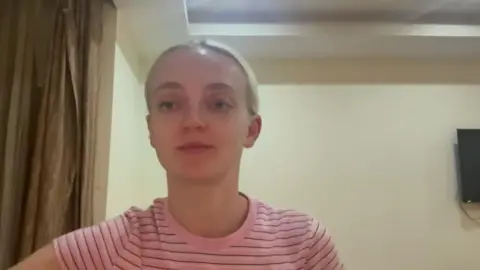
A passenger on the flight, named Mark, messaged the BBC as it was about to take off. He's travelling with his young family to London Stansted.

He described the "complete shambles" of Wednesday's delayed flight - check-in took two hours, and they were stuck on a bus to the plane for another hour with "no communication from the craft or the crew".

Mark said someone had a panic attack on the bus, and once the doors finally opened, they were told the crew were working out of hours, meaning the flight would not legally be able to reach Cairo.

Britons unable to secure a seat on the charter flight have been looking for alternative ways home.

Sam Sahabandu, 47, from Northamptonshire, who got stuck in Muscat after his flight back to London from Sri Lanka was diverted, was due to be on a Qatar Airways flight to Heathrow on Thursday afternoon local time.

Sahabandu said Muscat Airport appeared "relatively peaceful" despite the disruption, and some other passengers were being routed through other cities such as Rome to get back to the UK.

Poppy Cleary, 27, was one of those stranded in Muscat after her flight from Singapore was diverted to Oman on Saturday. She told BBC Your Voice that she registered and paid for a charter flight, but never heard back.

She said the British Embassy in Oman told her the first flight was not for people who had been diverted to Muscat, but instead for people who had come to Oman from "unsafe countries" including the UAE, Kuwait, Bahrain and Qatar.

Cleary said she was "relieved" to eventually secure a place on the Qatar Airways flight leaving Oman on Thursday, telling the BBC after boarding that it did not appear to be full, with a "fair amount of empty seats".

One woman selected for a space on the government charter flight said she had to decline her spot as her parents - who have indefinite leave to remain in the UK, but are Sri Lankan passport holders - were not eligible.

Erasha Amarasinghe, a 39-year-old doctor from Northampton, told BBC Your Voice: "I am travelling with my disabled mother and my father who has cognitive impairment […] I feel stuck as I cannot leave my parents behind."

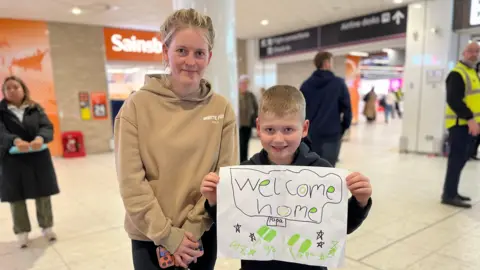
There were emotional scenes at Edinburgh Airport on Wednesday night as some 300 passengers landed on an Emirates flight from Dubai.

Andrew Crow and Jean Weir, from Glasgow, had checked out of the Fairmont The Palm hotel in Dubai just hours before it was caught in a large explosion on Saturday.

"The flight was a long one on the way back, I can assure you, but we are relieved to be home," Andrew said.

Victoria Cameron, from Larkhall, had been travelling home from New Zealand via Dubai when flights in the Middle East were grounded.

"The staff said 'run, run, leave your suitcases'," she told the BBC. "Our phones were going off, saying 'emergency alert'. We were crying, we were shaking."

Meanwhile, the UK government continues to set out its wider response to the crisis in the Middle East, including deploying a warship to the area close to Cyprus.

The Royal Navy destroyer HMS Dragon will be sent to the Mediterranean, possibly next week, to bolster defences around a British military base at Akrotiri after it was hit by an Iranian drone.

A number of flights departed Muscat, Oman on Thursday, including a British Airways flight to London. The airline said it is operating two more already fully-booked flights from Oman to Heathrow on Friday and Saturday.

It added: "We remain unable to operate flights from Abu Dhabi, Amman, Bahrain, Doha, Dubai and Tel Aviv."

In an update on X, Qatar Airways said it would be operating a "limited number" of relief flights from Thursday for passengers across the region.

Additional reporting by James Kelly, Rozina Sini, Alex Akhurst, Andree Massiah, Megan Bonar

Are you in Oman? Will you be on this flight? Get in touch via this link or use the form below.

Get our flagship newsletter with all the headlines you need to start the day. Sign up here.

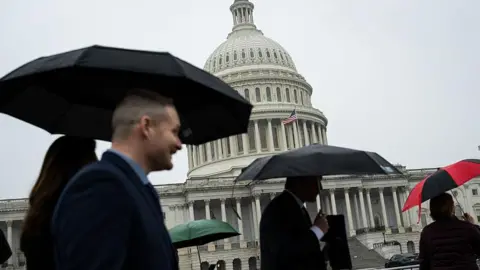
Four Democratic defectors helped Republicans defeat an attempt to rein in Trump's ability to wage war.

China is not feeling the shock of war in the Middle East - yet. But it is feeling the ripples.

The BBC's Helena Humphrey explains the steps required to reopen both embassies, which have remained closed for decades.

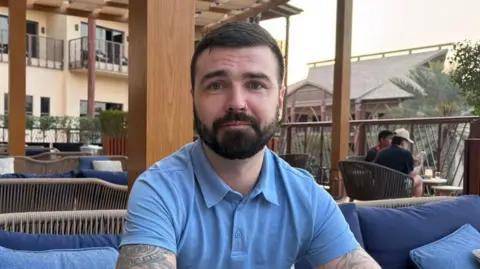
Mic Cassidy is stranded in Dubai after he was turned away from a repatriation flight and two others flights were cancelled.

Iranian Kurdish opposition groups in exile in northern Iraq tell the BBC they have plans to cross the border but deny already doing so.