Press
Passengers describe 'surreal' scramble to reach first government flight out of Middle East
Images
1 / 8

2 / 8
3 / 8
4 / 8
5 / 8
6 / 8
7 / 8
8 / 8
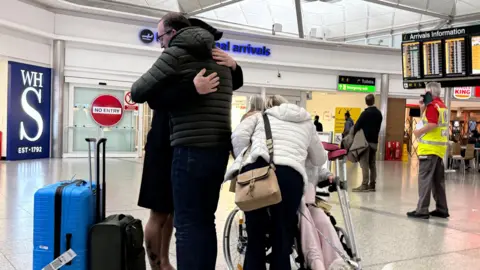
British nationals who landed in the UK on the first government flight out of the Middle East since the widespread conflict began six days ago have told how they scrambled across borders to get on the plane.

The flight, originally scheduled to leave Oman's capital Muscat on Wednesday night, had its departure delayed by nearly 24 hours following technical issues.

It eventually took off on Thursday night local time, before landing at London's Stansted Airport at 00:53 GMT on Friday.

More than 140,000 Britons in the region have registered their presence with the UK's Foreign Office, after US-Israeli strikes on Iran prompted retaliatory strikes by Iran across the region.

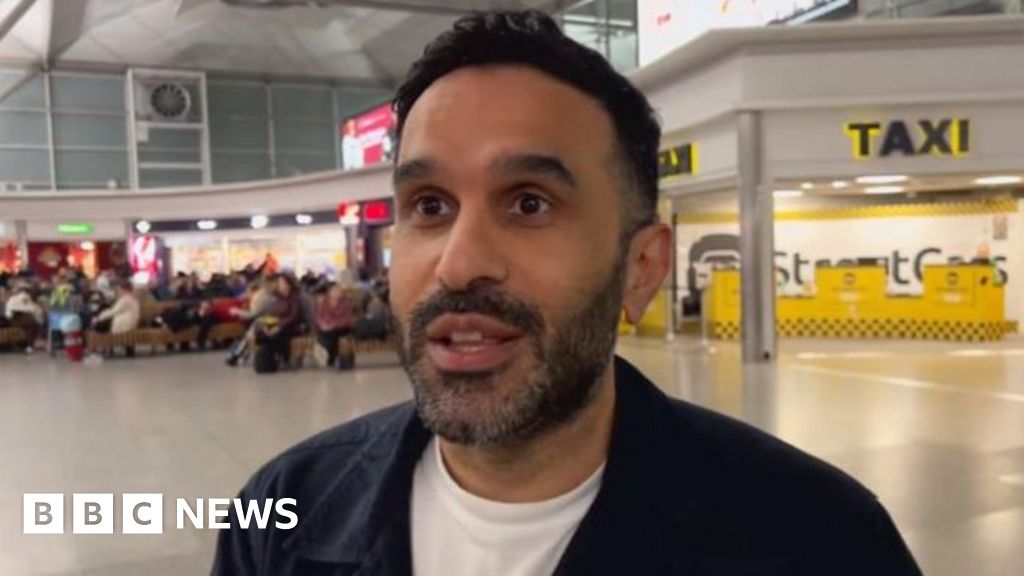
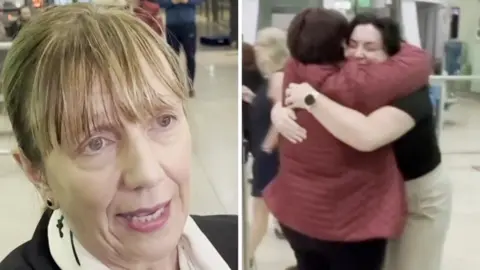
Fazal Chowdhury, a Dubai resident, has described the experience as "a little bit surreal to be honest", explaining he and his wife decided to drive to the Omani capital as soon as they saw the initial reports of attacks on the city.

Dubai has seen several direct strikes from Iran since Saturday, with damage reported at Dubai International Airport and several luxury hotels.

"We just made a run for it straight away, checked into a hotel in Muscat, and there we were just waiting," Chowdhury told the BBC after landing at Stansted on Friday.

Oman is situated across the Gulf of Oman from southern Iran but is about 1,200 miles (1,900km)  away from Tehran so is further from the Iranian capital than most of the Middle East nations.

Its capital city Muscat is just a 280-mile drive from the UAE's biggest city Dubai, where many British tourists and expats are currently based.

Chowdhury and his wife registered with the Foreign Office as soon as the details of the government chartered flight were released, he said, adding they were "very lucky" to get a seat onboard.

Though he said the flight delay had been described as a "bit of a shambles", he told the BBC that he thought it had been managed well overall and the communication from the UK government had been "really good".

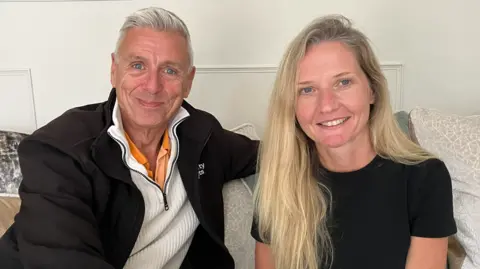
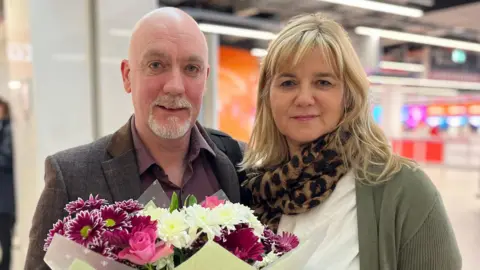
Amelia Reid and Samuel Sharp arrived in Dubai last Friday for a long weekend, but by Saturday evening, were forced to shelter in the car park beneath their hotel.

"We ended up sleeping in a car park in the basement of the hotel with about 100 other people, after the alarms went off on our phones," said Sharp.

He described being "on edge for four days", after having breakfast in their hotel on Sunday and hearing a "massive bang".

Reid, who was travelling in a wheelchair, said the couple had left Dubai at around 12:00 on Thursday local time, and travelled from the Oman border to the airport via coach in "the hope that we'd get on the Government plane".

The Foreign Office had warned people to wait to be contacted rather than just turning up at Muscat International Airport.

But people were allowed to register their presence in Oman as soon as they were in the country.

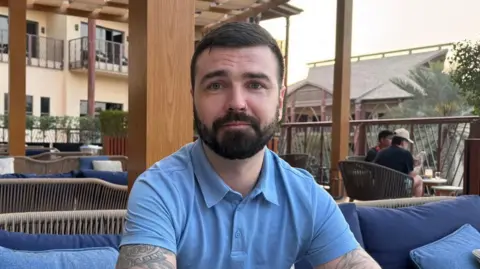
One man, who didn't want to be named, said that he fled Dubai along with his young family over the weekend, driving themselves to Oman.

He described a "terrible" wait for the chartered plane to take off yesterday, after spending around 36 hours in Muscat International Airport with his wife and young child.

Following the missile strikes across the Middle East, airspace remains severely restricted in the region, with flights completely or partially grounded over Saudi Arabia, Iran, Iraq, Qatar, Bahrain, Kuwait, Syria, the UAE and Israel.

When announcing the initial flight, the Foreign Office said it would prioritise the most vulnerable people, and that only British nationals, their spouse or partner, and children under 18 would be offered a seat.

Prime Minister Sir Keir Starmer said British Airways would be putting on daily flights from Oman, and the government will keep working with partners to "increase the speed and capacity of this airlift", adding additional charter flights would be scheduled in the coming days.

The people who had arrived back included "vulnerable Brits", Sir Keir added.

Speaking to BBC Breakfast on Friday, deputy prime minister David Lammy said 6,500 Britons have returned from the UAE.

He added the government was "dependent on air space opening up" but they are working with commercial airlines when space does open up to "get people out".

"It is our intention and our hope to see more charter flights out of Oman and more commercial flights out of the region over the coming hours and over the coming days," he said.

Those eligible for government flights are being asked to pay for seats.

If it is safe to do so, you can get in touch by following this link

A woman arrives back in Plymouth in time to begin her chemotherapy treatment.

Mic Cassidy is stranded in Dubai after he was turned away from a repatriation flight and two others flights were cancelled.

The Emirates flight was the first in a number of days after the United States-Israeli attacks on Iran led to the closure of nearly all airspace in the Middle East.

A flight carrying 300 travellers who had been stranded in Dubai arrives back at Edinburgh Airport.

The flight was carrying passengers whose flights were cancelled at the weekend, the Irish Department of Foreign Affairs says.