yahoo Press
Oracle Price Prediction: One Wall Street Analyst Says ORCL Could Hit $240 This Year
Images
1 / 4
2 / 4

3 / 4

4 / 4
Oracle (ORCL) posted cloud infrastructure revenue of $4.888B, up 84% year over year, with remaining performance obligations of $553B locked in from large-scale AI contracts, and management raised its FY2027 revenue target to $90B.

Oracle’s cloud business is scaling rapidly on sustained AI infrastructure demand, with the path to $240 per share dependent on converting its $553B contracted backlog into positive free cash flow as data center capex normalizes.

The analyst who called NVIDIA in 2010 just named his top 10 AI stocks. Get them here FREE.

Oracle (NYSE:ORCL) is trading around $165 after a bruising 23% year-to-date pullback from its December close, even as the business just delivered its strongest quarter in over a decade. The analyst consensus sits at $253, reflecting broad but measured optimism across the 32 buy-rated analysts covering the stock.

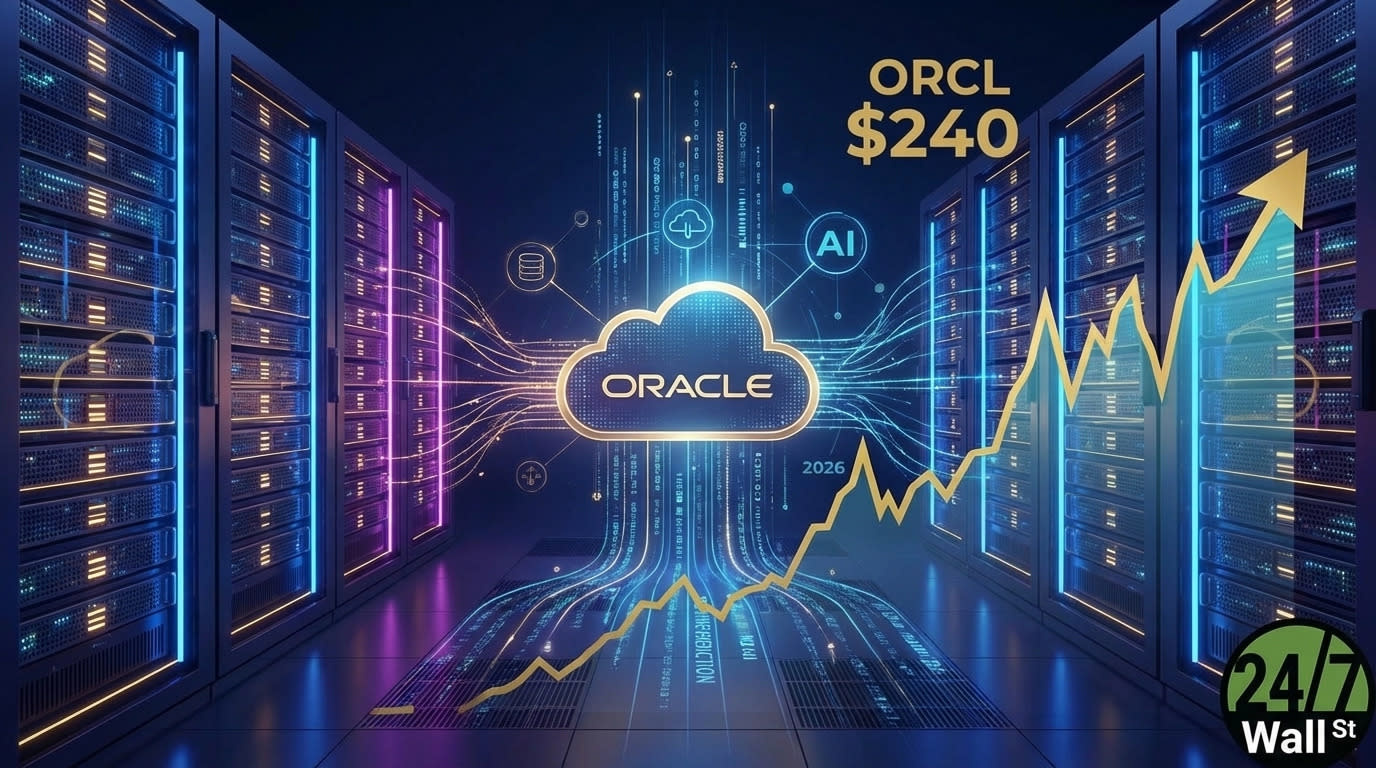
Barclays is stepping out ahead of that pack. Following Oracle's fiscal Q3 report released March 10, 2026, the firm raised its price target to $240 from $230 and maintained an Overweight rating. At the current price, that target represents roughly 45% upside. But can ORCL realistically reach $240 by end of 2026?

Barclays sees the shares "starting to work better from here,", citing the Q3 print as directly addressing investor concerns around capex trajectory, gross margin profile of new contracts, and Oracle's ability to deliver cloud capacity on time. The analyst also highlighted that software-as-a-service and maintenance are performing well, creating "plenty of upside" from current levels.

READ: The analyst who called NVIDIA in 2010 just named his top 10 AI stocks

The data backs the conviction. Oracle posted cloud infrastructure (IaaS) revenue of $4.888 billion, up 84% year over year, and management characterized results as "exceptional, exceeding expectations across every key metric." It was the first quarter in over 15 years with organic total revenue and non-GAAP EPS both growing 20%+ simultaneously.

At $240 per share against 2.874 billion shares outstanding, Oracle's implied market cap would reach approximately $690 billion. Three catalysts stand between here and there.

AI infrastructure demand sustaining IaaS hypergrowth. Oracle's remaining performance obligations of $553 billion grew 325% year over year, locking in future revenue from large-scale AI contracts. Demand for AI training and inferencing capacity continues to outpace supply.

FY2027 revenue ramp to $90 billion. Management raised its FY2027 revenue target to $90 billion and stated Oracle can "comfortably meet and likely exceed" that growth rate, underpinned by a $30 billion financing round that was substantially oversubscribed.

Margin recovery as capex normalizes. The market's primary concern is negative free cash flow of $24.7 billion on a trailing basis. As data center construction matures and contracted revenue flows, free cash flow turns positive and re-rates the stock.

The AI infrastructure buildout is the engine. Multicloud database revenue grew 531% year over year, and Q4 guidance calls for cloud revenue growth of 46% to 50%. For retirement investors with multi-year horizons, these compounding rates drive meaningful portfolio appreciation over time.

The FY2027 revenue ramp is the credibility test. A path from $67 billion in FY2026 to $90 billion in FY2027 demands execution, but the RPO backlog makes that trajectory contractually visible rather than speculative.

Margin recovery is the catalyst that closes the gap to $240. As capex peaks around $50 billion FY2026 target and data centers come online, operating leverage kicks in. Barclays is pricing exactly that inflection.

The primary risk is Oracle's $124.7 billion non-current debt load, leaving little room for execution missteps. Even so, with a $553 billion contracted backlog, accelerating cloud growth, and a raised FY2027 target, the Barclays $240 call is grounded in fundamentals that retirement investors can hold with confidence.

Wall Street is pouring billions into AI, but most investors are buying the wrong stocks. The analyst who first identified NVIDIA as a buy back in 2010 — before its 28,000% run — has just pinpointed 10 new AI companies he believes could deliver outsized returns from here. One dominates a $100 billion equipment market. Another is solving the single biggest bottleneck holding back AI data centers. A third is a pure-play on an optical networking market set to quadruple. Most investors haven't heard of half these names. Get the free list of all 10 stocks here.