yahoo Press
Tech stocks today: Microsoft shakes up AI leadership, Nvidia's Jensen Huang kicks off GTC event
Images
1 / 5

2 / 5

3 / 5

4 / 5

5 / 5
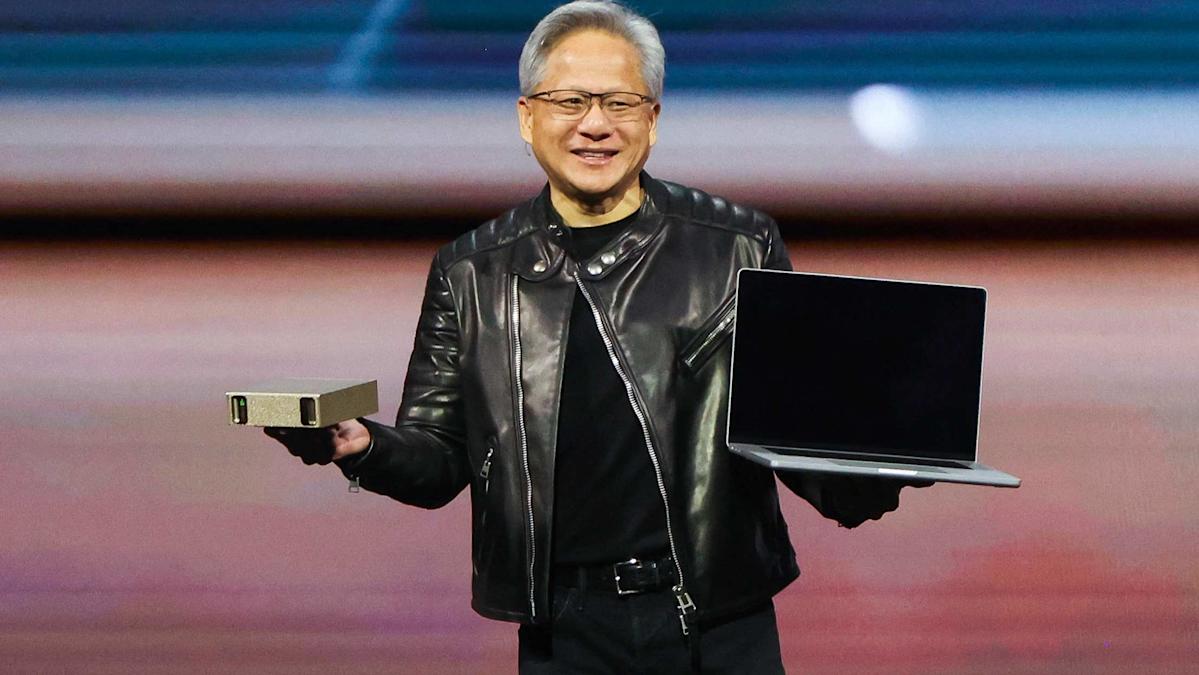
Nvidia (NVDA) CEO Jensen Huang kicked off the company’s GTC event in San Jose, Calif., with his annual keynote speech on Monday. Huang spent roughly two hours providing deeper insights into Nvidia’s business and announced a slew of deals and updates, including its all-new Nvidia Groq 3 chip, an AI chip for space, and the NemoClaw platform for AI agents. During his keynote, Huang also forecast that AI chip sales would reach $1 trillion by 2027, raising expectations from a previous outlook of $500 billion in demand through 2026. That was followed on Tuesday by Microsoft’s (MSFT) announcement that it plans to shake up the company’s AI organization, centralizing its commercial and consumer Copilot teams under the new executive vice president of Copilot, Jacob Andreou. The changes will allow Microsoft’s CEO of AI, Mustafa Suleyman, to focus on Superintelligence efforts and on building AI models, he said in a memo. Meanwhile, AI cloud company Nebius (NBIS) reached a deal with Meta (META) this week to provide the hyperscaler with up to $27 billion worth of capacity starting in 2027. Meta is reportedly considering mass layoffs as it looks to offset mounting spending on AI. Microsoft (MSFT) CEO Satya Nadella on Tuesday announced changes within the company’s AI organization that will bring its Copilot efforts more directly under his control within a new group. In a memo to staff, Nadella said Jacob Andreou will be named executive vice president of Copilot, reporting directly to Nadella. Under Andreou, this group will be focused on the Copilot experience across consumer and commercial, driving design, product, growth, and engineering, Nadella said in his note. Andreou had previously reported to Mustafa Suleyman, CEO of Microsoft AI. Suleyman said Tuesday in a memo that these changes will allow him to “focus all my energy on our Superintelligence efforts and be able to deliver world class models for Microsoft over the next 5 years.” “Progress at the AI model layer is more critical than ever to our success as a company over the next decade and is foundational to everything we build above it,” Nadella said. “We are doubling down on our superintelligence mission with the talent and compute to build models that have real product impact, in terms of evals, COGS reduction, as well as advancing the frontier when it comes to meeting enterprise needs and achieving the next set of research breakthroughs.” Earlier this month, Microsoft announced a new Copilot tier that will include access to Anthropic’s Claude alongside the latest generation of OpenAI models. Microsoft stock is down about 17% year to date. Nvidia (NVDA) announced on Monday that Uber (UBER) will begin rolling out a fleet of Level 4 autonomous vehicles in Los Angeles and San Francisco in 2027 as part of both companies’ broader self-driving efforts. The firms previously announced their intent to deploy 100,000 vehicles running on Nvidia’s Drive Hyperion self-driving platform during Nvidia’s GTC event in Washington, D.C., in October. But the latest news, unveiled at GTC in San Jose, Calif., provides a timeline for when and where vehicles will eventually hit the road. According to Nvidia, the service will eventually move beyond California to include 28 cities across four continents. In addition to Uber, Nvidia said Lyft (LYFT), Estonia-based Bolt, and Singapore’s Grab are also using its systems to power their own self-driving capabilities. Nvidia (NVDA) is moving further into AI software with the launch of its NemoClaw stack for the OpenClaw agent platform. The service gives companies that use OpenClaw privacy and security controls that Nvidia says make self-evolving autonomous agents “more trustworthy, scalable, and accessible to the world.” OpenClaw, which debuted as Clawd in November 2025 before being renamed Moltbot and finally OpenClaw in January, has taken off thanks to its ability to run AI agents powered by different AI models on users’ machines via apps like WhatsApp, Discord, Slack, and others. It can perform a litany of different tasks via your computer on your behalf using your existing data. But the fact that it can control a laptop or desktop and has access to your personal data raises certain privacy and security concerns. Nvidia’s NemoClaw is meant to address those issues. While OpenClaw can run on both Mac and Windows systems, Nvidia is positioning its own GeForce RTX platforms as the computers of choice for the service. That includes its RTX Pro-powered workstations, DGX Station, and DGX Spark mini desktop. Read more here. Nvidia (NVDA) kicked off its GTC event in San Jose, Calif., on Monday, debuting a number of chips and platforms ranging from its all-new Nvidia Groq 3 language processing unit (LPU) to its massive Vera central processing unit (CPU) rack, designed to go head-to-head with offerings from Intel (INTC) and AMD (AMD). All totaled, Nvidia said it’s rolling out five massive server racks, each serving different purposes inside AI data centers. The biggest announcement of the lot, though, is the Nvidia Groq 3 chip. Nvidia announced it had entered into an agreement to license technology from Groq and hired founder Jonathan Ross, president Sunny Madra, and other members of the Groq team as part of a $20 billion deal in December.Groq’s processors focus on AI inferencing, or running AI models. It’s what happens when you type something into OpenAI’s (OPAI.PVT) ChatGPT, Anthropic’s (ANTH.PVT) Claude, or Google’s (GOOG, GOOGL) Gemini and get a response. Nvidia’s graphics processing units (GPUs) are multipurpose and can both train and run AI models, but as the AI market moves toward running models, ensuring the company has a dedicated inferencing chip has become paramount. That’s where Groq 3 comes in. Yahoo Finance’s Dan Howley reports from on the ground at the GTC event in San Jose, Calif., that Nvidia (NVDA) is taking its AI chips to the next frontier: space. The company revealed its Vera Rubin Space Module, saying the platform is designed for orbital data centers, geospatial intelligence, and autonomous space operations. Read more here. Nvidia CEO Jensen Huang said the company now sees AI chip demand reaching $1 trillion through 2027. That’s a massive increase from the $500 billion high-confidence demand and order backlog for Blackwell and Rubin chips that Nvidia projected last year through 2026. “In fact, we are going to be short,” Huang added. “I am certain computing demand will be much higher than that.” CEO Jensen Huang touted Nvidia’s (NVDA) relationships with cloud service providers, such as Google (GOOG), Microsoft (MSFT), Amazon (AMZN), and Oracle (ORCL), saying the AI company is “bringing customers to them.” Huang argued that Nvidia is driving down data-processing costs by increasing scale and speed. “Moore's Law has run out of steam; we need a new approach,” Huang said. “Accelerated computing allows us to take these giant leaps forward, and as you will see later, because we continue to optimize the algorithms … and because our reach is so large and our installed base is so large, we can reduce the computing cost, increasing the scale, increasing the speed for everybody, continuously.” Hyperscalers account for roughly 50% of Nvidia’s data center revenue, which totaled $62.3 billion in the fourth quarter. Nvidia CEO Jensen Huang began his annual keynote address at a quarter after 2 p.m. ET on Monday. As my colleague Dan Howley noted in his preview of the event, Huang’s leather-jacket-clad keynotes are usually littered with a litany of product launches and updates, and we’ll likely see the same at this year’s event. Huang is expected to speak for about two hours. We’ll be following along and posting updates. You can watch the speech live below. Nebius (NBIS) stock soared 14% after the AI cloud company announced it struck a new long-term AI infrastructure supply agreement with Meta (META). Nebius will provide Meta with $12 billion worth of neocloud capacity as part of its deployment of Nvidia's Vera Rubin platform, starting in 2027. Meta has also committed to purchasing additional compute capacity up to a total of $15 billion over a five-year period. Last week, Nvidia disclosed a $2 billion investment in Nebius to deploy more than 5 gigawatts of data center capacity by the end of 2030. Meta stock rose 2.6% on the Nebius news, as well as rumors that it's planning sweeping layoffs that could affect up to 20% of the company as it looks to offset high artificial intelligence costs. The date and extent of the layoffs have yet to be finalized, according to Reuters, but it could mark Meta's largest restructuring since late 2022 and early 2023. Meta (META) has been working for months to develop a new frontier AI model that can better compete with top-of-the-line offerings from Anthropic (ANTH.PVT), Google (GOOG), and OpenAI (OPAI.PVT), but the effort has reportedly hit a major delay. According to the New York Times, while the new model, which is code-named Avocado, is better than Google’s previous generation Gemini 2.5 model, it can’t quite match Google’s Gemini 3. That model made a splash when Google debuted it late last year and pushed the company into the leadership position in the AI race, supplanting OpenAI in the eyes of analysts and developers. Now Meta is planning to delay Avocado until at least May. The company’s AI leaders have also discussed licensing Google’s Gemini model to help run its AI services on an interim basis. Meta has sunk billions into building up its Llama AI models. But after showing off its Llama 4 family in the spring of 2025, the company delayed its flagship Llama 4 Behemoth model. Meta still hasn’t launched the software. CEO Mark Zuckerberg subsequently hired Scale AI CEO Alexandr Wang, investing $14.3 billion into the company. Nvidia’s (NVDA) GTC 2026, the company’s biggest event of the year, kicks off in San Jose, Calif., on Monday with a keynote from CEO Jensen Huang. The leather-jacket-clad CEO’s keynotes are usually littered with a litany of product launches and updates, and we’ll likely see the same at this year’s event. Nvidia has been on a dealmaking spree over the past several months, including an agreement with AI inferencing chip designer Groq. That could mean we’ll see a new inferencing chip out of Nvidia using Groq’s technology, or the company could show how it’s integrating Groq’s tech into its own GPUs. There’s also rumors Nvidia could debut an all-new platform for AI agents, and you can also expect to hear plenty about Nvidia’s various open-source AI models The company could also launch its long-rumored laptop processor that would take on AMD’s own offerings. But don’t expect the chips to generate the kind of massive revenues that Nvidia’s GPUs and networking products do. Sales of the company’s gaming segment totaled $22.5 billion in 2025, while its data center business brought in $193.5 billion. Bloomberg reports: Read more here. Adobe (ADBE) CEO Shantanu Narayen is stepping down after 18 years in the role, the company announced on Thursday in conjunction with its first quarter earnings report. Adobe stock fell more than % on the news. Narayen will leave the post when a successor is found but will stay on as chair of the board afterward. The company's board also appointed Frank Calderoni, lead independent director of Adobe, as chair of the special committee that will look for CEO candidates both inside and outside of the firm. "I love Adobe and the privilege of leading it has been the greatest honor of my career. I will ensure that I set up Adobe for its next decade of greatness with the right leader and executive team, in partnership with the Board, while continuing to deliver on our FY26 Must Wins," Narayen wrote in an email to employees. "The opportunity in front of us is extraordinary. Together, we are uniquely positioned to lead it — and I remain deeply committed to doing so as we look ahead and prepare to name Adobe’s next CEO. I am more confident than ever that Adobe’s best days are still to come." For the quarter, Adobe saw earnings per share (EPS) of $6.06 on revenue of $6.39 billion, topping analysts' EPS and revenue estimates of $5.88 and $6.28 billion, respectively. Looking ahead to the second quarter, Adobe forecast revenue of $6.43 billion to $6.48 billion. Expectations were for $6.43 billion.