yahoo Press
U.S. Intervention in Venezuela Could Help Solve Colombia’s Energy Crisis
Images
1 / 4

2 / 4

3 / 4

4 / 4
Colombia’s natural gas production is spiraling ever lower, with the hydrocarbon sector impacted by tax hikes and leftist President Gustavo Petro’s reforms aimed at weaning the country off its dependence on fossil fuels. This forced Bogota to significantly boost costly liquified petroleum gas (LPG) imports to meet domestic demand and ensure the stability of Colombia's electricity grid. Those imports are straining government finances and the economy at a time of fiscal crisis. Nonetheless, U.S. President Donald Trump’s intervention in Venezuela has created an alternative, more cost-effective solution.

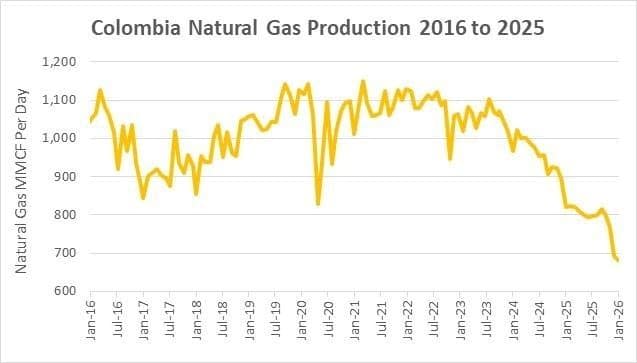
Colombia’s economically vital natural gas production has been in free fall for years. For January 2026, the Andean country’s natural gas output fell to a multi-decade low of 683 million cubic feet per day. While this is just over 1% lower than a month prior it is a shocking 17% less than the same period a year earlier.

Source: National Hydrocarbons Agency (ANH).

There are signs that Colombia’s natural gas output will continue falling despite the belief that recent discoveries, notably the Sirus 1 and 2 wells in the GUA-OFF-0 block, could bolster reserves by up to 6 trillion cubic feet.

A lack of investment in drilling activity, along with Petro’s decision to cease issuing new exploration and production contracts, is weighing on natural gas reserves as well as production. At the end of 2024, Colombia possessed reserves of 2.064 trillion cubic feet, which, at the current rate of production, is only sufficient for another 5.9 years. Around 70% of those reserves are associated with oil production. As Colombia’s oilfields age and decline rates rise, there is growing pressure on drillers to implement enhanced recovery techniques, one of the lowest cost being gas injection.

Natural gas produced alongside oil is reinjected into wells to boost reservoir pressure and reduce viscosity, making it easier and more efficient to lift the petroleum. As demand for enhanced recovery grows, because of Colombia’s aging oilfields, less associated natural gas is available for commercial production, further heightening domestic supply constraints. Those diminished reserves, along with production falling to multi-decade lows, pose a threat to Colombia’s economy, where the fossil fuel has long been a cost-effective alternative to other sources of energy.

This also jeopardizes the stability of the Andean country’s electricity grid, which is increasingly dependent on gas-fired power plants, especially during times of low rainfall, which impacts water levels at Colombia’s hydroelectric facilities. You see, more than 60% of Colombia’s electricity is generated by hydro-plants, with output falling sharply whenever water levels decline because of poor hydrology from reduced rainfall.


Any electricity shortfall is filled by thermal power plants fired by natural gas, coal, and fuel oil. These facilities also provide crucial baseline power for an ailing electric grid, where in some regions, power shortages and brownouts are regular occurrences. There is also growing demand for natural gas because of Bogota’s push to reduce greenhouse emissions by replacing coal-fired plants with those powered by natural gas. For these reasons, demand for natural gas soars during periods of substantially reduced rainfall, which impacts water flows at hydro facilities.

To address the ever-growing natural gas supply shortfall, caused by growing domestic demand and declining production, Bogota is ramping up LPG imports. The situation is so dire that it is predicted that as much as 30% of domestic natural gas will be supplied by LPG imports for 2026, a significant jump from 18% for 2025. This will push the cost of natural gas higher in a country where a spiraling cost of living is sharply impacting households and the economy.

While these events triggered alarm bells in Bogota, President Trump's intervention in Venezuela, with illegitimate President Nicolas Maduro snatched during a daring January night raid on Caracas by U.S. forces, offers a better solution. You see, aside from possessing the world’s largest petroleum reserves of more than 300 billion barrels, Venezuela holds considerable natural gas reserves totaling an estimated 6.3 trillion cubic feet, more than double those of Colombia. Most of that natural gas, estimated to be around 80%, is associated with offshore oil production.

Since the White House intervened in and eased sanctions against Venezuela, there is considerable opportunity for those natural gas reserves to be shipped to Colombia. This saw the plan to ship natural gas from Venezuela to Colombia, which was shelved years earlier because of strict U.S. sanctions and technical difficulties, reconsidered. Bogota and Caracas recently agreed to investigate repairing the Antonio Ricaurte natural gas pipeline after more than a decade of inactivity.

Related: Six Stocks That Could Soar in an Era of Regional Instability

The trans-Caribbean pipeline has the capacity to pump roughly 500 million cubic feet per day of natural gas from Venezuela to Colombia, more than adequately meeting the projected supply shortfall of up to 206 million cubic feet per day. Colombia’s Ministry of Mines and Energy announced this week it had formalized a roadmap with PDVSA to reactivate the Antonio Ricaurte pipeline. This includes replacing 3.3 miles or five kilometres of the pipeline and reversing the structure’s flow to pump gas from Venezuela to Colombia.

The facility was built originally to ship natural gas lifted from Colombia’s La Ballena field in La Guajira to Venezuela’s second-largest city, Maracaibo. It was only a year before the pipeline’s commissioning when Colombia pumped 699 million cubic feet of natural gas, with production exceeding domestic demand. This freed up natural gas supplies for export, with Venezuela, at the time, emerging as a key customer. At that time, with Colombia’s economy ravaged by a low-intensity multiparty civil war, President Alvaro Uribe’s administration was desperate to boost exports to invigorate the conflict-scarred economy.

Even so, restarting the Antonio Ricaurte pipeline doesn’t provide an immediate solution, with considerable work required before the facility can be recommissioned. The pipeline is heavily corroded and damaged after more than a decade of inoperability, with little to no crucial maintenance performed during that period on the 139-mile or 224-kilometer-long facility. As a result, many sections are badly damaged, with many key components scavenged by looters. For these reasons, until a technical review and urgent repairs are completed, it will remain inoperable.

While importing natural gas from Venezuela provides a cost-effective solution for boosting supplies of the fossil fuel in Colombia, it will take months, even years, to bring the Antonio Ricaurte pipeline online. This makes Bogota, at least for the immediate future, highly dependent on expensive LPG imports to meet domestic demand for natural gas. Indeed, to boost LPG supply, Colombia is engaging in a costly redevelopment of natural gas infrastructure. This will harm Colombia’s balance of trade and economy at a critical time, with a fiscal crisis looming during an election year.

By Matthew Smith for Oilprice.com

More Top Reads From Oilprice.com

Why $100 Oil Isn’t Going to Spark a New Shale Boom

The Chokepoint Economy: What Happens When Everything Breaks at Once

Fujairah Oil Terminals Resume Operations After Drone Attack

Oilprice Intelligence brings you the signals before they become front-page news. This is the same expert analysis read by veteran traders and political advisors. Get it free, twice a week, and you'll always know why the market is moving before everyone else.

You get the geopolitical intelligence, the hidden inventory data, and the market whispers that move billions - and we'll send you $389 in premium energy intelligence, on us, just for subscribing. Join 400,000+ readers today. Get access immediately by clicking here.