Press
Will Scotland be the first to legalise assisted dying?
Images
1 / 15

2 / 15
3 / 15
4 / 15
5 / 15
6 / 15
7 / 15
8 / 15
9 / 15
10 / 15
11 / 15
12 / 15
13 / 15
14 / 15
15 / 15
For more than a year, Scottish politicians have been grappling with matters of life and death as they debated one of the most contested bills in the history of devolution.

Tuesday's final Scottish Parliament vote on the Assisted Dying for Terminally Ill Adults (Scotland) Bill is seen as too close to call.

But, if it passes, Scotland could become the first nation in the UK to legalise assisted dying.

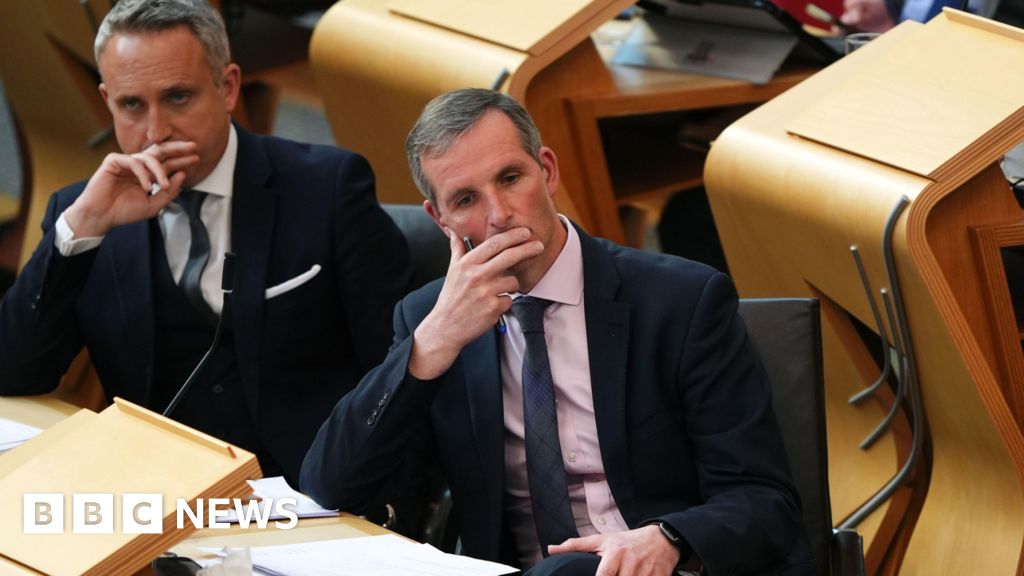
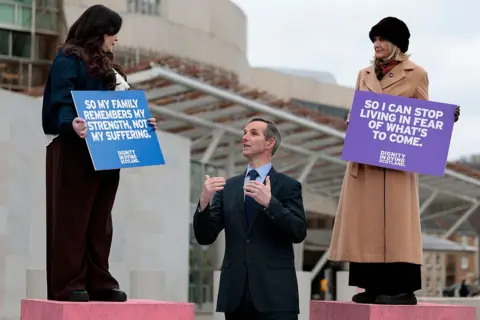
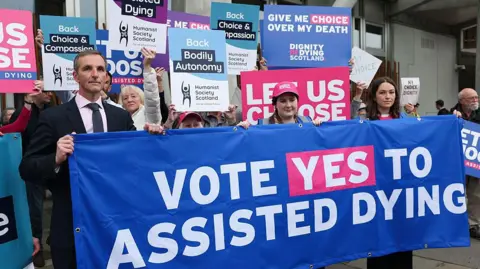
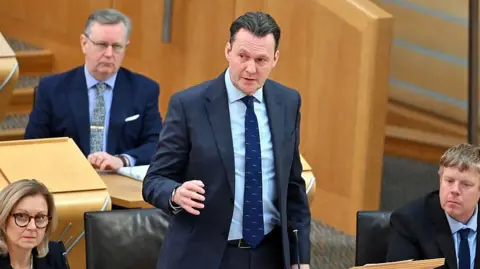
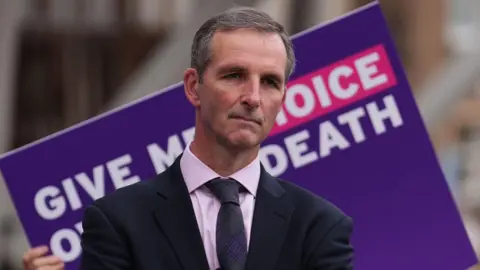
The legislation was introduced by backbench Scottish Liberal Democrat MSP Liam McArthur who said it would provide choice, compassion and dignity.

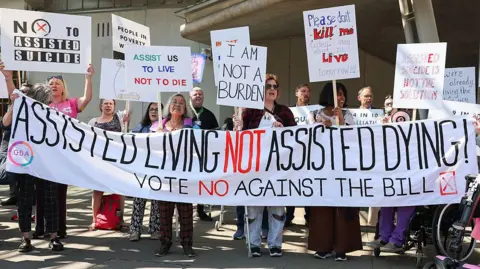
Critics of the bill have called it dangerous and say MSPs should focus instead on improving end-of-life care.

An assisted dying bill in England and Wales cleared the House of Commons last June but it is likely to run out of parliamentary time after stalling in the Lords when peers tabled hundreds of amendments.

In Edinburgh too the proposed law has been heavily amended, with MSPs debating and voting on 175 amendments last week alone.

McArthur said the result was a "bulletproof" bill which amounted to "the toughest and most comprehensively-safeguarded" such legislation in the world.

If enacted, the bill would allow a terminally-ill, mentally-competent adult, who has been resident in Scotland for at least 12 months, to request the provision of an approved substance to end their life.

They would need the approval of two doctors and, while the lethal substance would be provided by a medical professional, it would have to be self-administered by the patient.

In the closing days of debate, a life-expectancy timeframe was added to the bill, meaning only those who could "reasonably be expected to die within six months" would be eligible.

This is the third such bill which the Scottish Parliament has debated in the past 16 years.

In 2010, MSPs rejected the End of Life Assistance Bill, tabled by independent MSP Margo MacDonald by 85 votes to 16.

When the independent MSP, who had Parkinson's disease, died in 2014, her second attempt at legislation, the Assisted Suicide Bill was taken up by Patrick Harvie of the Scottish Greens.

It was rejected in 2015 by 82 votes to 36.

This third bill is again being considered as a matter of conscience – not whipped on party lines.

Although the Scottish government is officially neutral on the bill, First Minister John Swinney of the Scottish National Party is personally opposed, as is Scottish Conservative leader, Russell Findlay, and Scottish Labour leader, Anas Sarwar.

Hours of detailed, and sometimes emotional, debate can be divided into three strands: the moral, the practical and the constitutional.

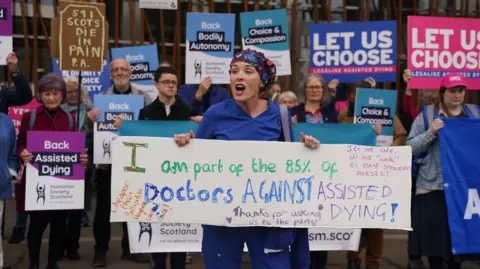
The moral argument relates to whether or not individual adults should have autonomy to decide on the timing and manner of their own death.

Opposition to that idea is rooted in the Christian religious tradition and has been expressed forcefully by 21st Century church leaders.

"True compassion does not mean helping someone to die, but committing ourselves to care for them in life," write a coalition of senior clergy from denominations including the Church of Scotland, the Roman Catholic Church and the Free Church of Scotland in an open letter to MSPs.

The opposite argument is advanced by the Humanist Society Scotland along with two other campaigning groups, Dignity in Dying Scotland, and Friends at the End.

Their position too has a long philosophical tradition dating back as far as Plato.

The Scottish Enlightenment philosopher, David Hume, for example, argued that suicide did not transgress a person's duty "to God, our neighbour, or ourselves".

Much of the parliamentary debate has focused on the practical rather than the moral argument.

Its supporters insist the legislative process has been rigorous and the bill contains enough safeguards.

In May 2025, MSPs approved the general principles of the legislation by 70 votes to 56 although some said they wanted to see how it eventually shaped up before forming a final view.

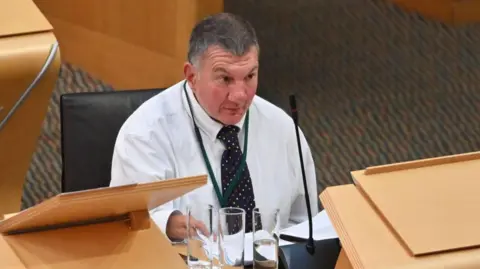
Russell Findlay of the Scottish Conservatives is one of those who moved from support to opposition.

He said he had become concerned about the potential for a dying person to be coerced by "unscrupulous relatives, or 'trusted' medical or legal professionals" into ending their life prematurely.

Even without experiencing obvious pressure, he added, some elderly people might feel they had become a "burden" on loved ones.

That distinction between overt and internalised coercion was also referenced by two disabled MSPs – Pam Duncan-Glancy and Jeremy Balfour, both of whom sit as independents and oppose the bill.

"The extent of internalised coercion - the risk that we would choose to die, and that the state will help - is real with this bill," said Duncan-Glancy.

"It is about the systemic coercion that makes us consider, for just a moment, that we would be better off dead," she added.

Balfour said: "As a disabled person, I know very well the risks not just of coercion, but of how society views disabled people, and how we can feel like a burden."

Other MSPs, including Lorna Slater of the Scottish Greens, invoked deeply personal experiences in supporting the bill.

Slater told BBC News about her father Andrew's  "beautiful" assisted death in Canada, aged 84, after suffering several strokes and other health issues.

"He was very clear in his mind that he did not want to continue to suffer", she said.

"As the needle went into his arm he turned to my mum, who was in the bed with him cuddling him, and said 'that's the last pain I'm ever going to feel.'  And that was a nice moment."

Other supporters of the bill, including the Scottish Conservatives' health spokesperson, Dr Sandesh Gulhane, insist it now contains multiple safeguards.

"As a GP and MSP, I believe that the assisted dying bill offers a safe, compassionate choice for those whose pain cannot be relieved," he said.

When the bill was considered by a committee of MSPs at stage two, 74 of 298 amendments passed.

These included raising the age for eligibility for an assisted death from 16 to 18 and clarifying that a disability or mental health condition alone would not constitute terminal illness.

Further measures were added as the bill went through its third and final stage of parliamentary scrutiny last week.

As well as the six-month prognosis clause, these included requirements for doctors to ensure the patient was acting voluntarily and to find out if they were receiving social or mental health care.

A duty to discuss palliative care, hospice care, and alternative treatment options was also introduced, reigniting a debate about the quality of end-of-life care.

Liam McArthur has repeatedly insisted that "it is not an either/or choice" between assisted dying and palliative care.

"We need both," he said, arguing that "investment in improving the quality of and access to palliative and hospice care, as well as good social care, is imperative."

Another practical argument against the bill has been concerns about a "slippery slope", with campaigners pointing to Belgium and Canada where assisted deaths have risen as eligibility criteria have expanded.

McArthur counters that the Scottish bill does not follow those "permissive and expansive models" but is instead modelled on stable, tightly-drawn laws in Australia and the US state of Oregon.

There is another potential stumbling block for the bill.

The Scottish Parliament's powers are limited and do not extend to the regulation of "medicines, medical supplies, and poisons" or of health professionals.

As the bill needs both, it will require Westminster cooperation to become law.

The UK government says it is neutral on the matter and has agreed to ensure the Scottish government has the relevant powers over "substances or devices".

The regulation of medical professionals is trickier.

The draft bill included legal protections for medical staff who do not wish to participate in the process of assisted dying, meaning conscientious objectors can opt out without suffering any detriment.

The UK and Scottish governments have discussed dealing with this problem by means of a transfer of powers known as a section 104 order.

This would require the bill to be stripped of the problematic provisions before it was passed, with MSPs trusting that Westminster would then reinsert them into the act.

Scottish secretary Douglas Alexander signalled that the UK government would be prepared to do so.

But in February, a group of seven medical organisations said this would mean "inadequate scrutiny."

Such matters, they said, "should not be left to a later process in which detailed debate, amendment, and accountability are significantly constrained".

McArthur said that problem had now been solved by passing amendments to the bill which would prevent it being implemented until protections were re-inserted.

That was welcomed by the British Medical Association but the Royal College of Psychiatrists and the Royal Pharmaceutical Society said it was not enough.

Both colleges now say they are opposed to the bill in its current form because MSPs will not be able to clarify and scrutinise the exact wording of the protections.

The Royal College of Psychiatrists in Scotland said the development had "drastically weakened essential safeguards" and the bill "now poses unacceptable risks to the general public and the psychiatric workforce."

The upshot is that after months of careful consideration this bill might fall not because a majority of MSPs oppose it in principle but because the Scottish could not enact it in a satisfactory manner under the current framework of devolution.

The assisted dying bill could run out of time to pass in law, with opinion still divided.

More than 100 Labour MPs warn that failing to pass the legislation would undermine trust in politics.

The Scottish Parliament will soon decide whether to allow terminally-ill adults to end their lives.

The long-running political battle over assisted dying comes to an end as MSPs get ready to vote.

MSPs will vote next Tuesday on whether to allow terminally ill adults to seek medical help in ending their lives.