yahoo Press
Scientists Thought Only Great Apes Were This Smart, But a Tiny Fish Proved Them Wrong
Images
1 / 14
2 / 14

3 / 14

4 / 14

5 / 14

6 / 14
7 / 14
8 / 14
9 / 14
10 / 14
11 / 14

12 / 14

13 / 14

14 / 14
The post Scientists Thought Only Great Apes Were This Smart, But a Tiny Fish Proved Them Wrong appeared first on A-Z Animals.

Cleaner wrasses used mirrors to locate and scrape marks placed on their bodies.

Experiments suggest fish can link reflections with sensations on their own bodies.

Findings challenge assumptions that only large-brained animals recognize themselves in mirrors.

Research raises questions about animal intelligence and how scientists interpret mirror tests.

For decades, scientists used a mirror experiment to explore whether animals could recognize themselves. In that test, researchers placed a mark on an animal’s body where it could only be seen in a mirror. If the animal used the mirror to investigate the mark on its own body, scientists interpreted the behavior as self-recognition. Only a small group of species seemed to pass the test. These included great apes, dolphins, elephants, and a few birds.

New experiments with a small reef fish have complicated that picture. Researchers studying the bluestreak cleaner wrasse discovered that this species can use a mirror to locate marks placed on its own body. The fish scraped at the marked spot when it saw the reflection. When the mirror was removed, the scraping stopped. These observations suggest the fish used the mirror to guide its actions.

The results have sparked debate among scientists. Some believe the fish demonstrates a form of self-related awareness. Others think the fish simply learned to associate the reflection with sensations on its skin. Either way, the findings are prompting researchers to reconsider how the mirror test should be interpreted.

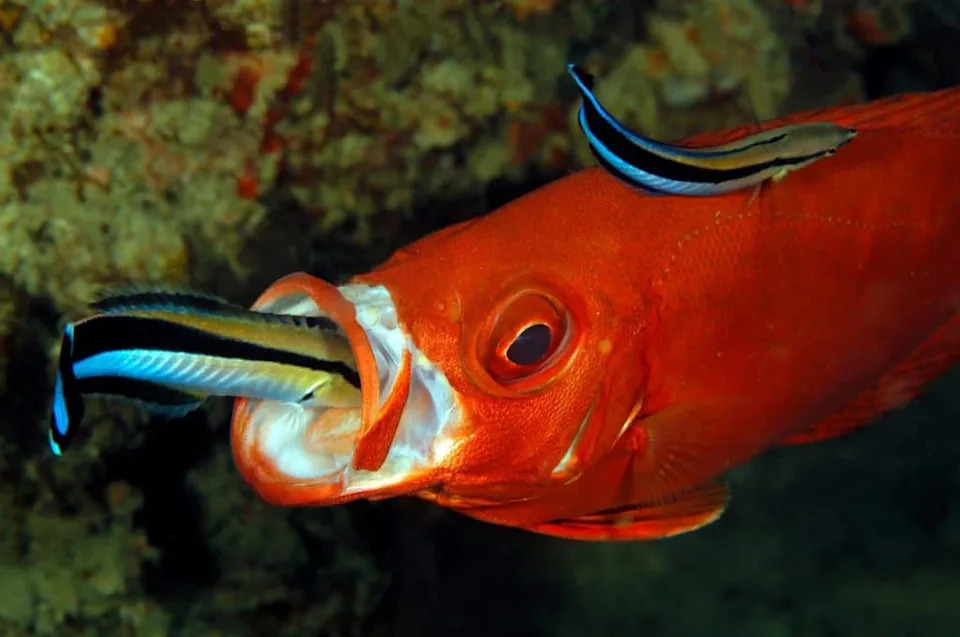
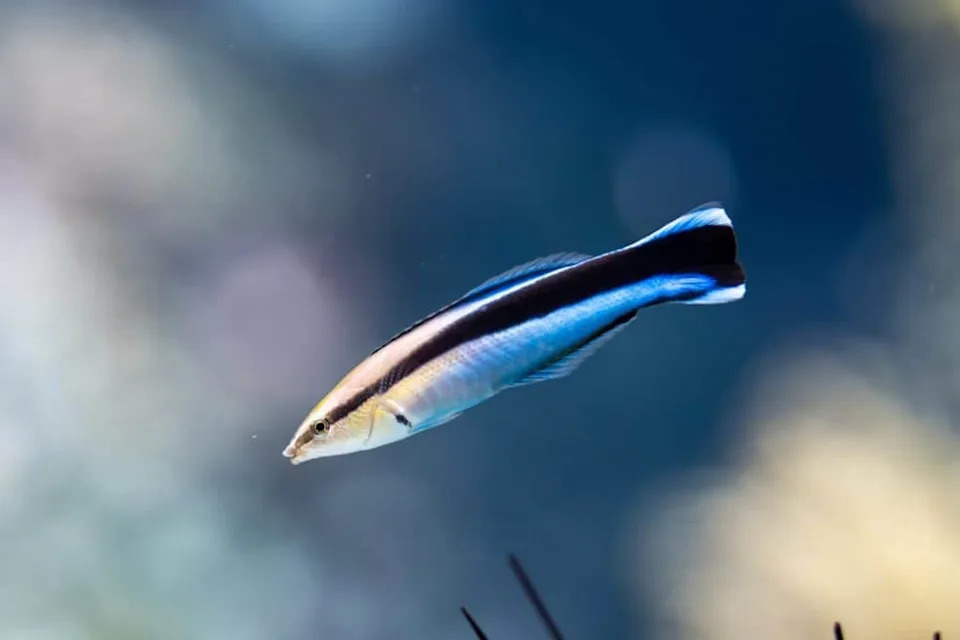
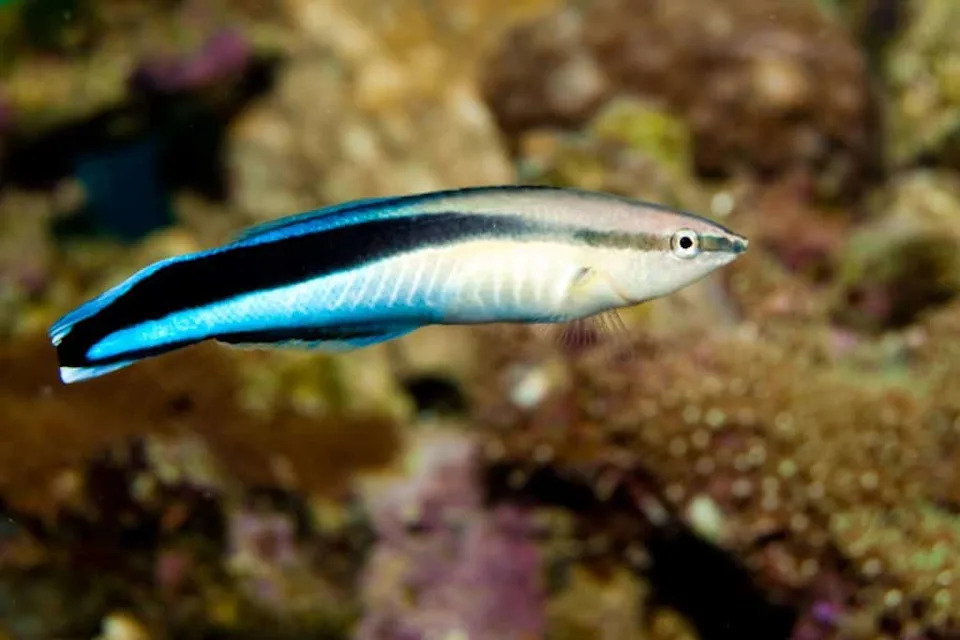
Living on coral reefs in the Indian and Pacific Oceans, the bluestreak cleaner wrasse plays an unusual ecological role. Instead of hunting typical prey, it removes parasites and dead tissue from larger fish. Many reef species visit cleaning stations where the wrasse performs this service. Its body is slim and usually only a few inches long. A dark stripe runs from the snout to the tail along a lighter background. Other fish often recognize this pattern and approach the cleaner wrasse without fear.

Because the wrasse regularly inspects the bodies of other fish for tiny parasites, it has sharp visual abilities and a strong interest in small marks or spots. These traits made it an appealing candidate for the mirror self-recognition test. Scientists suspected the species might respond strongly to unusual marks on its own body. Researchers reasoned that if any fish cared about detecting small specks on its skin, the cleaner wrasse would likely be among them.

Other fish tolerate the bluestreak cleaner wrasse, removing parasites from their bodies—even from inside their mouths.

©Daniel Lamborn/Shutterstock.com

Psychologist Gordon Gallup Jr. developed the mirror self-recognition test in the early 1970s. The experiment aimed to determine whether animals could identify their own reflections. In a typical setup, an animal first becomes familiar with a mirror placed in its environment.

After this period, researchers add a colored mark to a body location that the animal cannot see directly. The mirror becomes the only way the animal can view the mark. If the animal touches, rubs, or investigates the mark on its own body after looking at the reflection, scientists consider the test passed.

Humans begin to pass the mirror test at about 18 to 24 months of age. For many years, researchers believed only a few animals possessed this ability. Apes, dolphins, elephants, and magpies produced the clearest examples.

This led some scientists to suggest the test measured a deep form of self-awareness. According to that view, species that passed possessed advanced cognitive abilities while those that failed lacked that level of understanding.

Researchers later decided to examine how cleaner wrasse would react to mirrors placed inside aquarium tanks. At first, the fish responded aggressively, treating the reflection as a rival intruder. This behavior resembled territorial reactions seen in many species.

After repeated exposure, their behavior shifted. Instead of attacking the reflection, the fish began performing unusual movements in front of the mirror. They twisted their bodies and paused as if examining their own appearance.

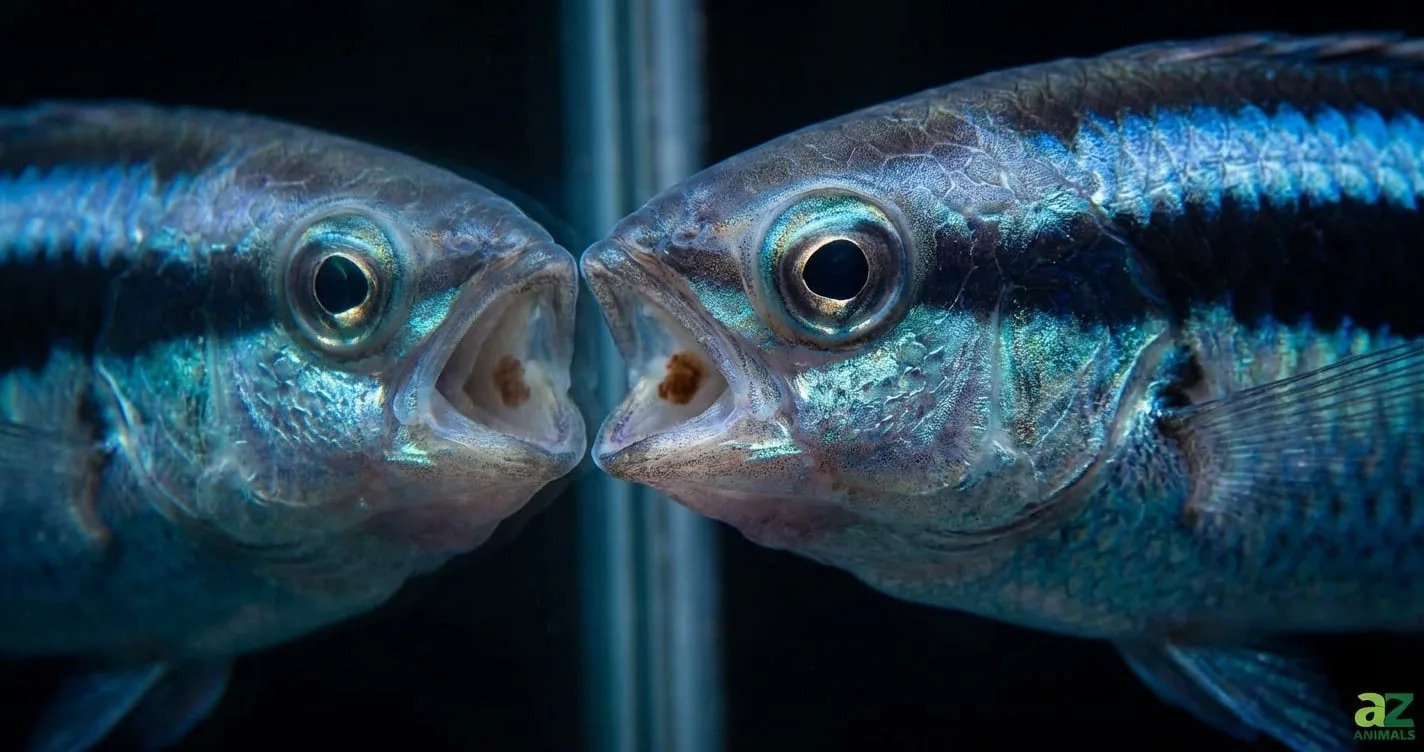
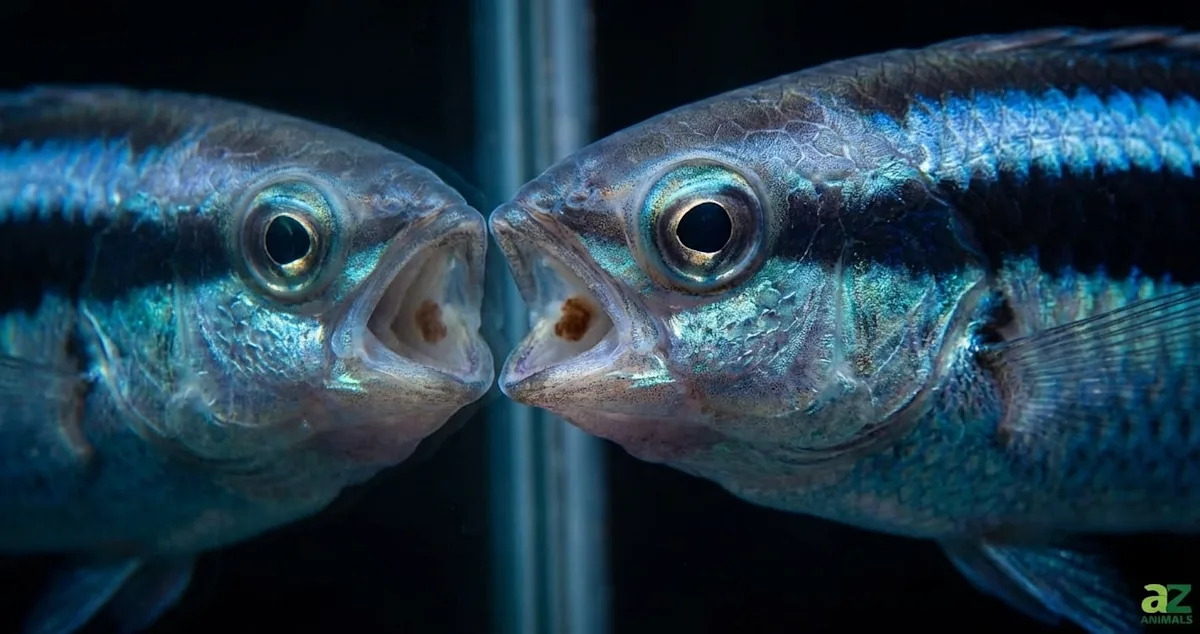
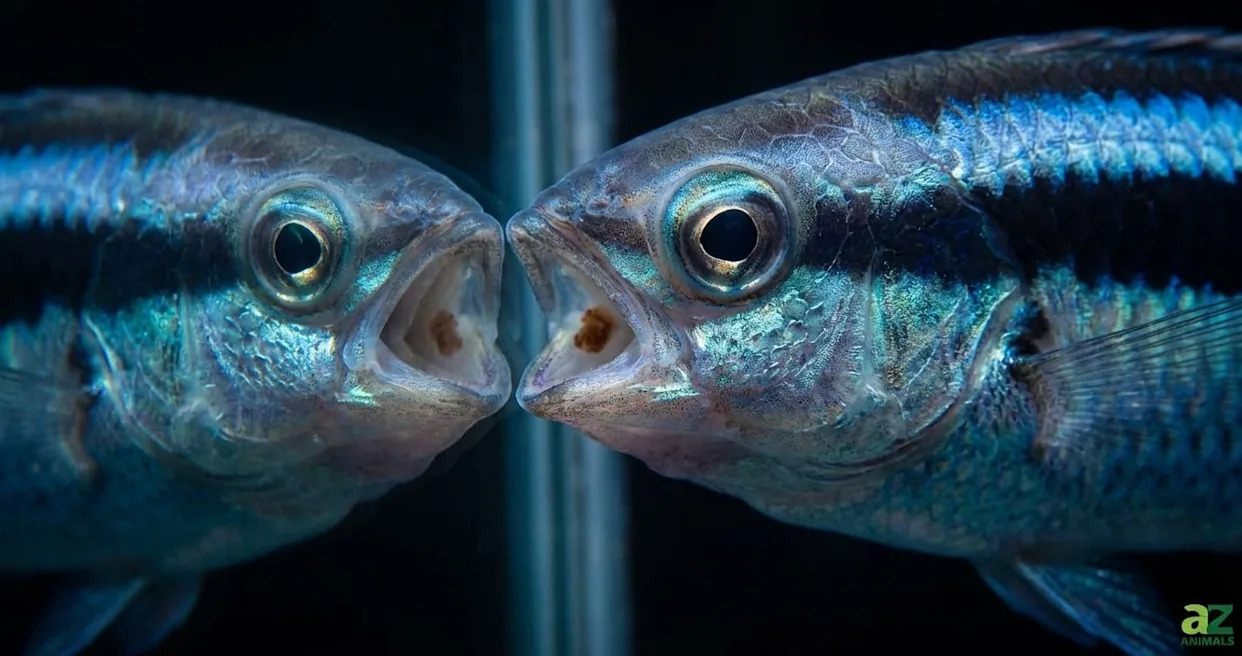
In experiments, this small fish was able to use a mirror to notice a brown mark placed on its own body.

©jinhong.ljh/Shutterstock.com

Scientists then applied a small brown mark resembling a parasite to the fish’s throat. When the mirror remained present, some individuals scraped their throats against the tank floor or nearby surfaces. This behavior closely matched how cleaner wrasse remove parasites during cleaning interactions. When the mark was invisible or the mirror was absent, the scraping behavior largely disappeared. These results suggested the fish used the mirror to detect the mark and respond to it.

Some scientists argued that the earlier test might not prove self-recognition. Critics suggested the fish could simply interpret the reflection as another fish carrying a parasite. That interpretation would trigger a cleaning response rather than self-directed awareness. To examine this possibility, researchers designed a new version of the experiment. Instead of introducing the mirror first, they applied the mark to the fish before the mirror appeared. The fish, therefore, felt the mark but could not see it.

When the mirror was finally introduced, many fish began scraping at the marked area within about an hour. In earlier experiments, the fish needed several days to reach that stage. The faster response suggested the fish quickly linked the reflection with the unusual sensation on its body. Some individuals also performed actions that resembled contingency testing. They moved their bodies in unusual ways while watching the reflection. In some cases, they dropped food pieces in front of the mirror and observed the reflection’s response. These behaviors resemble actions seen in other animals that explore how reflections correspond to their own movements.

Passing the mirror test does not necessarily prove that an animal possesses the same self-awareness humans experience. The experiment measures whether an animal can use visual feedback from a reflection to guide behavior toward its own body.

Some scientists propose that animals may succeed through learned associations between movement, visual cues, and bodily sensations. In this explanation, the animal recognizes patterns linking its actions to the mirror image. Others argue that the behavior suggests a more advanced form of self-related processing. The fish might hold a mental representation of its body and compare what it sees with what it feels.

Evidence from other experiments has strengthened interest in this question. Cleaner wrasses have shown the ability to adjust their behavior based on body size and environmental openings. Some studies suggest they respond differently to images that resemble themselves compared with other fish. These findings indicate the species may possess cognitive abilities that researchers did not expect in small fish.

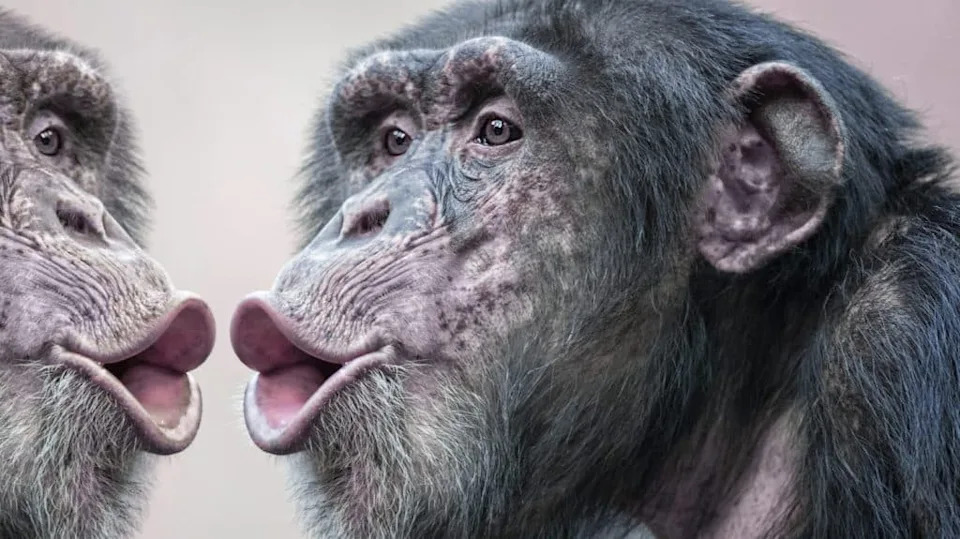
Before studies on cleaner wrasse, the list of species that passed the mirror test remained limited. Chimpanzees and orangutans used mirrors to inspect marks on their faces or heads. Some individuals touched the marks and examined their fingers afterward.

Chimpanzees are one of only a handful of animals that have passed the mirror test.

©Umesh Jayasekara/Shutterstock.com

Bottlenose dolphins displayed similar behavior in aquatic settings. They twisted their bodies to view marks placed on their sides while facing reflective surfaces. Asian elephants also showed responses that suggested recognition of their own bodies. Certain birds have produced positive results under controlled conditions. Eurasian magpies, for example, scratched marks placed on their feathers after seeing themselves in mirrors. These species share large brains and complex social structures. Their success led researchers to assume advanced cognition evolved mainly in large mammals and a few birds. The cleaner wrasse experiments challenge that assumption by showing that a small fish can display comparable behavior.

Research across many species has begun to change how scientists think about intelligence. Cognitive skills, once believed to be rare, now appear in a wide variety of animals. Crows solve multi-step problems and use tools. Octopuses navigate complex environments and manipulate objects. Bees can learn patterns and rules during training experiments. Some insects appear able to count small numbers when searching for food sources. Each discovery suggests that cognitive abilities may arise through different evolutionary paths.

The cleaner wrasse provides another example. Its daily life requires careful observation of other fish, precise movements near large predators, and rapid decisions during cleaning interactions. These challenges may have encouraged the development of flexible problem-solving abilities. Instead of viewing intelligence as a single ladder of complexity, researchers increasingly consider many forms of cognition shaped by each species’ environment and behavior.

Evidence that fish may possess advanced cognitive abilities has sparked discussions about animal welfare. Cleaner wrasses are sometimes collected for aquarium use or employed to control parasites in fish farms. A greater understanding of their behavior may influence how they are housed and handled. Providing appropriate environments could improve welfare for animals kept in captivity.

The wrasse’s environment likely influences its ability to process visual details.

©iliuta goean/Shutterstock.com

The findings also encourage scientists to design experiments suited to each species’ natural abilities. Traditional tests developed for primates may overlook important forms of intelligence in animals with different senses or lifestyles. Studying cognition across a wide range of species helps researchers build a more complete picture of how minds evolved. It also reveals that sophisticated behavior can appear in animals with very different brain structures.

The bluestreak cleaner wrasse did not attract attention because of its size or appearance. Instead, its daily work removing parasites from other fish placed it at the center of a major scientific discussion. Rather than offering a simple answer, the experiments highlight how complex animal behavior can be. Different species may arrive at similar solutions through very different biological paths. The cleaner wrasse continues to serve as a reminder that scientific assumptions sometimes change when researchers examine familiar animals from a new perspective.

The post Scientists Thought Only Great Apes Were This Smart, But a Tiny Fish Proved Them Wrong appeared first on A-Z Animals.