Press
Iran war: What is the Strait of Hormuz and why does it matter?
Images
1 / 11

2 / 11
3 / 11
4 / 11
5 / 11
6 / 11
7 / 11
8 / 11
9 / 11

10 / 11

11 / 11
Iran has effectively blocked the Strait of Hormuz, one of the world's busiest oil shipping channels, since the US and Israel attacked the country on 28 February.

About 20% of the world's oil and liquefied natural gas (LNG) usually passes through the strait and the war has sent global fuel prices soaring.

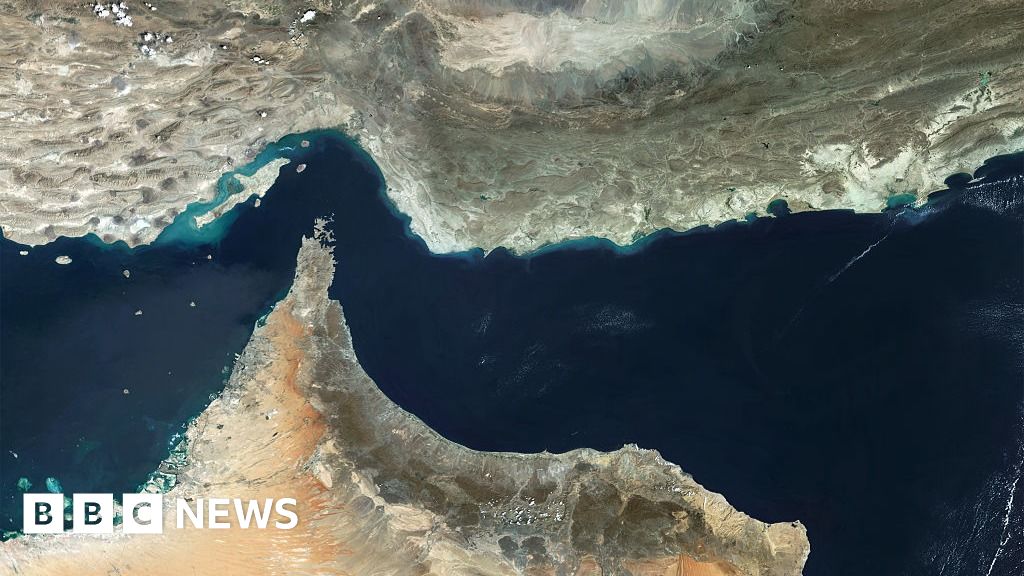
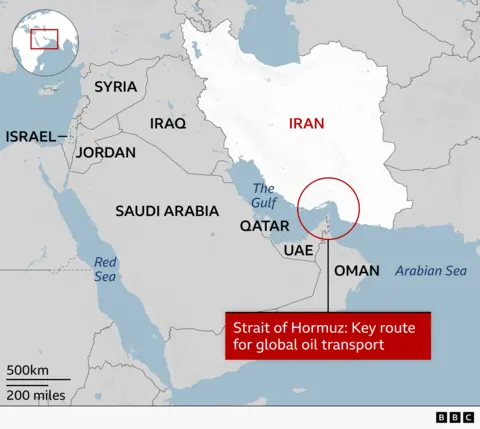
Bounded to the north by Iran and to the south by Oman and the United Arab Emirates (UAE), the corridor – only about 50km (31 miles) wide at its entrance and exit, and about 33km wide at its narrowest point – connects the Gulf with the Arabian Sea.

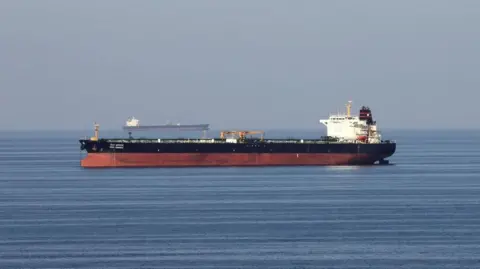
The strait is deep enough for the world's biggest crude oil tankers, and is used by major Middle Eastern oil and LNG producers, as well as their customers.

In 2025, about 20 million barrels of oil and oil products passed through the Strait of Hormuz per day, according to estimates from the US Energy Information Administration (EIA). That is nearly $600bn (£447bn) worth of energy trade per year.

The oil comes not only from Iran but other Gulf states such as Iraq, Kuwait, Qatar, Saudi Arabia and the UAE.

About 20% of global LNG is also shipped through the strait, mostly from Qatar. In 2024, it exported about 9.3 billion cubic feet per day (Bcf/d) of LNG through the strait, and the UAE about 0.7 Bcf/d, according to the US government.

LNG is gas turned into liquid, which takes up 600 times less space for transport, which is then turned back into gas at its destination to be used for heating, cooking and power.

Hormuz is also a crucial route for exports of fertiliser from the Middle East, where natural gas is used heavily in the production process. About one-third of the world's fertiliser trade normally passes through the strait.

And going in the opposite direction, the strait is a vital channel for imports to the Middle East, including food, medicines and technological supplies.

About 3,000 ships usually sail through the strait each month but this has dramatically decreased recently, with Iran threatening to attack tankers and other ships.

At least 21 vessels have been hit or targeted, or have reported attacks, since the start of the war, according to an AFP news agency tally on 18 March.

According to one UAE estimate, quoted by AFP, "more than 18 merchant ships of various nationalities have been hit by projectiles, missiles, drone boats and sea mines".

The same estimate said that at least eight people had been killed, with four still missing.

"You can be attacked, and you can't get insurance or it is extremely expensive, so you have to wait until the security situation is better," Arne Lohmann Rasmussen, chief analyst at Global Risk Management, a provider of energy market insights, told CBS News, the BBC's US partner.

"While there is no physical blockade, threats from the Iranians, plus drone and missile attacks, mean tankers are not going through the strait."

Energy prices remain well above levels before the conflict. Crude oil has risen to about $100 a barrel, according to the Reuters news agency - up almost 70% this year and nearly 50% from a year ago.

Gulf countries, including Iran, rely heavily on energy exports for their income.

A blockade of the strait will also hit Asia hard, with China alone estimated to buy around 90% of the oil that Iran exports to the global market.

Because China uses that oil to make products it then exports to other countries, higher oil prices could also mean higher prices for consumers around the world.

United Nations rules allow countries to exercise control of territorial seas up to 12 nautical miles (13.8 miles) from their coastline.

At the narrowest point, the Strait of Hormuz and its shipping lanes lie entirely within Iran and Oman's territorial waters.

According to experts, one of the most effective ways for Iran to restrict the strait militarily would be to lay mines using fast attack boats and submarines.

Iran's fast boats are often armed with anti-ship missiles.

So far, the US has not deployed any warships to the strait, confining its military response to air attacks on Iran, including its navy.

On 18 March, for instance, the US military reported bombing Iranian anti-ship cruise missile sites along the strait.

A recent call by US President Donald Trump for other countries, including both US allies and China, to help secure Hormuz by sending warships met with little enthusiasm. He then said the US did not actually need their help.

The US has previously used its military might to re-establish the flow of maritime traffic through the strait.

In the late 1980s, during the eight-year Iran-Iraq war, strikes on oil facilities escalated into a "tanker war" that saw both countries attacking neutral ships to exert economic pressure.

Kuwaiti tankers carrying Iraqi oil were especially vulnerable. Eventually, American warships began escorting them through the Gulf in what became one of the largest naval surface warfare operations since World War Two, according to the US Naval Institute.

Only 21 tankers, along with a number of other vessels, have passed through the strait since the war began, the US business news site CNBC reported on 18 March.

Between 1 and 15 March, a total of 11 China-linked vessels transited through the strait, it said.

On 14 March, India said two India-flagged tankers carrying liquefied petroleum gas had passed through Hormuz, and the country is hoping that talks with Iran will ease restrictions.

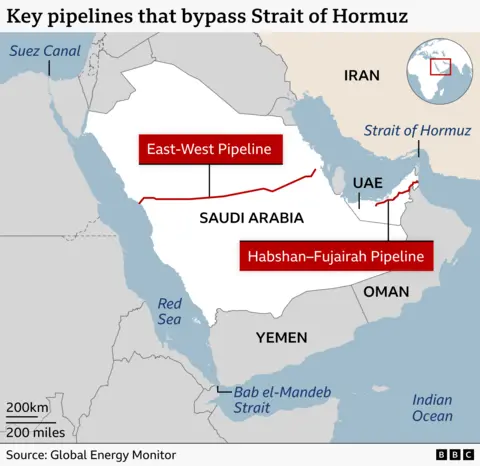
The persistent threat of closure has, over the years, prompted oil-exporting countries in the Gulf region to develop overland routes.

Saudi Arabia operates the 1,200km-long East–West Crude Oil Pipeline, capable of transporting up to five million barrels of crude oil per day, according to the US government.

In the past, it has also temporarily repurposed a natural gas pipeline to carry crude oil.

The UAE has connected its inland oilfields to the port of Fujairah on the Gulf of Oman via a pipeline with a daily capacity of at least 1.5 million barrels.

Oil could be diverted along the alternate infrastructure to bypass Hormuz but Reuters reports that would lead to a drop in supply of 8-10 million barrels per day.

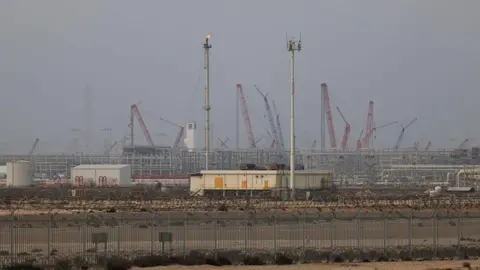
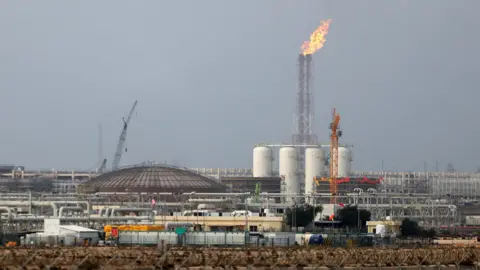
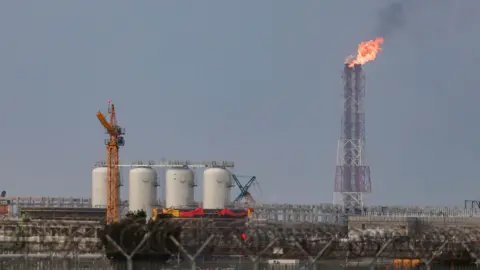
In addition, oil loading at Fujairah has been disrupted by drone attacks.

Energy costs jump after fresh strikes hit key infrastructure in the Middle East,

Analysts fear the disruption to supply could continue for longer than initially thought.

The attacks led to a spike of more than 25% in gas prices in Europe on Thursday.

It comes days after Trump criticised Japan for not answering his demands for help in the Strait of Hormuz.

They were killed when shrapnel landed in Beit Awwa, while a Thai worked was also killed by shrapnel falling in Israel.