huffpost Press
How Trump Is Trying To Suppress Voting On College Campuses Ahead Of November
Images
1 / 6

2 / 6
3 / 6
4 / 6
5 / 6

6 / 6
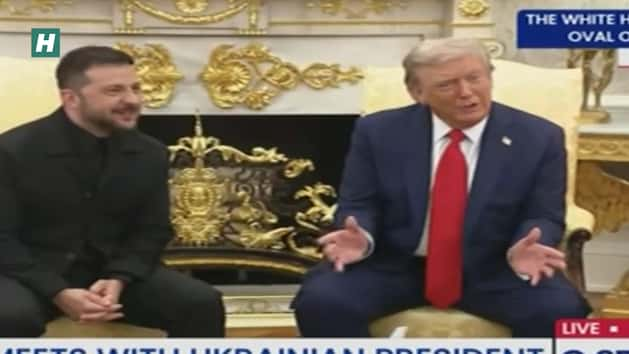
WASHINGTON ― President Donald Trump has been brazen about trying to make it harder for certain people ― voters who lean Democratic ― to vote in November.

He’s demanded Republicans “take over” voting and nationalize elections, and his White House says it “can’t guarantee” it won’t post immigration enforcement agents at polling stations, which would be illegal and aimed at deterring immigrants from voting. He’s now refusing to sign any more bills into law this year until Congress passes the SAVE America Act, a sweeping GOP measure that would virtually ban mail-in voting, require photo IDs to vote, and make people present a passport or birth certificate to register to vote.

But there’s another, less visible way his administration is quietly trying to stifle voting in the coming elections, and it’s targeted at a specific faction of people who tend to vote Democratic: students on college campuses.

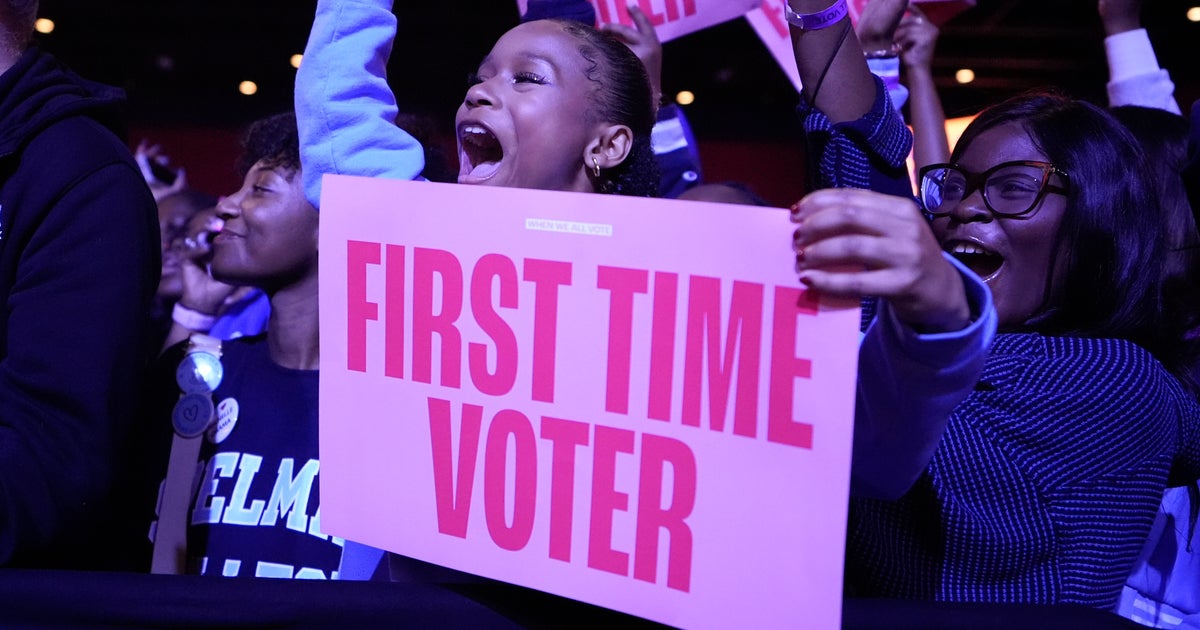
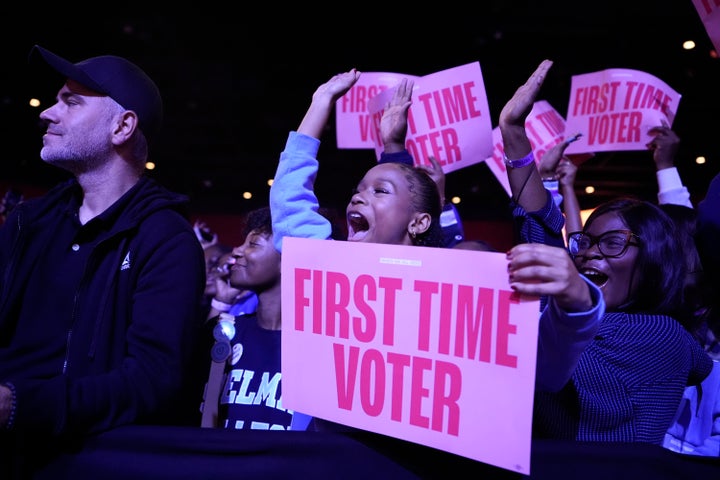
The Trump administration has effectively killed the National Study of Learning, Voting and Engagement, a 13-year running nonpartisan research group that tracks student voting rates across more than 1,000 college and university campuses. NSLVE, which is housed at Tufts University, works with schools to boost student participation in national elections. It’s been credited with helping drive up college student turnout from 39% in 2016 to 47% in 2024.

The administration’s goal appears to be to discourage universities from participating in programs that encourage their students to vote. While Trump picked up unusually strong support from young voters in 2024, those voters have sharply turned against him and favor Democrats by wide margins in public polling.

Dakota Hall, executive director of Alliance for Youth Action, a group focused on engaging youth in democracy, said there is “no legal basis” for killing the program.

“This is voter suppression, plain and simple,” said Hall. “We won’t let fear of retaliation silence a generation of young people.”

What’s more, the administration seems to be going after NSLVE based on an obscure conspiracy theory being pushed by a leading far-right think tank.

Last month, the Education Department announced an investigation into Tufts and the National Student Clearinghouse, a nonprofit hub of information that matches student enrollment records against publicly available voting files. It accused NSLVE of illegally sharing students’ personal data with organizations to “influence elections.” The department also sent threatening letters to the leaders of colleges and universities nationwide, warning them not to work with NSLVE or risk being found in violation of federal privacy laws.

Except there is no evidence of wrongdoing by NSLVE. Even the Education Department’s letter to universities concedes its investigation is based on a “preliminary analysis.”

And NSLVE doesn’t even have students’ personal data.

It receives de-identified, aggregated data from the National Student Clearinghouse. NSLVE essentially tells college campuses how many of their students voted in a given election, without anybody’s individual data or details about vote choices.

So what is going on here?

An Education Department spokesperson did not respond to requests for comment.

A Tufts University spokesperson pointed to a March 10th statement on their website defending NSLVE’s work and its compliance with the Family Educational Rights and Private Act, or FERPA, a 1974 federal law that protects the privacy of students’ education records.

“NSLVE is a longitudinal nonpartisan study that seeks to understand whether students vote, not who they vote for,” reads the Tufts’ statement.

“All data received by Tufts from the Clearinghouse are anonymized, and NSLVE’s reports include only de-identified, aggregated data about overall student voting trends,” says the university. “Tufts does not solicit, receive or review any identifying student information and never has access to information about party affiliation or candidate selection.”

It adds: “NSLVE, by design, complies with FERPA.”

Trish Lorino, a spokesperson for the National Student Clearinghouse, said only that the organization is committed to following laws.

“We remain firmly dedicated to FERPA compliance and will continue prioritizing our support of the core mission of the Clearinghouse and the institutions we serve,” said Lorino.

“NSLVE ... seeks to understand whether students vote, not who they vote for.”

The administration’s allegations against NSLVE seem to have come from an obscure 2023 report by a group called Verity Vote, led by election conspiracy theorist Heather Honey.

A far-right activist and election researcher, Honey, is known for misrepresenting Pennsylvania voter data in 2020 and falsely claiming there were more votes reported than there were voters ― something Trump parroted to his supporters on Jan. 6, 2021, before they stormed the U.S. Capitol to try to prevent Joe Biden from being certified as president. Trump has since appointed Honey to an election integrity post at the Department of Homeland Security.

A couple of conservative news outlets wrote about the Verity Vote report in 2023 and 2024 ― Honey was even quoted by one of them ― but the report’s allegations were never substantiated, so nothing came of it.

Sen. Mike Lee (R-Utah), a staunch ally of Trump’s who was previously on the president’s short list for a Supreme Court nomination, introduced a bill in 2024 based on the same allegations. It also went nowhere.

Now the Trump administration appears to be trying to resurrect these allegations and turn this into an issue that impacts the 2026 elections.

National youth voter groups say the administration’s actions are a clear case of trying to intimidate universities and suppress the youth vote in the coming elections.

“The attack on NSLVE is baseless and unfounded,” said Arianna Jones, executive director of NextGen America, a leading organization for empowering young people to organize and vote. “The Trump administration’s investigation into an organization whose only purpose is better understanding youth civic participation and engagement is deeply troubling, but not surprising.”

But even if the Education Department’s probe is bunk, it’s already having its intended effect. The National Student Clearinghouse announced it is cutting ties with NSLVE, effective March 27, citing its commitment to following federal privacy laws.

Without the clearinghouse providing data to NSLVE, and with college presidents being threatened with potential financial consequences if they work with NSLVE, it’s not hard to see how this could chill efforts to boost student turnout in the 2026 elections.

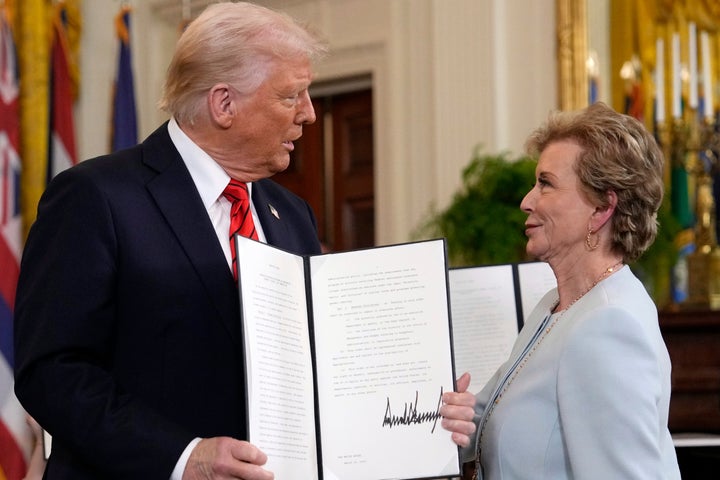
One group has been noticeably celebrating the National Student Clearinghouse cutting ties with NSLVE: the America First Policy Institute, a far-right think tank that’s been led by a who’s who of former and current top Trump administration officials, including Education Secretary Linda McMahon. The group even appears to be taking credit for inspiring the investigation.

In a statement last week, the group hailed the dissolution of the NSLVE’s partnership with the clearinghouse and claimed college students “are finally being protected.”

Severing the two groups “represents an important step toward ensuring that sensitive student data is not exploited for political purposes,” said Anna Pingel, a campaign director at the America First Policy Institute. “The purpose of higher education is to prepare students for the workforce, not to make them unwitting targets of political operations.”

At the bottom of its statement, the America First Policy Institute claims it sent a letter to the Education Department earlier this year “outlining concerns that the partnership may have allowed sensitive student data to be shared with third parties for political purposes, potentially violating the Family Educational Rights and Privacy Act.”

Guess who announced the department’s investigation right around that time: McMahon, the former chair of the board of America First Policy Institute.

The institute did not respond to a request for comment on what role it played in instigating the Education Department’s probe. Instead, a spokesperson said they raised concerns with NSLVE based on the group’s own description of how it carries out its work.

“AFPI raised these concerns based on NSLVE’s own description of its process to ensure federally funded institutions are not enabling the disclosure of sensitive student information in ways that can be exploited for partisan purposes – the privacy of student data and supporting election integrity are not partisan or political,” the spokesperson said in a statement. “It’s just good policy.”

Hall, of Alliance for Youth Action, said it seems obvious the administration is going after NSLVE because Trump knows his support among young voters is plummeting.

A Wall Street Journal poll in late January found 58% of voters under 30 now disapprove of Trump’s performance. An Economist-YouGov poll in February found Trump’s support among Gen Zers ― the cohort of people born between 1997 and 2012 ― has dropped to its lowest point in his second term, with 67% of voters aged 18 to 29 disapproving of his presidency.

Young people were certainly key to the coalition of voters that helped secure Trump’s victory in 2024. Today, many of those voters say they’re having buyer’s remorse.

“He’s weaponizing the federal government to make sure they pay for it before November,” Hall said of Trump. “Instead of changing his deeply unpopular policies, he’s rigging the system.”

It’s not clear how long the Education Department’s investigation will continue. In the meantime, some youth voter groups say it’s more important than ever that they step up to encourage student democratic engagement in the coming elections.

“NSLVE has benefited campuses across the country in their efforts to help students participate in the voting process,” said Jen Domagal-Goldman, executive director of the ALL IN Campus Democracy Challenge, a nonpartisan nonprofit focused on boosting campus voter participation. “But activities like voter registration do not depend on NSLVE and can continue.”

“We remain committed to our mission of increasing student voter participation and helping students form the habits of active, informed citizenship,” she said.

By entering your email and clicking Sign Up, you're agreeing to let us send you customized marketing messages about us and our advertising partners. You are also agreeing to our Terms of Service and Privacy Policy.