yahoo Press
Chinese Publication Claims U.S. Has Two Months of Rare Earths Left
Images
1 / 5
2 / 5

3 / 5

4 / 5

5 / 5
The U.S. has already launched hundreds of missiles and precision-guided weapons in the escalating conflict with Iran, an air campaign that has consumed billions of dollars in advanced military hardware in just weeks. But a new warning circulating in Chinese and Western media suggests the materials needed to keep producing those weapons may be running dangerously low.

Reports from the South China Morning Post and Reuters indicate Washington could have only weeks or months of certain rare-earth inventories available for defense manufacturing if supply disruptions deepen.

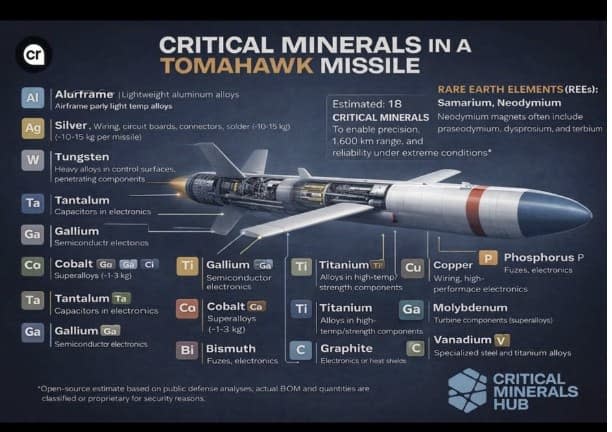
Rare earth elements are embedded throughout modern military systems—from missile guidance and drone propulsion to radar systems and fighter aircraft electronics.

“You can’t fight a twenty-first-century war with twentieth-century supply chains,” said Lipi Sternheim, CEO of REalloys. “Modern weapons rely on materials that are difficult to source, difficult to process, and difficult to replace once inventories begin to tighten.”

REalloys (NASDAQ: ALOY) is one of the few companies rebuilding the rare-earth metals stage of the supply chain in North America, converting rare-earth oxides into the metals and alloys used by magnet manufacturers and defense suppliers.

And it’s the 11th hour for American defense and the entire defense industry, even if it wasn’t in the middle of a war with Iran that reportedly cost $5.6 billion just in the first two days.

That vulnerability isn’t new. For decades, the United States allowed much of its rare-earth processing and metallization capacity to migrate overseas, leaving China to dominate the stages of the supply chain that convert raw materials into the metals and magnets used in advanced technology. Today, much of the rare-earth material used in Western defense systems still traces through Chinese processing facilities. The Pentagon is now racing to reverse that dependence ahead of a 2027 deadline that will prohibit U.S. weapons systems from using magnets made with Chinese-origin rare earths.

REalloys’ flagship facility in Euclid, Ohio, is already ahead of the deadline.

REBUILDING AMERICA’S RARE EARTH METALS CAPACITY

Mountain Pass in California produces rare-earth concentrate that is separated domestically into NdPr oxide. That is an important step in rebuilding North American capability - but oxide itself is not the material defense contractors actually use.

Before it can enter manufacturing, oxide must first be chemically reduced into pure rare-earth metal. That metal is then blended into precise alloys used to produce high-performance permanent magnets.

For decades, that conversion—from oxide to metal—has taken place almost entirely in China. Even when rare-earth ore was mined in the United States and separated into oxide domestically, the metallurgical step that turns that chemistry into usable industrial metal was still performed overseas.

That is the break in the supply chain.

REalloys is positioned to help close it.

At its Euclid facility, the company converts rare-earth oxides into finished metals and magnet-grade alloys through high-temperature reduction and refining processes. Those materials are the feedstock required by magnet manufacturers and advanced industrial users.

It is also one of the most technically difficult stages of the entire rare-earth value chain. Metallization requires tightly controlled reduction reactions, high-temperature furnaces, and continuous process control capable of maintaining stable yields and purity levels across multiple rare-earth elements.

“Metallization is the least developed part of the value chain outside China,” said REAlloys co-founder Tim Johnston. “It requires deep operating expertise and process control systems capable of managing complex variables in continuous production. Even with capital and strong execution, replicating that capability typically takes three to seven years or more, with significant technical and qualification risk.”

The Euclid facility is already operating, converting rare-earth oxides into metals and alloys inside North America rather than sending those materials overseas for processing.

Upstream, REalloys owns the Hoidas Lake rare-earth project in Saskatchewan, anchoring primary resource exposure inside Canada.

In Greenland, the company has signed a long-term non-binding letter of intent covering roughly 15% of future production from the Tanbreez rare-earth project, one of the largest deposits of heavy and medium rare earths outside China.

Additional supply agreements extend to Kazakhstan, where the company is working with AltynGroup on access to material from the Kokbulak project and surrounding concessions. In Brazil, an alliance tied to the Araxá rare-earth project adds another potential non-Chinese source of feedstock.

“We’ve already solved the hardest part—proving that rare-earth metallization and alloying can be done domestically to the specifications real customers require,” Johnston said.

REalloys (NASDAQ: ALOY) isn’t stopping at metallization, either.

The company is also developing a large-scale permanent magnet manufacturing facility in the United States, designed to start with roughly 3,000 tons of neodymium-iron-boron (NdFeB) magnet production annually and expand to as much as 18,000 tons per year.

At full capacity, that level of output could supply magnets for roughly 1.5 to 2 million electric vehicles annually, thousands of wind turbines, and large volumes of industrial motors, robotics systems, and medical devices. Defense systems—from missile guidance units to radar and avionics—also rely heavily on high-performance rare-earth magnets.

That dependency runs across the entire contractor base. Lockheed Martin (NYSE: LMT), whose F-35 program requires hundreds of pounds of rare earth materials per airframe for flight controls, radar, and electronic warfare suites, has moved to dual-source critical mineral inputs as the 2027 deadline closes in. RTX Corporation (NYSE: RTX) faces the same pressure through its Raytheon unit, where AMRAAM and Tomahawk production depends on dysprosium and terbium magnets capable of holding performance under combat heat and vibration. At the smaller end of the contractor spectrum, Kratos Defense & Security Solutions (NASDAQ: KTOS) has built its high-volume drone and unmanned systems business around domestic supplier agreements that lock in proven rare earth alloys—a model that only works if the metallization layer it depends on actually exists inside the United States.

The facility is designed to integrate multiple stages of the rare-earth value chain, including metallization, alloying, powder production, and final magnet manufacturing.

If completed at the projected scale, it would represent one of the largest NdFeB magnet production sites outside Asia and a significant step toward rebuilding a fully integrated rare-earth supply chain in North America.

With Euclid converting oxide into metal inside the United States, the rare-earth supply chain begins to close a loop that has been broken for decades—just as Washington prepares to bar Chinese-origin rare earths from U.S. defense systems in 2027.

By. Michael Kern

The AI boom is triggering an unexpected and unprecedented bull run in natural gas and power  stocks. If you aren't paying attention to the energy demands of data centers, you will miss the biggest energy story of the decade. The smart money is already quietly moving into the few companies prepared to power the trillion-dollar AI machine.

Oilprice Intelligence brings you the inside view on where the next gains will come from, breaking down the market's biggest growth driver with analysis from veteran oilmen and experts. Click here to get this crucial intel for free

Important Disclosure: The owner of Oilprice.com owns shares and/or stock options of the company and therefore has an incentive to see the company’s stock perform well. We encourage you to conduct your own due diligence and seek the advice of your financial advisor or broker before investing.FORWARD LOOKING STATEMENTSThis publication contains forward-looking statements, including statements regarding expected continual growth of the featured companies and/or industry. The Publisher notes that statements contained herein that look forward in time, which include everything other than historical information, involve risks and uncertainties that may affect the companies’ actual results of operations. Factors that could cause actual results to differ include, but are not limited to, changing governmental laws and policies concerning, among other things, recreational and medical cannabis sales, success of the company’s proprietary technology, the size and growth of the market for the company’s products and services, the company’s ability to fund its capital requirements in the near term and long term, pricing pressures, etc.

IMPORTANT NOTICE AND DISCLAIMERNeither the author nor the publisher, Oilprice.com, was paid to publish this communication concerning REalloys (NASDAQ: ALOY). The owner of Oilprice.com owns shares and/or stock options of the featured company and therefore has an incentive to see the featured company’s stock perform well. The owner of Oilprice.com may buy or sell shares of the featured company at any time including at or near the time you receive this communication. This share ownership should be viewed as a major conflict with our ability to be unbiased. This is why we stress that you conduct extensive due diligence as well as seek the advice of your financial advisor or a registered broker-dealer before investing in any securities.

This communication is not, and should not be construed to be, an offer to sell or a solicitation of an offer to buy any security. Neither this communication nor the Publisher purport to provide a complete analysis of any company or its financial position. The Publisher is not, and does not purport to be, a broker-dealer or registered investment adviser. This communication is not, and should not be construed to be, personalized investment advice directed to or appropriate for any particular investor. Any investment should be made only after consulting a professional investment advisor and only after reviewing the financial statements and other pertinent corporate information about the company. Further, readers are advised to read and carefully consider the Risk Factors identified and discussed in the advertised company’s SEC, SEDAR and/or other government filings. Investing in securities is speculative and carries a high degree of risk. Past performance does not guarantee future results. This communication is based on information generally available to the public and does not contain any material, non-public information. The information on which it is based is believed to be reliable. Nevertheless, the Publisher cannot guarantee the accuracy or completeness of the information.

INDEMNIFICATION/RELEASE OF LIABILITYBy reading this communication, you acknowledge that you have read and understand this disclaimer, and further that to the greatest extent permitted under law, you release the Publisher, its affiliates, assigns and successors from any and all liability, damages, and injury from this communication. You further warrant that you are solely responsible for any financial outcome that may come from your investment decisions.

TERMS OF USEBy reading this communication you agree that you have reviewed and fully agree to the Terms of Use found here http://oilprice.com/terms-and-conditions If you do not agree to the Terms of Use http://oilprice.com/terms-and-conditions, please contact Oilprice.com to discontinue receiving future communications.

INTELLECTUAL PROPERTYOilprice.com is the Publisher’s trademark. All other trademarks used in this communication are the property of their respective trademark holders.  The Publisher is not affiliated, connected, or associated with, and is not sponsored, approved, or originated by, the trademark holders unless otherwise stated. No claim is made by the Publisher to any rights in any third-party trademarks.

Oilprice Intelligence brings you the signals before they become front-page news. This is the same expert analysis read by veteran traders and political advisors. Get it free, twice a week, and you'll always know why the market is moving before everyone else.

You get the geopolitical intelligence, the hidden inventory data, and the market whispers that move billions - and we'll send you $389 in premium energy intelligence, on us, just for subscribing. Join 400,000+ readers today. Get access immediately by clicking here.