yahoo Press
Cape Canaveral rocket launch may be seen in Cape Coral, Fort Myers, Naples
Images
1 / 8
2 / 8

3 / 8

4 / 8
5 / 8

6 / 8

7 / 8

8 / 8
A 20-story tall, 1.3 million-pound Atlas V rocket will blast off from Florida, and it's possible people in Fort Myers − and other states along the East Coast − can see it light up the sky.

Teams with United Launch Alliance are prepping for the Atlas V rocket launch, the fifth Amazon Leo constellation mission. Liftoff is planned at 3:53 a.m. EDT Sunday, March 29, 2026, from Cape Canaveral, Florida.

Though rockets in Florida blast off from NASA's Kennedy Space Center or nearby Cape Canaveral Space Force Station, it's possible for spacecraft to be seen far beyond the launch pad, including in other states: In December 2023, the SpaceX Falcon Heavy rocket was spotted from Boca Raton to Cedar Key to Myrtle Beach. And in February 2025, people in Fayetteville, North Carolina, posted photos and video of a Falcon 9 rocket after liftoff from Cape Canaveral, Florida. More recently, in February 2026, a SpaceX Falcon 9 rocket was seen about 150 miles away from Cape Canaveral in West Palm Beach, Florida.

Fort Myers is more than 300 miles away from Cape Canaveral Space Force Station.

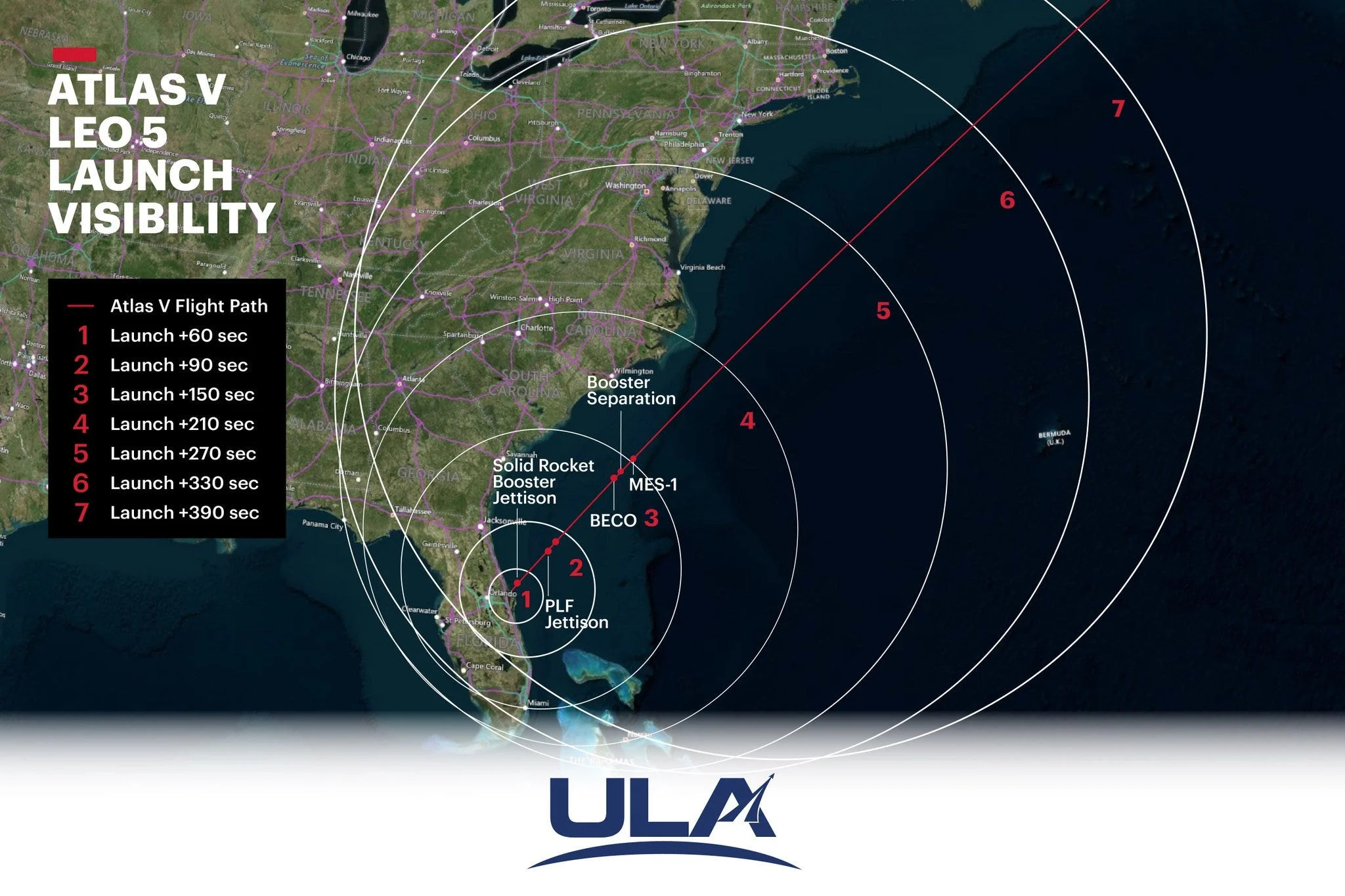
Pending weather conditions and cloud cover, the Atlas V-Amazon Leo predawn launch could be visible from Florida to New England, according to ULA. That is, if their city falls on the ULA Atlas V rocket launch visibility map (see below), and if they're awake at the time of liftoff.

Visibility from most of Florida is possible, according to ULA.

The Atlas V rocket will be equipped with five solid rocket boosters to launch the next batch of Amazon Leo broadband satellites (previously referred to as Project Kuiper) into low-Earth orbit — giving a great show to those watching.

Godspeed! Here's the list of all 2026 rocket launches from NASA's Kennedy Space Center and Cape Canaveral, Florida

In Florida, we can best see this moment in person, particularly if you're anywhere on the Space Coast (Melbourne, Florida, area), the Fun Coast (Daytona Beach area) or the Treasure Coast (Vero Beach, Jensen Beach and Fort Pierce).

Below is information on ULA's Atlas V rocket, how to watch the Amazon Leo rocket launch and suggestions on where to watch it from Florida and beyond.

A United Launch Alliance Atlas V rocket with five solid rocket boosters will send a batch of Amazon Leo broadband satellites (previously referred to as Project Kuiper) into low-Earth orbit with a 29-minute launch window that begins at 3:53 a.m. ET Sunday, March 29, 2026. The ULA Atlas V rocket launch will be from Launch Complex 41 at Cape Canaveral Space Force Station in Florida, and no sonic booms for the Space Coast area are expected.

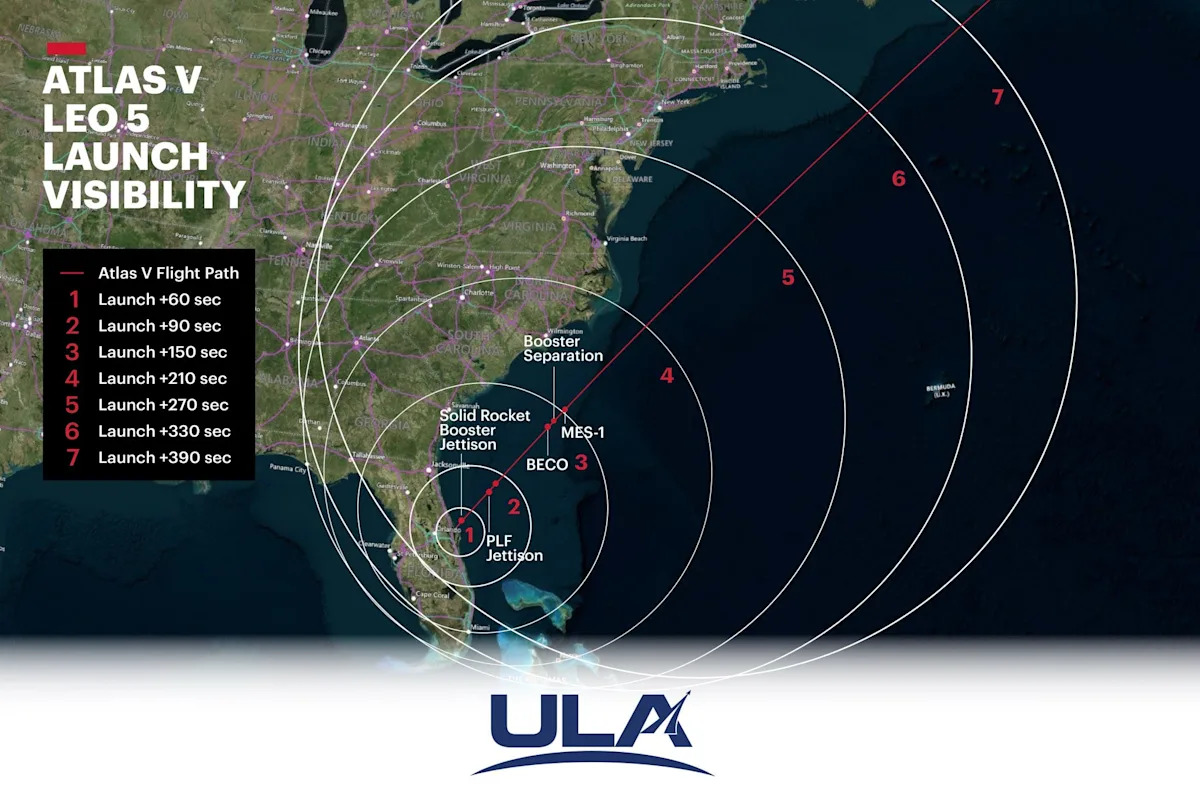
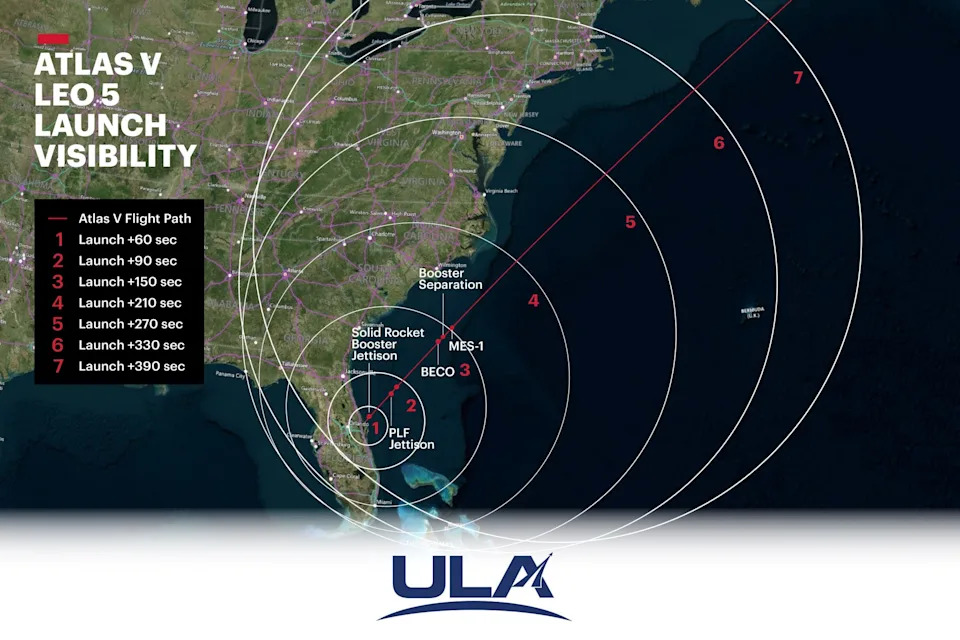
The visibility map provided by ULA shows about when and where your best chances are to see the rocket as it streaks northeasterly into space.

ULA provided a helpful graphic (see above) that shows the Atlas V rocket launch and its intended flight path and launch visibility. Note: Cities in the Space Coast of Florida, which is in Brevard County and measures 72 miles of coast, include Titusville, Mims, Port St. John, Merritt Island, Cocoa, Cocoa Beach, Melbourne, West Melbourne, Palm Bay, Satellite Beach, Indian Harbour Beach, Indialantic, Melbourne Beach, Grant-Valkaria and Sebastian.

Launch, Space Coast, east Orlando, near University of Central Florida, Bithlo, the northern part of the Treasure Coast, Indian River County, Sebastian, Vero Beach, parts of Daytona Beach, New Smyrna Beach and Oak Hill

1: Launch + 60 seconds, Space Coast, Orlando, the Treasure Coast, Indian River County, Sebastian, Vero Beach, Fort Pierce, Stuart, Port St. Lucie, Jensen Beach, Martin County, St. Lucie County, Daytona Beach, New Smyrna Beach, Oak Hill, Ormond Beach, Volusia County, Ocala, Lakeland area, East Orlando, Winter Park

2: Launch + 90 seconds, which includes PLF Jettison or separation and jettison of the payload fairing: Space Coast, Daytona Beach, New Smyrna Beach, Oak Hill, Port Orange, Volusia County, Treasure Coast, Indian River County, Martin County, St. Lucie County, Orlando, Sanford, Kissimmee, Central Florida, Ocala, Lakeland, St. Augustine, Ponte Vedra Beach, near Jacksonville

3: Launch + 150 seconds, which includes solid rocket booster jettison, visibility includes most of Florida, near the Big Bend area and excluding the Panhandle, extending past Jacksonville, with these cities and counties in the visibility map: Sebring, Winter Haven, Palatka, Gainesville, Sarasota, Manatee County, Sarasota County, Cape Coral, Fort Myers, Naples, Collier County, Lee County, St. Petersburg, Tampa, Clearwater, Hillsborough County, Pinellas County, West Palm Beach, Lake Worth Beach, Wellington, Jupiter, Mar-a-Lago, Palm Beach, Miami, Fort Lauderdale. Parts of Georgia including Savannah and Atlanta, and southern area of South Carolina

4: Launch + 210 seconds, which includes booster separation, visibility still includes Florida, Tallahassee, the Florida Keys, Nassau, Bahamas, and extending to Atlanta and Columbus, Georgia, Spartanburg, Greenville, Columbia, Charleston, South Carolina, and parts of North Carolina, like Charlotte, Wilmington, Asheville, Greensboro and Raleigh

5: Launch + 270 seconds, ULA Atlas V rocket launch visibility extends across most of Florida to the Bahamas, includes Georgia, South Carolina, North Carolina, Virginia, West Virginia, Delaware, New Jersey, Maryland, Kentucky, Tennessee, Alabama. Visibility may include Richmond, Virginia and Virginia Beach; Winston-Salem and High Point, North Carolina; Dover and Annapolis, Delaware.

6: Launch + 330 seconds, ULA Atlas V rocket launch visibility extends along the Eastern Coast, up New England area and west to Alabama, Tennessee, Kentucky, Indiana and Ohio. Visibility may include Huntsville and Birmingham, Alabama; just outside Nashville, Tennessee; Lexington and Louisville, Kentucky; Cincinnati, Columbus and Cleveland, Ohio; Pittsburgh, Harrisburg and Philadelphia, Pennsylvania; Trenton, New Jersey; parts of New York, Binghamton, Buffalo and Albany; Hartford, Connecticut; Providence, Rhode Island; Manchester and Boston, Massachusetts; just outside Concord, New Hampshire.

7: Launch + 390 seconds, ULA Atlas V rocket launch visibility extends along the Eastern Coast, up New England, west to Alabama, Tennessee, Kentucky, Indiana and Ohio and north into Canada. Visibility may include Michigan, including Detroit; Toledo, Ohio; parts of Canada, including Toronto, Mississauga, Hamilton, St. Catharines in Southern Ontario, Canada.

The above guidelines are estimates based on the graphic provided by ULA.

When and where: Full coverage of the launch, including a live webcast with live tweets and updates, kicks off 90 minutes before liftoff at floridatoday.com/space (you can type this on your browser on your phone) and will feature in-depth coverage. Ask our FLORIDA TODAY space team reporters Rick Neale and Brooke Edwards questions and strike up a conversation. You also can watch coverage via the FLORIDA TODAY app, which is available in the App Store or Google Play. You can download the free app for iPhone or Android or type floridatoday.com/space into your browser. FLORIDA TODAY is part of the USA TODAY Network.

Click here to download FLORIDA TODAY app on App Store

Click here to download FLORIDA TODAY app on Google Play

For the latest news and launch schedule from Cape Canaveral Space Force Station and NASA's Kennedy Space Center, visit floridatoday.com/space. Another easy way: Click here to sign up for our weekly Space newsletter.

Sangalang is a lead digital producer for USA TODAY Network. Follow her on Twitter or Instagram at @byjensangalang. Support local journalism. Subscribe to the free Florida TODAY newsletter.

This article originally appeared on Fort Myers News-Press: What time is Atlas V rocket launch? It may be seen in Southwest Florida