Press
Consumer confidence hit by 'ripple of fear' over Iran war
Images

1 / 8

2 / 8

3 / 8
4 / 8

5 / 8
6 / 8

7 / 8

8 / 8
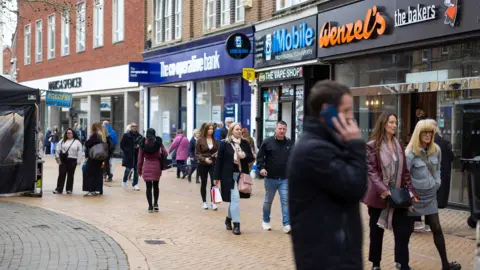
Confidence among UK shoppers has started to decline over concerns about the impact of the US-Israel war with Iran, according to a key survey.

Research firm GfK said its Consumer Confidence Barometer for March indicates growing doubt over prospects for the UK economy in the next 12 months. It also suggests less appetite for big purchases, and more interest in saving.

"A ripple of fear is spreading," said GfK's Neil Bellamy. "People simply do not feel the economy is robust enough to ride out the knock-on effects from the Middle East conflict."

It comes as figures from the Office for National Statistics (ONS) showed a 0.4% fall in retail sales for February, before the Iran conflict began.

The ONS said supermarket sales fell back from January, while household goods retailers saw demand dampened due to February's wet weather.

Non-store retailers - including online and catalogue businesses - also saw a dip in sales volumes, with retailers suggesting shoppers had brought forward spending to take advantage of January sales.

The drop in ONS retail sales was "modest" and below forecasts, but the fall in consumer sentiment is a "a sign of things to come", Capital Economics UK economist Ashley Webb said.

Energy prices have increased dramatically since the outbreak of the US-Israeli war with Iran on 28 February, with benchmark Brent crude oil up around 50% to $110 a barrel.

Drivers are already seeing price rises at the pump, with figures from the RAC showing petrol up 34% on average, while diesel has climbed 24%.

There are also fears about household energy bills beyond the summer. While the energy price cap will fall in April, energy consultants Cornwall Insight have predicted average annual energy bills for a typical household could go up by around £300 from July.

On Thursday, the latest forecast from global policy group the Organisation of Economic Co-operation and Development predicted the UK would face the biggest hit to growth from the Iran war out of the G20 major economies.

GfK said its consumer confidence index fell two points to minus 21 this month, while expectations for the general economic situation over the next year dropped six points to minus 37.

"The decline in GfK consumer confidence in March... is probably the start of a bigger fall and suggests real household spending growth will soften in 2026," Webb said.

GfK's research suggested people are less likely to make big buys like furniture and electrical goods, and more interested in putting money into savings due to uncertainty over the economy.

The fall in sales in February reported by the ONS was smaller than analysts had expected, with a drop of 0.7% having been predicted.

However, it is "still a shaky base" in light of the US-Israel war with Iran, said Susannah Streeter, chief investment strategist at investment platform Wealth Club.

"With confidence weakening, costs rising due to higher freight and energy costs and spending intentions faltering, the outlook for retailers looks set to be an increasing struggle in the months to come," she said.

The OECD downgrades forecasts for many of the world's biggest economies due to the US-Israel war with Iran.

The speed of price rises in the UK has stayed the same, according to data which was collected before the US-Israel war with Iran began.

The interest rate set by the Bank of England affects mortgage, loan and savings rates for millions.

Chancellor Rachel Reeves announced changes to cash Isa rules, but what are they and how do they work?

UK Inflation has dropped back from record highs but remains above the Bank of England's 2% target.