yahoo Press
Doris Kearns Goodwin shares lessons for today's politics
Images
1 / 8
2 / 8

3 / 8

4 / 8
5 / 8

6 / 8

7 / 8

8 / 8
WORCESTER – Thursday night, March 26 acclaimed presidential historian Doris Kearns Goodwin spoke to a capacity crowd at Assumption University in Worcester. The Pulitzer-prize winning author of presidential histories had the full attention of the audience at the Curtis Performance Hall as she discussed lessons she has learned from decades of presidential research and how they apply to today's challenging American political landscape.

Goodwin was brought to Assumption to help bring attention to Assumption's Center for Civic Friendship, a program launched by the university in 2024 to help foster community collaboration and bringing opposite views together and working towards a common purpose.

Mary Jane Rein, Director of the Center for Civic Friendship, said that Goodwin, through her decades of research on figures such as Abraham Lincoln navigating the Civil War or Franklin Delano Roosevelt combatting the Great Depression, can provide insight on how the country overcame challenges even larger than the ones they face today.

"We are living in polarizing times and it is important to remember our country has survived even more challenging periods," Rein said.

The following are five key messages from Goodwin's presentation at Assumption.

Goodwin began her career in political history while serving as an intern in the White House while a graduate student at Harvard, where she had a close relationship with then-President Lyndon Johnson. After Johnson left the White House, failing to seek re-election largely as the country turned against the Vietnam War, Goodwin went to Texas with Johnson to work on his memoirs.

"As I've gotten older, I've become to appreciate more what a privilege it was to spend so many hours with this aging lion of a man, a victor of a thousand contests domestically but in other ways broken by the war in Vietnam," Goodwin said. "I like to think that experience is what led to me deciding to become a presidential historian. Although, I'm not sure I ever decided to become one, but all of a sudden I was writing my next book about the Kennedy's."

Goodwin is probably best known for her work on Abraham Lincoln, with her book "Team of Rivals: The Political Genius of Abraham Lincoln" winning the Pulitzer Prize and the inspiration for the Steven Spielberg film, "Lincoln." Assumption President Greg Weiner, who hosted the interview with Goodwin, noted that Lincoln was the most documented figure in American history, with over 16,000 books already written about him, and asked Goodwin what it was like trying to write something new about such a figure.

Goodwin said that she met with Lincoln scholar, David Donald, who told her that no matter what she discovered, she would be a better person for having spent so much time documenting Lincoln's morality and virtues.

"I wanted to do it, but I was scared," Goodwin said. "He (David Donald) told me not to be afraid and that whatever I came up with, I would become a better person for having studied Lincoln. That the virtues that Lincoln had I would come to value. I really did feel like afterwards, that by living in his presence, I would try and combat those feelings of envy, anger and jealously, those feelings that do you no good at all, and Lincoln understood the important of getting rid of them."

Goodwin said that while documenting the presidents she notes that while figures such as Lincoln, Teddy Roosevelt or Johnson often get the historical credit for major changes in the country, it is only citizen activists that drive change at the base level that allows major leaders to impact change at the highest level.

"Lincoln would say later to not quote him as a liberator after the emancipation proclamation – it was the anti-slavery movement and the union soldiers that did it all," Goodwin said. "Teddy Roosevelt was able to do what he did because there was already a progressive movement in the cities and states. The civil rights movement was essential for what Lyndon Johnson did. There was the women's rights movement, the gay rights movement; change always comes from the ground up and we have to remember that. It is not just the leaders who made us who we are. It is the citizens."

During the event, Goodwin was asked a question from an audience member about history education today and Goodwin responded by rebuking messages such as President Trump's executive order "Ending Radical Indoctrination in K-12 Schooling" which seeks to eliminate negative aspects of American history in teaching.

"It is heartbreaking to hear that history is being taught less in schools, that fewer people are majoring in history, but even more troubling is that there seems to be a spread throughout the world and in our country that we should only teach good things about our history and not embarrass people by teaching troubling things," Goodwin said. "We can't know what the country was able to achieve without knowing that they went through difficult times to get there. Jim Crow was instituted and Jim Crow was ended because of the civil rights movement. We don't know that good things can happen without understanding the bad things that happened."

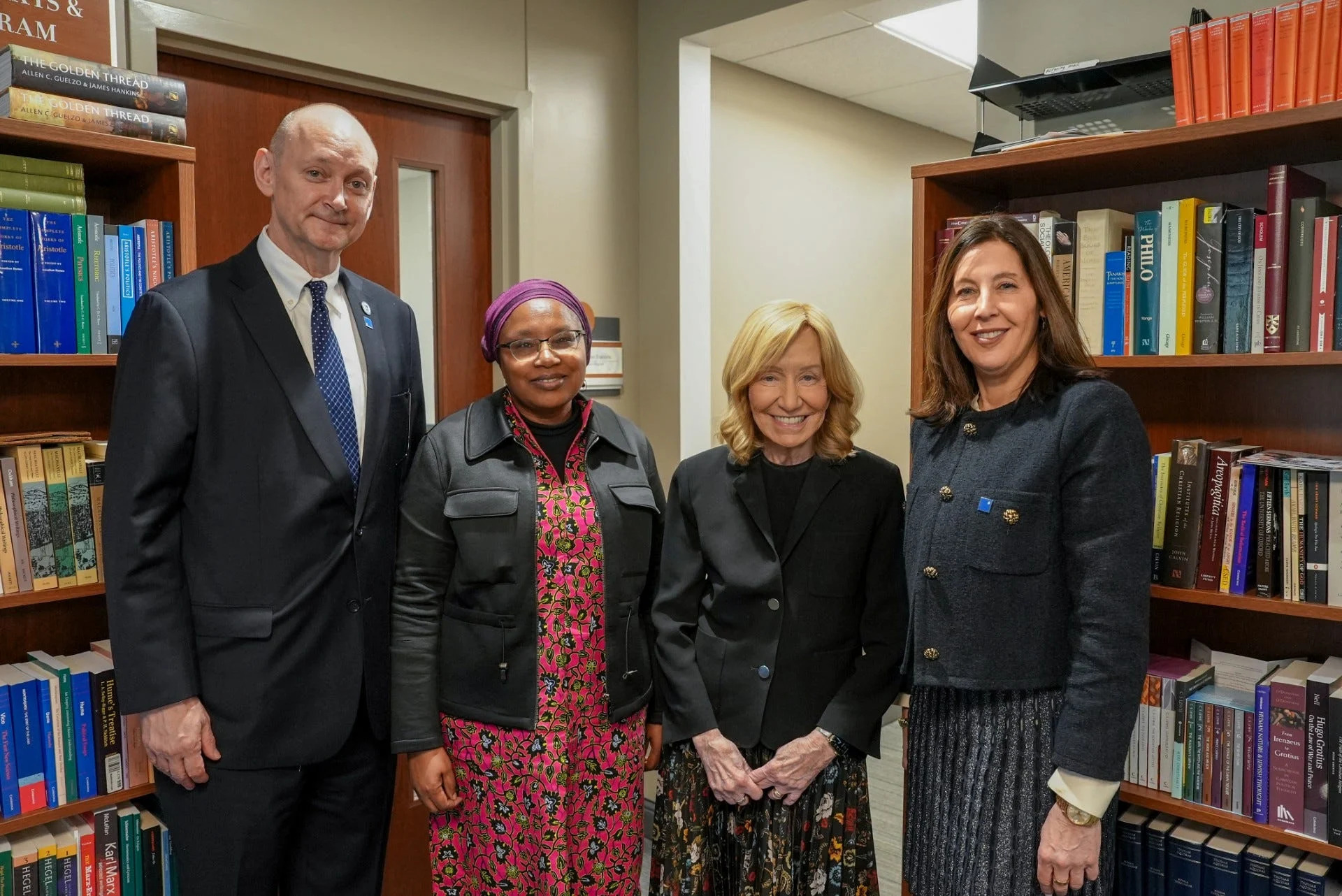
Goodwin said that earlier Thursday, March 26 she got a chance to meet with Assumption students who were learning at the Center for Civic Friendship and said that she was impressed with the depth, care and interest students showed about the world around them.

"I met with some students this afternoon in this wonderful civic friendship program that is being inaugurated and its very exciting," Goodwin said. "We have so much depending on the next generation and if today's students are an example I think we are OK. We are going to be in good shape."

This article originally appeared on Telegram & Gazette: Doris Kearns Goodwin on history's lessons for today