Press
World Cup risks being ‘stage for repression’ for millions of fans: Amnesty
Images
1 / 5

2 / 5

3 / 5

4 / 5

5 / 5
Rights group says the football tournament in Canada, Mexico and the US poses grave risks for international fans and those from local communities.

Save

Share

The upcoming FIFA World Cup will be held at a time of “acute human rights crisis” and will pose significant risks to travelling fans, local communities and those working at the tournament, Amnesty International has said.

The rights group on Monday laid out the threats faced by millions of local and international football fans who will travel to Canada, Mexico and the United States for the six-week tournament.

“The US – where three-quarters of World Cup matches will be held – is facing a ‘human rights emergency’ and a recognisable pattern of authoritarian practices,” Amnesty said.

The scathing report was released 10 weeks ahead of the tournament amid immigration crackdowns, protest restrictions and deaths at the hands of US law enforcement officials.

“Armed agents are breaking down doors, detaining children and have deported hundreds of thousands of people,” it said, referring to US immigration policies.

Amnesty International said that though FIFA had judged the World Cup to be a “medium risk” tournament, it could become a “stage for repression and a platform for authoritarian practices”.

At least six people have died in the custody of US Immigration and Customs Enforcement (ICE) in 2026, and a seventh person was fatally shot by an off-duty ICE officer. Last year, 32 deaths were reported in ICE custody.

While most of the deaths were due to health complications, some of the late detainees’ families have made accusations of abuse and medical neglect.

The acting director of ICE said last month that the agency will be “a key part of the overall security apparatus for the World Cup”.

The report from London-based Amnesty urges FIFA and World Cup host countries to take urgent action to protect fans, players, journalists, workers and local communities.

FIFA has promised a tournament where everyone “feels safe, included and free to exercise their rights”. But Amnesty said incidents of forced protest shutdowns, gender bias, indiscriminate raids, ethnic profiling, arbitrary arrests, mass detention, cartel violence and unlawful deportations paint a different picture of the host nations.

It accused the US, which will host 78 of the 104 tournament fixtures, of closing civic space while dehumanising and criminalising marginalised people under the administration of President Donald Trump.

“The administration has aggressively advanced an anti-migrant, anti-refugee agenda, subjecting migrants, asylum seekers and refugees to a litany of human rights violations,” the report said.

Amnesty also raised concerns over the Trump administration’s visa ban for nationals of 12 countries, of which four have qualified for the World Cup, saying the “blanket bans target individuals based on their race, religion, nationality and focus on countries with predominantly Black, Brown and Muslim-majority populations, constituting racial discrimination under human rights law”.

Mexico, which will host the opening game of the tournament, is facing its own internal issues following a wave of violence that was triggered in the country on February 23 after the killing of a drug lord who led one of the most powerful Mexican criminal organisations.

Gunmen torched cars and blocked highways in more than half a dozen states in the immediate aftermath of the news of his killing.

Mexican officials thereafter sought to assure FIFA authorities and potential travellers that the tournament would be safe.

In addition to warning of potential violence, Amnesty’s report said a movement of women – mothers seeking truth, justice, and a remedy for the country’s 133,500 disappeared people – is planning a peaceful protest outside the opening match at the Banorte Stadium in Mexico City.

Meanwhile, in Canada, it is feared that people experiencing homelessness will be displaced amid a growing housing crisis. Amnesty’s report also pointed out “violence and harassment” against the LGBTQ community.

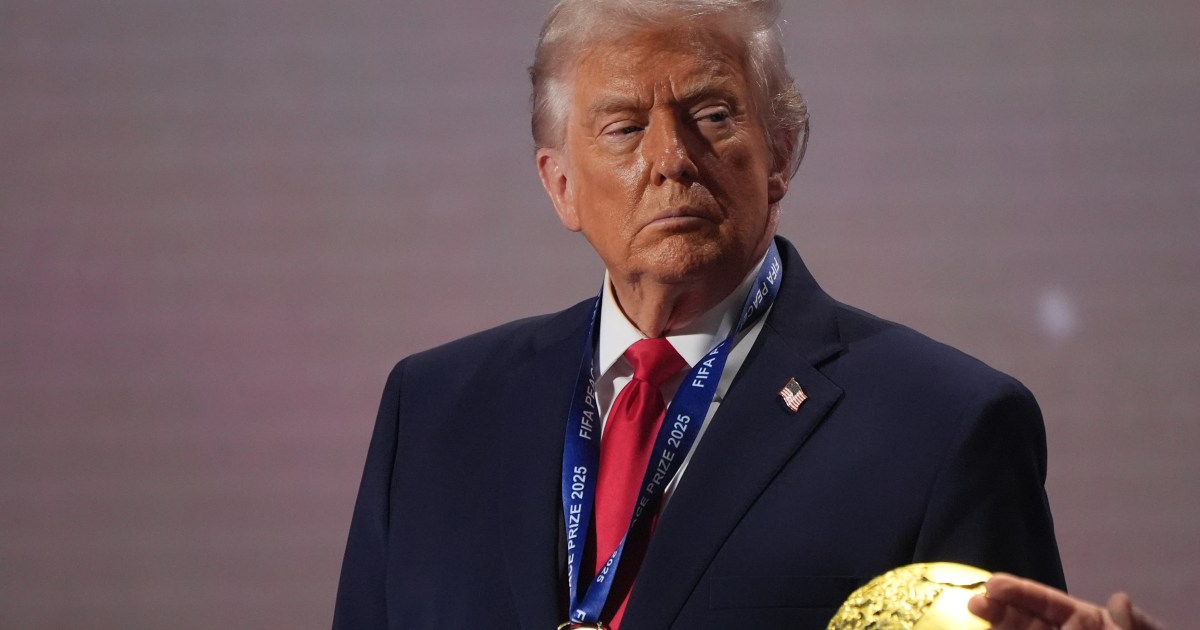
Amnesty’s report also criticised President Trump, who was awarded the newly created FIFA Peace Prize in December 2025, when FIFA President Gianni Infantino heaped praise on Trump.

Infantino, a close ally of Trump, had made it clear that he thought the US president should have won the Nobel Peace Prize for his efforts to broker a ceasefire in Israel’s genocidal war on Gaza.

“This is your prize, this is your peace prize,” Infantino said at the glitzy, celebrity-studded ceremony.

But Amnesty said the Trump administration has “actively sought to dismantle and defund existing systems of international cooperation, committed an act of aggression in Venezuela, launched air strikes that constitute extrajudicial executions in Latin America and initiated, jointly with Israel, large-scale attacks against Iran – killing civilians as well as putting the country’s participation in the tournament in doubt”.

Amnesty said none of the published US host city plans address how fans or local communities will be protected from ICE operations.

The global football governing body, which has been heavily criticised over its decision to present the award to Trump, stands to earn $11bn from the tournament cycle.

“While FIFA generates record revenues from the 2026 World Cup, fans, communities, players, journalists and workers cannot be made to pay the price,” said Steve Cockburn, Amnesty’s head of economic and social justice.

“It is these people – not governments, sponsors or FIFA – to whom football belongs, and their rights must be at the centre of the tournament.”

The World Cup kicks off on June 11 at the Mexico City Stadium in Mexico, with the final scheduled for July 19 at the MetLife Stadium in New Jersey in the US.