Press
What is Nasa's Artemis II Moon mission and how far will astronauts go?
Images
1 / 10

2 / 10
3 / 10
4 / 10
5 / 10

6 / 10

7 / 10
8 / 10

9 / 10
10 / 10
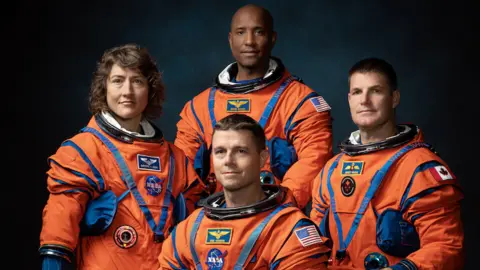
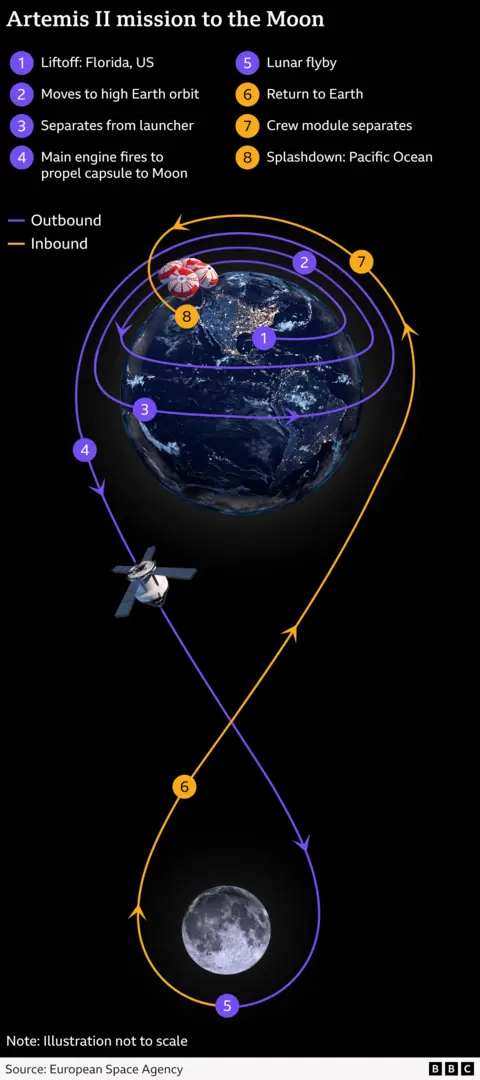
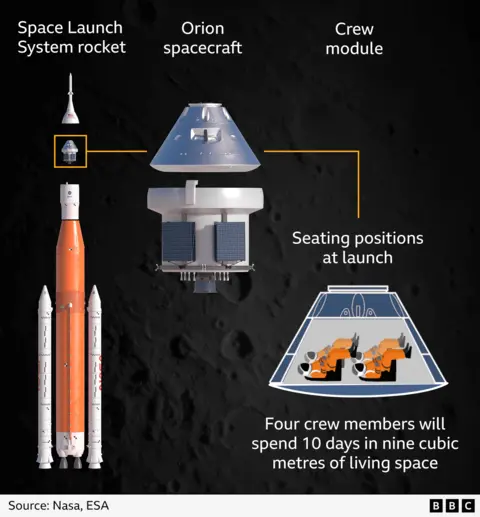
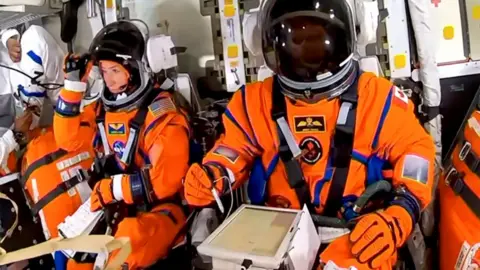
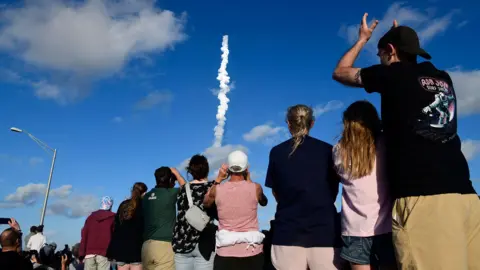
Nasa launched its first crewed mission around the Moon for more than 50 years on 1 April. The Artemis II mission will last about 10 days and take its astronauts further into space than anyone has been before. The four-person crew will not land on the Moon but will circle it, aiming to set the stage for an eventual human landing for the first time since the 1960s and 70s. Technical issues made for a nervy couple of hours before launch. There were problems with both the flight termination system, designed to destroy the rocket if it goes off course, and a battery for the Launch Abort System, which would pull the crew capsule away from danger in case of an issue. Nasa was able to resolve the problems. After launch, there was a short-lived comms issue, which meant ground control could not hear the astronauts. And there was a problem with the toilet, which has since been fixed. Technical issues have ruled out previous launch dates. In February, a pre‑flight test - known as a wet dress rehearsal - was cut short when hydrogen rocket fuel leaked from a connection linking the launch tower to the rocket. A March launch was also ruled out after a helium leak was discovered. When setting a date for takeoff, mission planners had to consider weather conditions and wait until the Moon was in the right part of its orbit. The mission crew launched on 1 April at 18:35 CDT (23:35 BST). Astronauts shared their pre-launch messages from inside the Orion crew capsule during the 10-minute countdown to lift off. "We are going for all humanity," said mission specialist Jeremy Hansen. Cheers erupted among jubilant crowds gathered outside the Kennedy Space Center, as Nasa technicians monitored the ascent. Observers also watched as various milestones were achieved, like seeing the twin rocket boosters separate from the rocket after helping it reach a speed of more than 10,000mph (16,100km/h) Once Artemis II entered the upper atmosphere, spacecraft commander Reid Wiseman declared it was a "great view". The crew officially entered orbit when they crossed the Kármán line – the boundary between Earth's atmosphere and space. Artemis II's four astronauts – Reid Weisman, Victor Glover, Christina Koch and Jeremy Hansen – make up the first crewed flight of Nasa's gigantic Space Launch System (SLS) rocket and the Orion space capsule. Hansen, who is from the Canadian Space Agency, will also make history as the first Canadian to venture to the Moon. During the mission, the astronauts will test how Orion handles. This will involve manually flying the capsule in Earth orbit to practise steering and lining up the spacecraft for future Moon landings. They will then head out to a point thousands of kilometres beyond the Moon to check Orion's life‑support, propulsion, power and navigation systems. The crew will also act as medical test subjects, sending back data and imagery from deep space. They will work in a small cabin in weightlessness. Radiation levels will be higher than on the ISS, which is in low‑Earth orbit, but still safe. On return to Earth, the astronauts will experience a bumpy return through the atmosphere and a splashdown off the west coast of the US, in the Pacific. No. This mission is to lay the ground for a lunar landing by astronauts in the Artemis IV mission, planned for 2028. Ahead of that, Nasa plans another crewed test mission, Artemis III, in 2027, to rehearse Orion's rendezvous and docking with one or more lunar landers and to try out the new spacesuits if they are ready in time. Nasa has picked two rival commercial landers for Artemis: SpaceX's Starship and a craft designed by Jeff Bezos's company Blue Origin, and will decide closer to the time which vehicles fly which missions. When Artemis IV finally flies, the astronauts will be heading to the Moon's south pole. After this, the aim is to have another landing later in 2028 with the Artemis V mission, to build up the capability for a sustained human presence on the Moon. Nasa has paused work on its planned Gateway station in lunar orbit. Further Artemis missions will focus on building up a Moon base and flying crews regularly to the surface, with more landings, new surface modules and robotic rovers to follow. More countries will join the effort, with astronauts from a widening group of nations living and working on and around the Moon for longer stays. The last crewed Moon mission was Apollo 17, which landed in December 1972 and returned to Earth later that month. In all, 24 astronauts have travelled to the Moon and 12 of them have walked on its surface, all during the Apollo programme. Of the 24 to have been to the Moon, five are still alive. America first went in the 1960s, primarily to beat the Soviet Union to assert its geopolitical and technological dominance. Once that goal was achieved, political enthusiasm and public interest ebbed, as did the money for future Moonshots. The Artemis programme grew out of a desire to return humans to the Moon, but this time for a longer-term presence built around new technology and commercial partnerships. Several other countries have ambitions to put people on the Moon in the 2030s. European astronauts are set to join later Artemis missions and Japan has also secured seats. China is building its own craft, targeting a first landing near the Moon's south pole by 2030. Russia continues to talk about flying cosmonauts to the surface and building a small base sometime between about 2030 and 2035. However, sanctions, funding pressures and technical setbacks mean its timetable is highly optimistic. India has also expressed ambitions to one day see its own astronauts walking on the Moon. Following the success of Chandrayaan 3's landing near the lunar south pole in August 2023, India's space agency set out a goal of sending astronauts to the Moon by about 2040. This would be part of a push to move its human spaceflight programme beyond low Earth orbit. Additional reporting by Kevin Church and Emily Selvadurai. The company’s public stock debut is set to be one of the most valuable in history, and could make Musk the world's first trillionaire. People on a commercial flight were treated to a rare view of the launch of Nasa's first crewed mission to the Moon in half a century. There was giddy euphoria at the Kennedy Space Center after the launch, writes the BBC's Pallab Ghosh. Science editor Rebecca Morelle watched from just three miles away as the most powerful rocket ever built blasted off from Florida. After delays and technical issues, the first crewed Moon mission in 50 years finally took off from Florida and is now in Earth's orbit.