Press
Israeli demolitions levelling towns in south Lebanon, satellite images show
Images
1 / 10

2 / 10
3 / 10
4 / 10
5 / 10
6 / 10

7 / 10
8 / 10
9 / 10
10 / 10
Towns and villages in southern Lebanon are being levelled by Israeli demolitions, satellite images and videos obtained by BBC Verify reveal.

BBC Verify analysis found more than 1,400 buildings had been destroyed since 2 March based on verified visual evidence.

This is just a snapshot of the overall damage caused by Israeli air strikes and demolitions, because of limited access on the ground and available satellite imagery. The true scale is likely to be much higher.

Israel's levelling of these structures comes after Defence Minister Israel Katz's order on 22 March to "accelerate the destruction of Lebanese homes" near the Israeli border based on the "model in Gaza" as part of its campaign against Hezbollah.

The systematic demolition of these towns and villages may amount to a war crime, international law experts told BBC Verify.

The Israel Defense Forces (IDF) said that it operates in accordance with the Law of Armed Conflict and does not allow the destruction of property unless there is an imperative military necessity.

It added, without providing evidence, that Hezbollah has embedded military infrastructure within civilian areas in the region.

On 2 March the Iranian-backed armed group Hezbollah launched rockets and drones into Israel in retaliation for the killing of Iran's supreme leader at the start of the war with Israel and the US.

The IDF responded with a wave of strikes across Lebanon, targeting what it said was Hezbollah infrastructure, and launched a ground invasion of southern Lebanon.

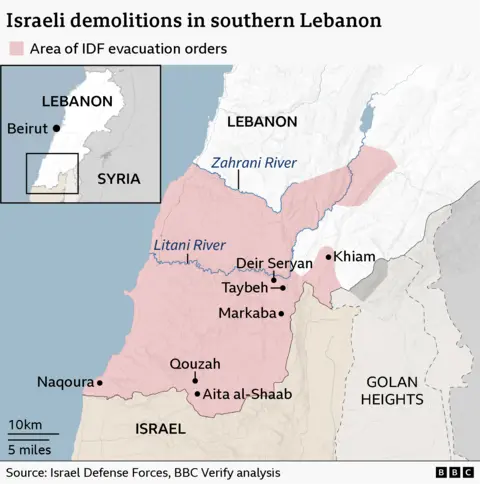
An IDF spokesperson first ordered Lebanese civilians living close to the border to leave on 2 March. Days later the evacuation order was expanded to those living south of the Litani river about 30km (20 miles) from the border, and it was then later widened further to those living south of the Zahrani river 40km from the border.

On 16 March, the IDF said its troops had begun a ground operation against Hezbollah - a Shia Muslim political and military group - in south Lebanon.

More than 1.2 million people are estimated to have been displaced across Lebanon, including 820,000 from the south, according to figures by the UN Office for the Co-ordination of Humanitarian Affairs (OCHA). It said the war in Lebanon has forced many to flee to areas further north or cross into Syria.

The Lebanese health ministry says more than 2,000 people have been killed since the war began. Israeli authorities said 13 soldiers and two civilians have been killed by Hezbollah over the past six weeks.

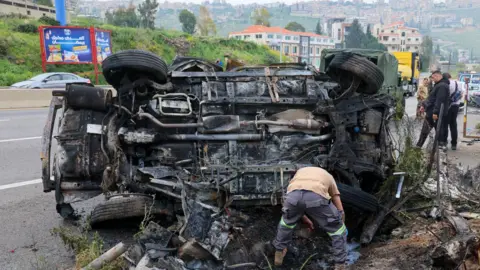
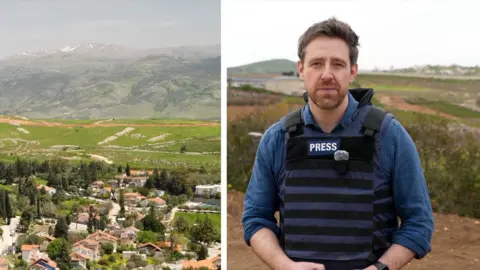
Lebanese hilltop border towns and villages are now hard to recognise. Once characterised by their winding streets lined with stone buildings overlooking sweeping valleys, verified videos now show how they have turned grey from dust and debris of explosions.

Katz's plan for an Israeli-controlled "security zone" extending from the border to the Litani river would take up about 10% of Lebanon's territory. Israeli Prime Minister Benjamin Netanyahu said it was to "thwart the threat of invasion".

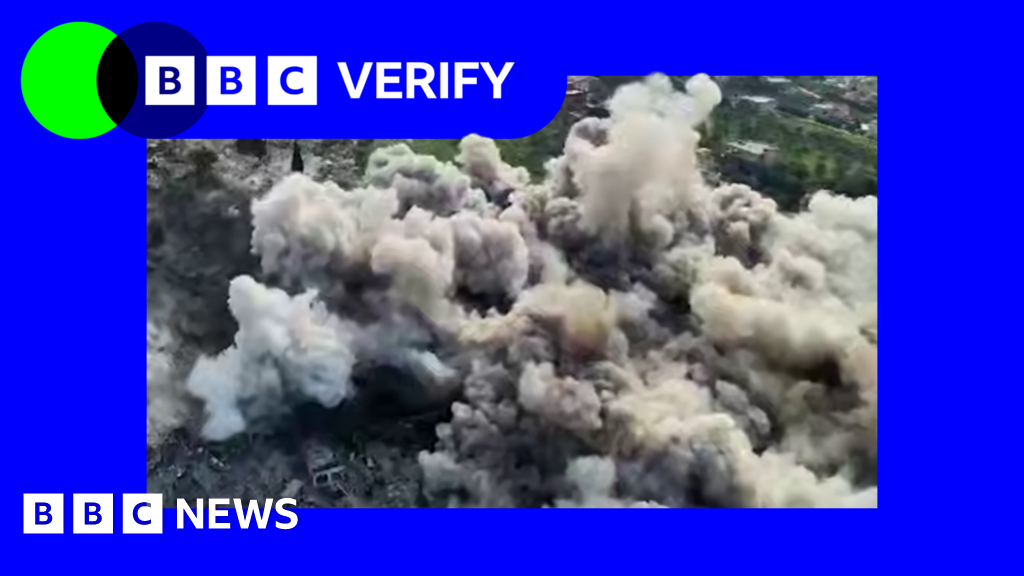
Using verified footage and analysis of available satellite imagery, BBC Verify found evidence of controlled Israeli demolitions in at least seven border towns and villages.

The town of Taybeh, about 4km (2.4 miles) from the border, has been subject to particularly intense demolitions. Eleven verified videos show whole sections of the town blown up simultaneously.

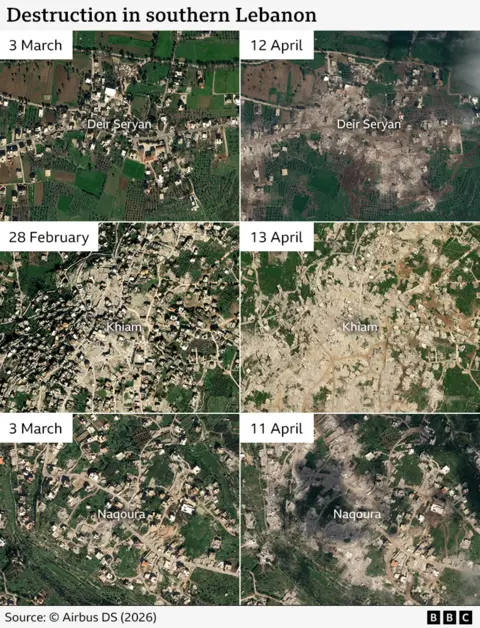
A comparison of satellite images taken on 28 February and 11 April shows more than 400 buildings, including a mosque, have been levelled there.

Meanwhile, in the town of Khiam and the villages of Qouzah, Deir Seryan, Markaba and Aita al-Shaab, other verified videos show co-ordinated explosions engulfing several buildings.

We found more than 460 buildings had been demolished in Aita al-Shaab alone. Excavators and armoured vehicles can also be seen in satellite imagery of the village, according to Tony Reeves, founder of intelligence analysis firm MAIAR.

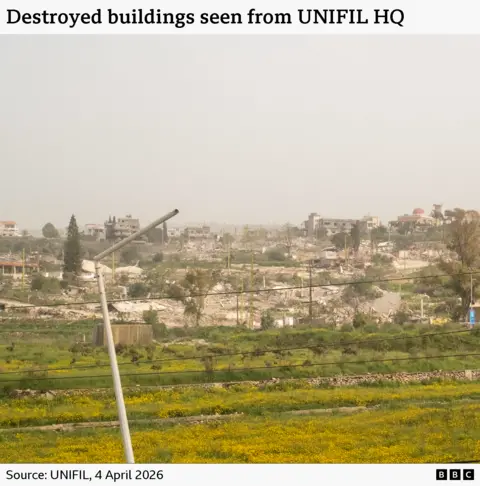
In the coastal town of Naqoura, explosions from Israeli demolitions have also damaged the headquarters of the UN's peacekeeping mission in southern Lebanon.

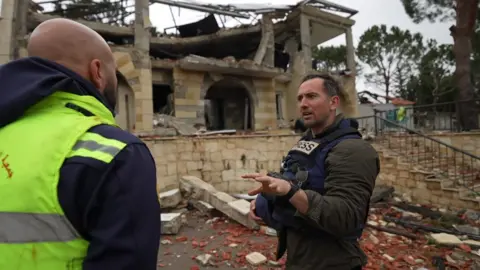
Kandice Ardiel, a spokeswoman for the United Nations Interim Force in Lebanon (Unifil) based at the HQ, said she had seen regular demolitions of several buildings at a time since early April.

Our satellite image analysis shows at least 100 buildings have been levelled in Naqoura in recent weeks.

Ardiel said most of the buildings opposite the Unifil HQ had now been destroyed, describing the "scale of the destruction" in Naqoura as "truly heartbreaking". "These are not just buildings, they represent a community," she added.

The deliberate demolition of structures is not a new Israeli military tactic. It has been deployed across swathes of Gaza during the war that was triggered by the Hamas-led attack on Israel on 7 October 2023.

"It's been clear since October 7 and since Israel and Hezbollah have gone to war that there has been a strategy for Israel to revise the balance of power in the region," said Renad Mansour, Deputy Director of Middle East and North Africa Programme at Chatham House, a UK-based think tank.

Multiple legal experts told BBC Verify the destruction of property is strictly prohibited by international humanitarian law, unless it is demanded by military necessity.

The bar for necessity is higher than military convenience or advantage, according to Prof Janina Dill, a global security and international law expert at Oxford University: "It certainly does not cover levelling entire villages as a predicate to long-term national security."

It also requires case-by-case analysis when determining which buildings have military significance, said Yuval Shany, a legal expert from the Israel Democracy Institute think tank.

The capacity of some civilian buildings to be used for military activity "does not justify a sweeping policy of creating buffer zones next to the border inside which all buildings are to be destroyed", he added.

Prof Ben Saul, UN Special Rapporteur on counter-terrorism and human rights, said Israel's "extensive destruction of residential areas, particularly in Southern Lebanon but also parts of Beirut" appeared to violate international humanitarian law.

Shia Muslim communities make up the vast majority of the southern Lebanese population, but other groups including Christians live there too.

"In places the pattern of attacks appears aimed to 'cleanse' predominantly [Shia] villages and populations from the south, collectively punishing civilian populations within which Hezbollah fighters may be mingled," Saul said.

The IDF said in response that "any suggestion that the IDF is acting to "cleanse" civilian populations, punish communities, or target civilians on the basis of religion or sect is categorically false."

"Such warnings are not intended to permanently displace civilians or prevent their lawful return," it added.

Dr Lawrence Hill-Cawthorne, co-director of the Centre for International Law at the University of Bristol, reiterated that the "fundamental rule of law" is that civilian objects must not be targeted.

"It is not a permissible defence to claim that the total destruction of towns and villages in southern Lebanon is necessary for creating a buffer zone to hold back Hezbollah," he said. "Even if Israel's war in Lebanon can be considered self-defence against attacks from Hezbollah, its conduct seems to go far beyond a limited war of self-defence against specific attacks."

Additional reporting by Paul Brown and Adam Durbin.

Israel strikes hit southern Lebanon and Hezbollah fires rockets at Israel, a day after rare direct negotiations.

A US statement said the two sides had agreed to launch direct negotiations, at a time and place to be determined.

BBC foreign correspondent Nick Beake visits Metula, an Israeli town surrounded on three sides by Lebanon.

The Lebanese government go into peace talks with limited influence over the group.

BBC Middle East correspondent Hugo Bachega joins paramedics on duty in Nabatieh - a city that was once vibrant, but is now abandoned.