huffpost Press
Trump To Brag About His Tax Cuts, Which Are Way Smaller Than His Tariff Tax Increases
Images
1 / 4

2 / 4

3 / 4

4 / 4
WASHINGTON – President Donald Trump is hitting the road Thursday to brag about his various temporary cuts for taxes on tip income, overtime and the elderly, even though the new law gives the vast majority of Americans far less than his tax increases on imported goods have cost them.

Republicans have long hoped bigger tax returns for Americans could be the start of a political comeback for Trump and his party, who are in danger of losing both chambers of Congress in this year’s midterm elections. Trump’s trip to Las Vegas is intended to kickstart their sales job, although voters don’t seem inclined to buy, with discontent with the economy at record highs.

A key reason why: Trump’s tariffs, the majority of which were ruled illegal earlier this year, on average cost American households $1,000 more in higher prices, amounting to the largest tax increase in decades. That pain has now been further exacerbated by spiking gasoline prices thanks to Trump’s war against Iran.

In contrast, the tax changes in his “One Big Beautiful Bill” save the vast majority of households several hundred dollars, while a few favored groups are receiving a break worth thousands of dollars.

What’s more, even though Trump’s White House and congressional Republicans have attempted to rebrand the package as the “Working Families Tax Cut,” more than 73% of those benefits are flowing to households earning between $100,000 and $500,000 a year, according to an analysis by the Tax Policy Center.

“The bulk of the tax benefit goes to people pretty high up in the income distribution,” said Joseph Rosenberg, a senior fellow at the think tank.

The very design of the cuts ensured that some Americans benefit while most do not.

According to Treasury Department figures, 6 million employees who rely on tips are benefiting by as much as a few thousand dollars. So are 25 million who claimed the overtime deduction. Another 30 million elderly Americans are benefiting between $600 and $1,440, depending on their tax bracket. These are the groups Trump plans to focus on during a roundtable in Las Vegas Thursday afternoon.

The remaining 140 million or so households that did not qualify for those categories are largely limited to getting the $150 to $525 from a higher standard deduction and $200 more per minor child.

Despite this, Trump and his Republican allies continue claiming that Americans across the board are saving “thousands” of dollars thanks to his law.

“I don’t know how they’re getting those numbers,” said David Cooper, an analyst at the Economic Policy Institute.

At a White House news briefing on Wednesday, Treasury Secretary Scott Bessent sang the praises of Trump’s tax cuts as a boon for taxpayers and the economy.

“This is a home run!” Bessent said after rattling off statistics on the number of people taking the various deductions. “This is hardworking Americans keeping more of their money.”

Trump and his White House, meanwhile, have, as they often do on issues where the facts do not support their claims, simply lied even more aggressively, usually starting with the false claim that Trump’s cuts are the largest in American history. In fact, those were pushed through by President Ronald Reagan in 1981, and several other cuts since World War II have also been larger than those passed under Trump in 2017 and then extended and added to last year.

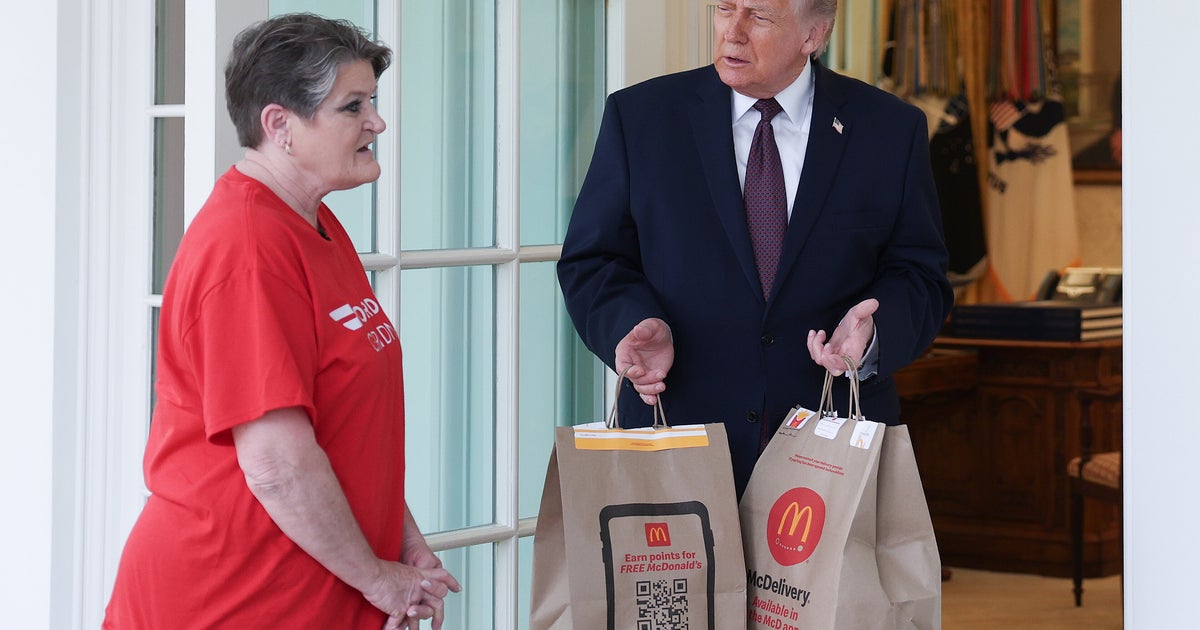
On Monday, Trump staged a McDonald’s delivery at the White House and then claimed that the DoorDash driver had saved big because of the tip income deduction.

“You picked up an extra $11,000 that you didn’t think you’d get because the tax bill was so big, the refund was the biggest you’ve ever had,” he said.

His claim is mathematically impossible, given that the deduction is capped at $25,000 in tips and the top marginal tax rate — paid by those with household incomes greater than $751,600 — is only 37%.

In reality, the driver is almost certainly paying at most the 12% rate, which would yield tax savings of $3,000 on $25,000 in tip income.

HuffPost inquired about Trump’s false claim multiple times, but White House aides, including the one responsible for economic issues, did not respond. Instead, the White House posted Trump’s $11,000 lie on social media.

While the word “no” features in all of Trump’s tax-cut marketing — “no tax on tips,” “no tax on overtime,” and “no tax on Social Security” — it is false in every instance.

On tips, there is the $25,000 maximum deduction per household on tip income. For overtime, there is a $12,500 per-person deduction cap, and for those 65 and older, a $6,000 per-person deduction that has nothing to do with Social Security.

In fact, because Social Security is already taxed at a much lower rate than ordinary income under a complicated formula, the “no tax on Social Security” provision is actually most beneficial for older Americans who get little or no Social Security payments and the least helpful to those who get most of their income from Social Security rather than wages or retirement savings.

The “no tax on overtime” piece has a similarly arcane structure and technically applies only to the “premium” portion of pay. For a worker who normally makes $20 an hour but receives, for example, 10 hours of overtime at time and a half in a given week, the deduction can legally be taken only for the “half” part of the overtime amount. So rather than being able to deduct $300 of total overtime, the worker is only supposed to deduct $100 from that pay period — a nuance that likely has been lost on a number of tax filers who may have claimed far more than permitted under IRS rules.

The good news for inadvertent tax cheats is that the IRS has been deeply gutted in its staffing under Trump.

“Frankly, given the cuts to the IRS, I don’t know how closely our tax enforcement agencies are going to be looking at that,” Cooper said.

He added that giving large tax deductions only to certain groups, but not to everyone else, is likely to bring unintended consequences and even engender resentment. Employers may be tempted to lower base pay and increase required overtime, which could actually save them money while lowering tax revenues to the U.S. Treasury. And customers at restaurants, bars and other businesses may alter their own behavior if they know their server is not paying taxes on that income.

“They may be less inclined, some of them, to tip,” Cooper said.

Overall, the main thrust of last year’s legislation was to make permanent the individual and business tax rates that were passed in 2017 but were set to expire and which disproportionately benefit the rich. The price tag for those was about $4 trillion over a decade.

The targeted cuts Trump and his allies prefer to talk about cost about $130 billion a year and are set to disappear at the end of Trump’s term.

Ironically, the biggest winners of Trump’s new tax law are likely owners of expensive homes with large mortgages in high-tax states — most of which are run by Democrats. The tripling of the cap on the deduction for state and local taxes from $10,000 to $40,000 is worth several thousand dollars in tax savings.

By entering your email and clicking Sign Up, you're agreeing to let us send you customized marketing messages about us and our advertising partners. You are also agreeing to our Terms of Service and Privacy Policy.