Press
How climate change threatens the economic backbone of the Pacific
Images
1 / 12

2 / 12
3 / 12
4 / 12
5 / 12
6 / 12
7 / 12

8 / 12
9 / 12

10 / 12

11 / 12

12 / 12
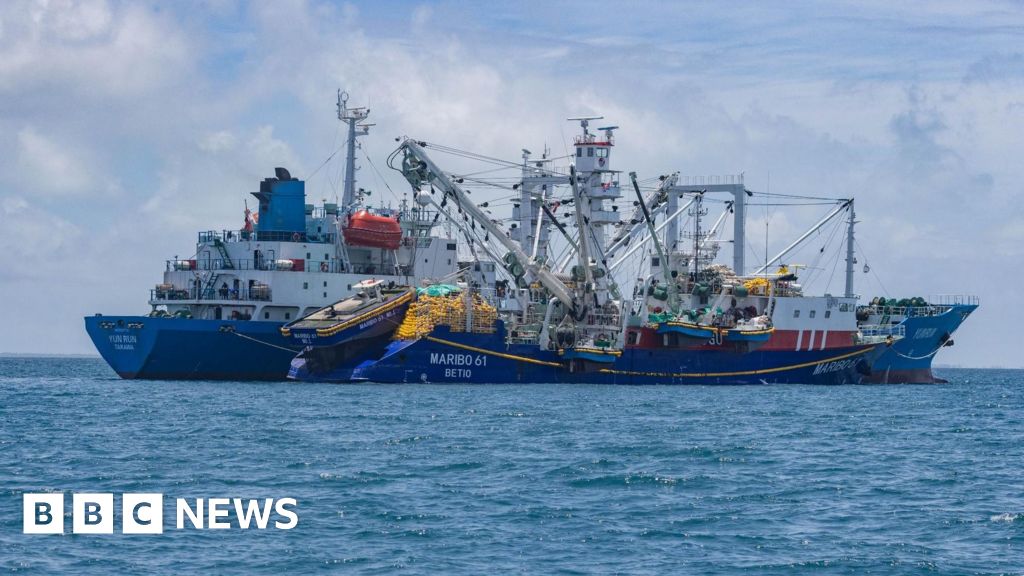
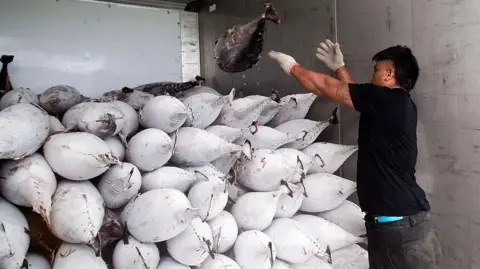
The vast Pacific Ocean and the islands dotted within it produce more than half of the world's tuna.

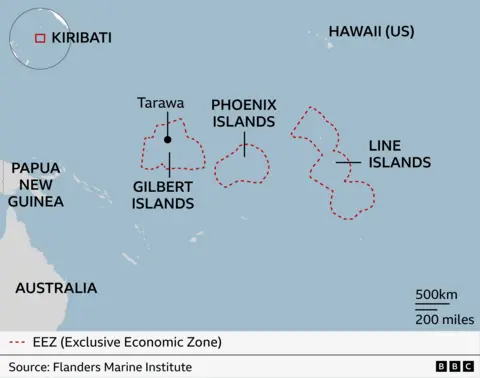
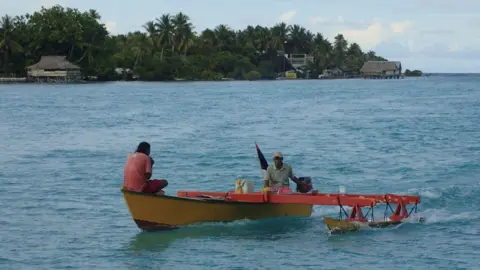
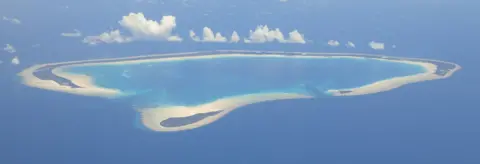
Among the islands are 33 scattered across the centre that encompass the country of Kiribati.

Here more than 70% of government revenues come from selling tuna fishing licenses to foreign fleets - the highest proportion of any nation.

Kiribati has a tiny land mass. When all the islands are combined it is about the size of New York City. However, it has a huge swathe of territorial waters, otherwise known as its Exclusive Economic Zone (EEZ).

Totalling more than 3.4 million sq km (1.3m sq miles), the EEZ is spread across three separate parts, surrounding the country's three groups of islands - Gilbert, Phoenix and Line.

Collectively, this area is bigger than India and offers access to an ocean abundant with marine life, including skipjack, yellowfin and bigeye tuna.

Yet, while the ocean is intimately linked to the culture, livelihoods and economy of Kiribati, it is also the country's biggest threat.

Warming water temperatures caused by climate change pose a substantial risk to local tuna populations, threatening Kiribati's economic backbone.

Scientists fear warmer waters could lead to tuna moving permanently out of its EEZ to cooler temperatures to the east, reducing the demand from overseas fleets for its fishing licenses, which would badly hit the country's economy.

The global tuna market is worth more than $44bn a year, according to one study.

To fish in Kiribati's waters, foreign fleets must first obtain a licence from the government. Then they have to pay the required fees, and follow strict rules on catch limits and reporting hauls.

The majority of these licences are sold to countries like Japan, China, the US and members of the European Union.

Kiribati generated $137m (£102m) from selling fishing licenses in 2024, government figures showed.  This income is a "critical financial lifeline", says Riibeta Abeta, permanent secretary for the country's Ministry of Fisheries.

Abeta adds that such licenses contributed to almost three-quarters of government income between 2018 and 2022.

This equates to roughly two-fifths of the entirety of Kiribati's GDP, according to the International Monetary Fund.

"Next time you go into the supermarket and you look at the cans of tuna, five-and-a half cans out of 10 stacked up are coming from the Western Central Pacific Ocean [including Kiribati]," says Simon Diffey. He is a fisheries specialist with more than 30 years of experience covering Kiribati.

Diffey says the two biggest players in the region are Kiribati and Papua New Guinea. But while Papua New Guinea has the landmass and physical resources to diversify its economy, Kiribati does not.

"The highest point above sea level in Kiribati - unless you climb a coconut tree - is two metres. No water, no land, no resources other than fish."

Tuna react to small changes in water temperature to within a tenth of a degree of celsius, adds Diffey. As the surface water temperature rises in the Pacific Ocean, the tuna will migrate to cooler areas.

Numerous studies say that in the Pacific this migration will be eastwards, away from many island nations, including Kiribati.

Abeta says that the risk of international fishing ships not needing to buy the country's fishing licences "introduces significant volatility to the country's revenue".

Kiribati is predicted to be among the worst affected by tuna stock migration, according to a communique issued last November by the regional development organisation, the Pacific Community.

Kiribati's Ministry of Fisheries says that preliminary modelling showed that it "could lose more than $10m in fishing access fees per year" by 2050 if global greenhouse gas emissions remained high.

But, under a best-case analysis of much lower emissions, the Ministry says "no decrease in tuna biomass" is predicted in the country's EEZ.

Yet local fisherman in Kiribati will see a catch decrease under both high and low emission scenarios, according to the Pacific Community.

The Line Islands are set to be the worst affected, with a loss of two-thirds estimated under the low-emission scenario alone. At the same time, Kiribati's population of around 130,000 is expected to grow, with rapid urbanisation, particularly in the capital Tarawa placing additional strain on already limited land and resources.

There's also concerns about the reduction in local fish stocks feeding into a growing food security challenge.

With local fish supplies already under pressure, households are becoming more reliant on imported foods. The UN's Food and Agriculture Organization warns that this shift is increasing costs and reducing nutritional quality, particularly in outer island communities where fish has traditionally been the main source of protein.

According to The Pacific Community, the average person in Kiribati consumes around 100kg of fish a year. This compares with about 9kg in the US, and 22kg in Japan.

In response, new support schemes are being rolled out.

The United Nations' Green Climate Fund (GCF) launched its $156.8m (£116m) "adapting tuna-dependent Pacific Island communities and economies to climate change" project last year, covering 14 countries and territories in the region.

This "is helping Pacific Island countries get ahead of climate change by strengthening their food security based on better information", says Hemant Mandal, GCF director for Asia and the Pacific.

It looks to build a stronger warning system so places like Kiribati can better predict the redistribution of tuna stocks and its economic impact. It also pledges to maintain food security and government revenue despite declining reef fisheries.

"These measures are expected to provide around four million nutritious fish meals each year for communities in Kiribati," says the Ministry of Fisheries.

The Kiribati government says it is expanding the country's own tuna processing and canning facilities rather than just selling licences to foreign ships.

Abeta says the administration is also developing ocean farming of species like milkfish, snapper and sea cucumbers to support exports and domestic food security.

It is also seeking to diversify revenues beyond the sea economy through the likes of tourism, renewable energy and the country's offshore sovereign wealth fund.

"Kiribati retains grounds for optimism and strategic opportunity," he says.

Yet despite this hope, Kiribati and its territorial waters face an existential threat from climate change.

Now one of the biggest sportswear firms, Anta's rise follows a playbook adopted by many Chinese giants.

President Trump said on Saturday that the US had cancelled plans to send a team to Pakistan for negotiations.

One of the UK's largest chicken producers and a water company accused of polluting three rivers including the River Wye

Rosanne Guille is currently creating portraits of islanders connected to marine life.

Here's your ultimate guide to what is being proposed and why people are protesting.