yahoo Press
Trump launches bid to open Strait of Hormuz, Iran strikes ships, UAE port
Images
1 / 10

2 / 10

3 / 10

4 / 10
5 / 10
6 / 10

7 / 10

8 / 10

9 / 10

10 / 10
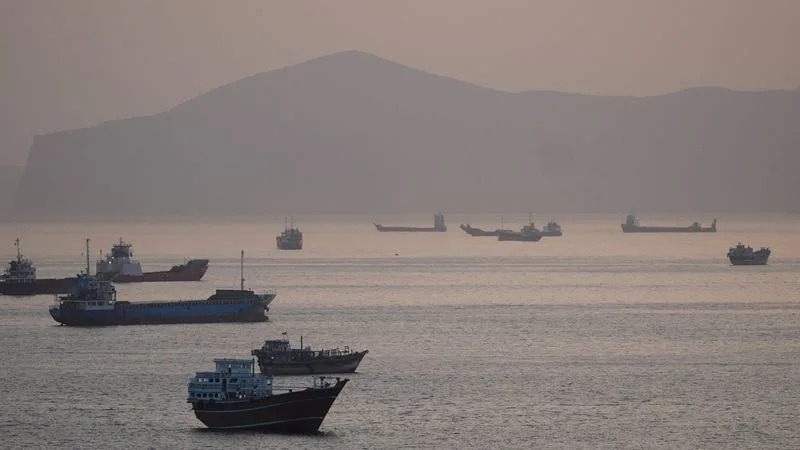
By Parisa Hafezi, Ahmed Tolba and Phil Stewart DUBAI/WASHINGTON, May 4 (Reuters) - U.S. President Donald Trump launched a new operation on Monday seeking to open the Strait of Hormuz to shipping, prompting Iran to lash out in an effort to keep control of the critical energy shipping route. A handful of commercial vessels were reported to have been hit and a UAE oil port was ablaze after an Iranian strike as Trump's attempt to use the U.S. Navy to free up shipping provoked the war's biggest escalation since a ceasefire was declared four weeks ago. The U.S. said it destroyed six small Iranian boats. Trump announced his new "Project Freedom" mission on social media overnight to enable stuck ships to travel through the strait, the first apparent attempt to make use of naval power to unblock the world's most important energy shipping route. But the gamble, at least initially, appeared to have backfired, bringing no surge of merchant ship traffic while provoking a show of force from Iran, which has threatened to respond to any escalation with new attacks on its neighbours. The U.S. military said two U.S. merchant ships made it through the strait, without saying when. Iran denied any such crossings had taken place. The commander of U.S. forces in the region said his fleet had destroyed six small Iranian boats, which Iran also denied. Admiral Brad Cooper said he "strongly advised" Iranian forces to keep clear of U.S. military assets carrying out the mission. Iranian authorities released a map of what they said was an expanded sea area now under their control, extending far beyond the strait to include long stretches of the United Arab Emirates' coastline. South Korea reported one of its merchant ships suffered an explosion and fire inside the strait. The British maritime security agency UKMTO reported two ships had been hit off the coast of the UAE, and the Emirati oil company ADNOC said one of its empty oil tankers was hit by Iranian drones. After reported drone and missile attacks inside the UAE throughout the day, including one that caused a fire at an important oil port, the UAE said Iranian attacks marked a serious escalation and it reserved the right to respond. Its government also said that it was implementing distance learning for school students for safety reasons. STRAIT STILL BLOCKED Trump has struggled to find a solution to the disruption of international energy supplies caused by Iran's blockade of the strait, which carried a fifth of global oil and liquefied natural gas before the war. In the more than two months since Trump launched an air war against Iran alongside Israel on February 28, Tehran has largely blocked the strait to ships apart from its own. Since last month, the United States has imposed its own blockade of ships leaving and entering Iranian ports. Reuters could not independently verify the full situation in the strait on Monday as the warring sides issued contradictory statements. There was no immediate sign that large numbers of merchant ships were making new attempts to cross, and major shipping companies said they were likely to wait for an agreed end to hostilities before trying. REVOLUTIONARY GUARDS SAY NO TRANSITS TOOK PLACE In a post on X, U.S. Central Command said some of its Navy guided-missile destroyers were inside the Gulf supporting the operation, and two U.S.-flagged merchant vessels had crossed the strait "and are safely headed on their journey". It did not identify the warships or merchant vessels or say when any of the reported crossings had taken place. Iran's Revolutionary Guards said no commercial vessels had crossed the strait in the past few hours, and U.S. claims to the contrary were false. Earlier, Iran said it had fired on a U.S. warship approaching the strait, forcing it to turn around. An initial Iranian report had said a U.S. warship was struck, but Washington denied this and Iranian officials later described the fire as warning shots. The UAE, meanwhile, reported a fire at an oil installation in its port of Fujairah after an Iranian drone attack. Fujarah lies beyond the strait, making it one of few export routes for Middle East oil that does not require passing through it. SHIPPING INDUSTRY AWAITS CLARITY Oil prices jumped more than 5% in volatile trade on reports of the increased Iranian attacks. [O/R] In his social media post, Trump gave few details of what action the U.S. Navy would take to get ships through the strait. In response, Iran's unified command told commercial ships and oil tankers that they needed to coordinate with its armed forces. "We have repeatedly said the security of the Strait of Hormuz is in our hands ... We warn that any foreign armed forces, especially the aggressive U.S. Army, will be attacked if they intend to approach and enter the Strait of Hormuz," it said. The United States and Israel suspended their bombing of Iran four weeks ago, and U.S. and Iranian officials held one round of face-to-face talks. But attempts to set up further meetings have failed. Iranian state media said on Sunday that Washington had conveyed its response to a 14-point Iranian proposal via Pakistan, and Tehran was reviewing it. Neither side gave details. The Iranian proposal would postpone discussion of Iran's nuclear programme until after an agreement to end the war and resolve the standoff over shipping. Trump said over the weekend he was still studying it but would probably reject it. (Reporting by Reuters bureaux; Writing by Gareth Jones, Peter Graff and Patricia ZengerleEditing by Clarence Fernandez, Kevin Liffey, Joe Bavier and Cynthia Osterman)