yahoo Press
The Supreme Court's redistricting ruling could shift the balance of power in Washington. How will it affect the midterms?
Images
1 / 13
2 / 13

3 / 13

4 / 13

5 / 13

6 / 13
7 / 13
8 / 13
9 / 13
10 / 13

11 / 13

12 / 13

13 / 13
On April 29, the Supreme Court issued a decision that could change American politics for the foreseeable future by making it harder for lawmakers to draw up districts that shield nonwhite voters from discrimination — and easier to draw up districts that help their own party win.

Even before the court’s latest bombshell, partisan redistricting — the fraught process by which states redraw their voting maps to benefit the party in power — was already rampant in the U.S., with Republicans in red states (like Texas) and Democrats in blue states (like California) launching unprecedented mid-decade efforts to maximize their electoral muscle within the last year.

But now it’s likely to be turbocharged.

Under the Voting Rights Act of 1965 and subsequent Supreme Court rulings, lawmakers have been allowed for decades to consider an area’s racial makeup when drawing district boundaries. The goal was to counteract systemic barriers to equal representation by creating districts where nonwhite voters would retain the power to elect their preferred candidates — while preventing politicians from dismantling those districts for raw partisan gain.

But in a new 6-3 ruling, the court’s conservative majority decided that this longstanding interpretation of the law no longer applies. Instead, the majority declared that Louisiana lawmakers violated the Constitution when they used race to draw up a new congressional map — known as SB8 — that created a second majority-Black district in their state.

“Because the Voting Rights Act did not require Louisiana to create an additional majority-minority district, no compelling interest justified the State’s use of race in creating SB8, and that map is an unconstitutional racial gerrymander,” the opinion stated.

The opinion explained that in order to undo congressional maps, plaintiffs will have to prove that they were “intentionally” designed to disenfranchise voters “because of their race” — i.e., discriminatory effect is insufficient. In the absence of such proof, the opinion continued, the law will not “intrude on states’ prerogative to draw districts based on nonracial factors, including to achieve partisan advantage.”

And attempting to achieve partisan advantage is exactly what’s about to happen. Already this week, Republican lawmakers in at least four Southern states — Louisiana, Alabama, South Carolina and Tennessee — have at least started the process of potentially eliminating majority-Black districts ahead of November’s midterms.

It’s the latest episode in America’s new era of tit-for-tat, no-holds-barred redistricting. Here’s everything you need to know to keep tabs on Republicans and Democrats as they rush to remake the political landscape — including how their efforts could affect the 2026 midterms and 2028 presidential election.

Every 10 years, the census determines how the 435 seats in the House of Representatives are divided between the states. Once states know how many seats they’ll have, they get to choose how to carve up their territory into their allotted number of districts.

In most cases, district maps are approved by the state legislature, which creates an obvious incentive for the party in power to manipulate the maps to their advantage. When they do that, it’s called gerrymandering. Gerrymandering is nothing new, but it’s become increasingly important over the last two decades as both parties have gotten more and more aggressive in how they slice up their district maps to maximize the number of seats their members win.

Here’s a simple example of how gerrymandering can allow a party with even only a slight majority of voters to dominate a state's congressional representation.  Click the arrows below to cycle through various redistricting scenarios.

The country was already in the midst of an unprecedented redistricting race even before the Supreme Court’s decision was handed down.

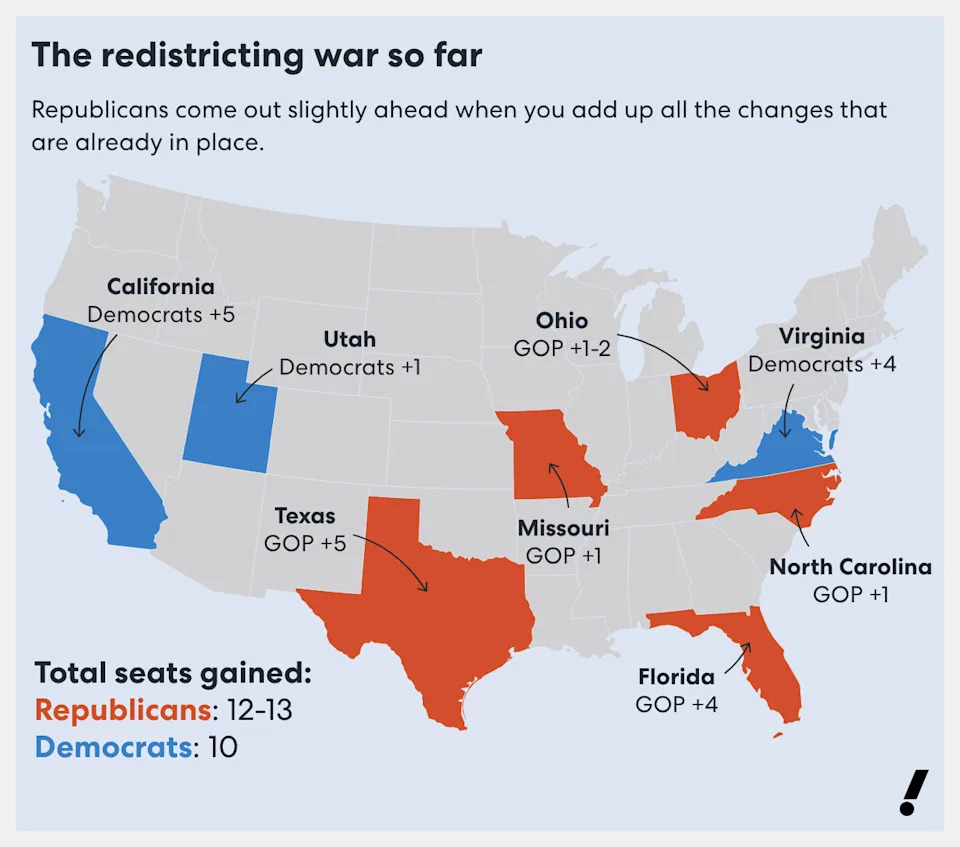
It started last summer in Texas, where the Republican-led Legislature pushed through new district lines that will likely give Republicans five additional seats in the House after the midterms.

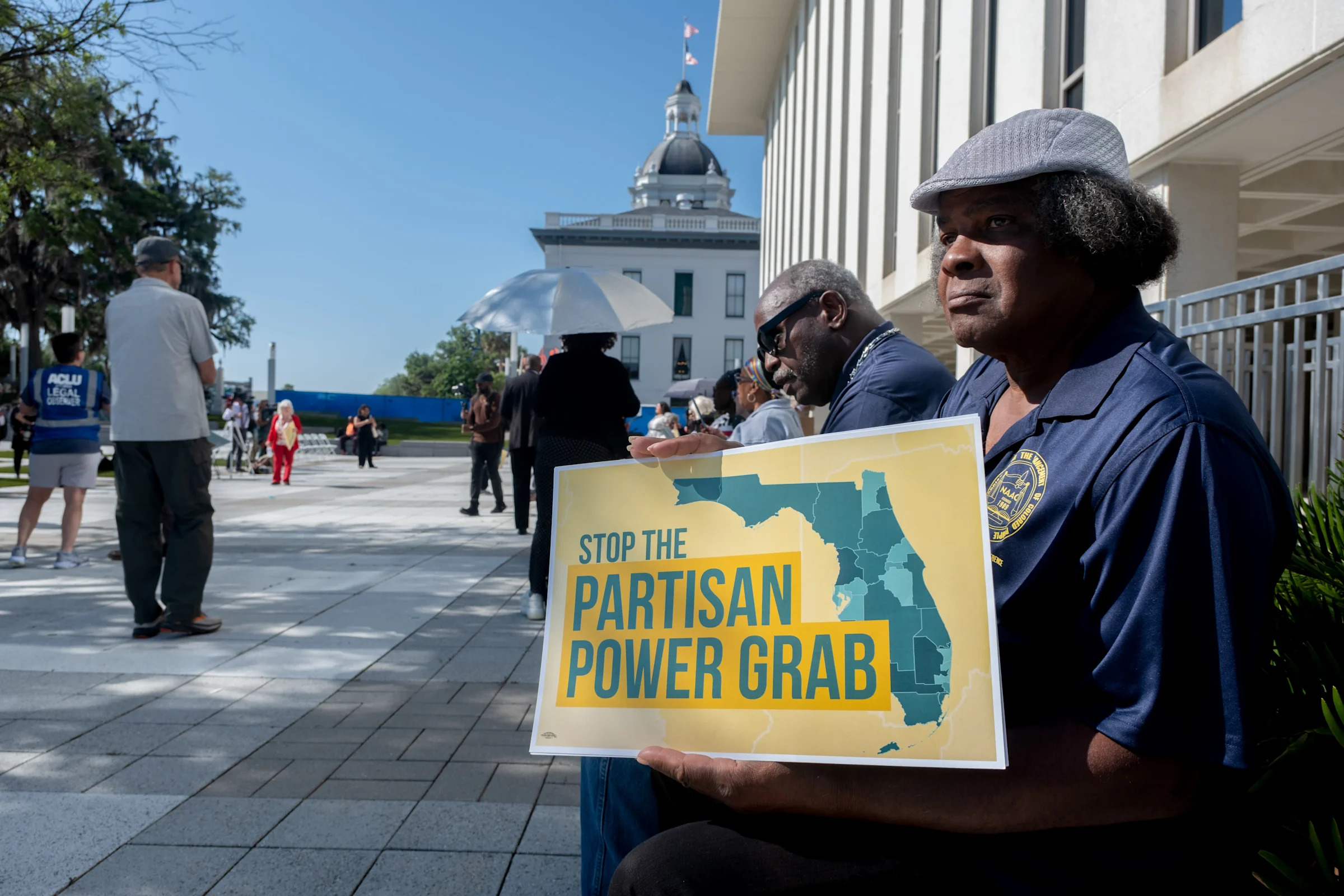
Three other red states quickly followed suit. Missouri and North Carolina both carved up their congressional maps to give the GOP one additional seat from their states. Ohio approved a new map that could tilt one or two seats to Republicans. Florida’s Republican Gov. Ron DeSantis, who had been discussing his redistricting plans for months, finally made it official on Monday by signing a new map into law that could give Republicans four additional seats.

Democrats in California moved to counteract the GOP’s gains by pushing a new map with five new safe Democratic seats. California’s laws required voters to approve the change, which they did by a large margin last November. In Utah, a judge ordered the GOP-run state Legislature to throw out its previous map, which made all four of its districts safe for Republicans. The decision is likely to give Democrats one additional seat. Last month, voters in Virginia approved a new map for their state that could give Democrats four more House seats.

Assuming that all the new state maps survive ongoing legal challenges, the redistricting fight so far hasn’t done much to change the potential balance of power in Congress. When all the changes are added up, Republicans might come out two or three seats ahead — a relatively small shift in a chamber with 435 members.

All of the redistricting so far has happened under the old interpretation of the law, which limited how much areas with high concentrations of minority voters could be broken up. The court’s new ruling weakens those protections and would make certain challenges harder to win, opening the door for states to gerrymander their congressional maps even more aggressively than before.

That said, the timing of the court’s decision limits how much it can impact this year’s midterms. Most states are well into their party primaries, which means it’s too late for them to redraw their district lines at this point.

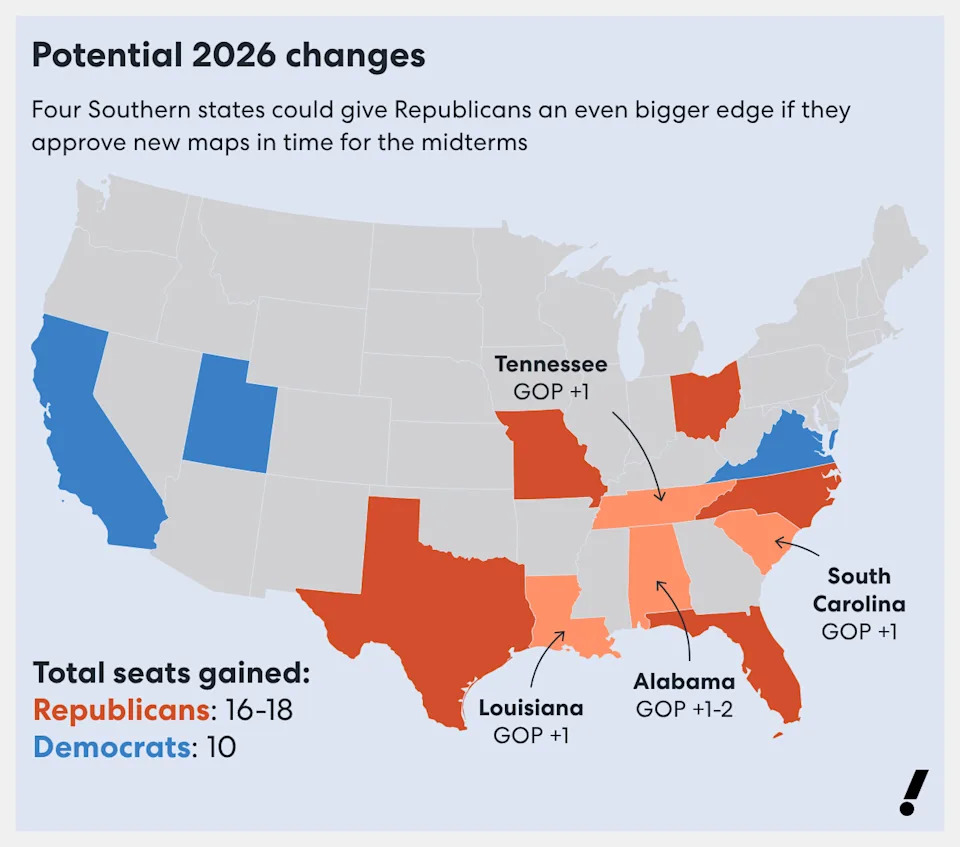
It will have at least some impact, however. Four Republican-led states are scrambling to get new maps in place in time for them to be used this election cycle.

The day after the decision was handed down, Louisiana Gov. Jeff Landry suspended House primaries in his state to allow the legislature time to approve a new congressional map. The new standards established by the Supreme Court could theoretically allow Louisiana Republicans to eliminate both of the state’s Black-majority districts, but reports suggest they are likely to pursue a map that only breaks up one of those districts.

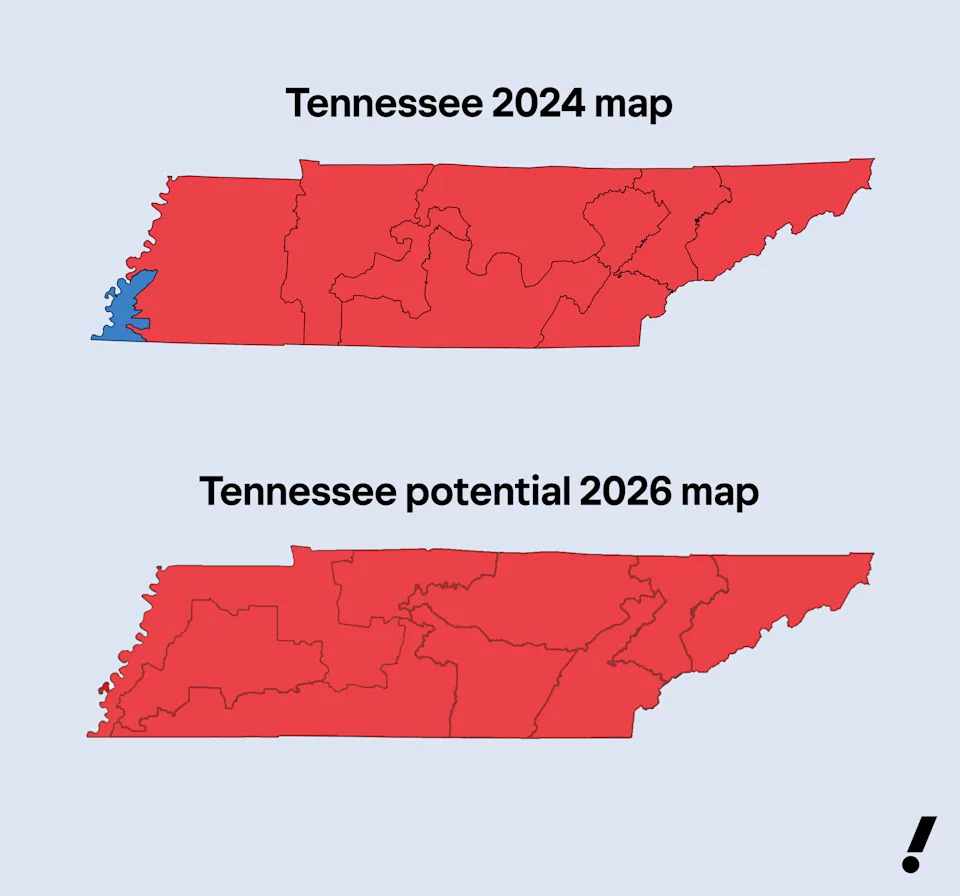
Republicans in Tennessee are also moving quickly to approve a new map that would likely break up the state’s only Democrat-held district, which would give the GOP full control of Tennessee's nine House seats.

Tennessee provides an example of how the court’s ruling makes more aggressive gerrymandering possible. The state’s lone blue district includes Memphis, a city that’s more than 60% Black, according to the U.S. census. Until recently, courts might have rejected a map that broke up Memphis’s minority voting bloc on the basis that it violated the Voting Rights Act. But now, with protections weakened, Republicans are proposing a map that would slice up Memphis, so its voters are spread out over several safe red districts.

The Alabama Legislature is also holding a special session on redistricting to potentially pass a new map that could eliminate one or both of the state’s two Democratic districts. But that effort is complicated by a court order barring Alabama from changing its maps until 2030. The state’s attorney general has asked the Supreme Court to lift that order in light of its decision.

The South Carolina state Legislature has also taken the first steps of a potential redistricting push, which would likely target the state’s only Democratic district.

If all four states are able to put new maps in place, it could give four or five additional seats to Republicans.

The immediate impact of the new Supreme Court decision might be modest. But if several Republican-led Southern states succeed in redrawing their maps this year as a result of the ruling, Democratic states are likely to try to retaliate in 2027 and beyond.

There have been rumblings that New York and Colorado might move first, following in the footsteps of California and Virginia to help cancel out Republican gains across the South. If those two states eventually amend their constitutions to allow partisan, legislative redistricting, they could, in theory, put an additional 11 congressional districts under Democratic control.

More extreme scenarios are possible as well: Last week, one Democratic congresswoman from Alabama reacted to the Supreme Court’s ruling by saying she would now happily slice and dice previously settled maps in order to “take 52 seats from California … and 17 seats from Illinois.”

That would mean unanimous Democratic control of each state’s congressional delegation. But it would also create even more convoluted districts that trample on longstanding norms — keeping communities of interest together, maintaining geographic compactness, protecting the voting power of minorities — and risk further eroding Americans’ confidence in their democracy, which gerrymandering has already been shown to do.

The question for 2027 and beyond is whether either party is willing to go that far — because if one does, the other is almost certain to follow. The result, as the New York Times recently put it, would be “a great carving [that] could effectively dilute the power of millions, especially minority voters, and make partisan primaries more important than general elections when it comes to choosing leaders.”

“I have long felt that we all have to play by the same set of rules,” Rep. Alexandria Ocasio-Cortez, a Democrat from New York, told reporters on Wednesday. But “if Republicans are going to redraw North Carolina, if they’re going to redraw Texas, if they’re going to redraw and gerrymander every one of their states, then unfortunately we have to provide balance to that until we get to the day when we can all finally agree to put this behind us.”

Nearly 6 million people in California voted for Republican House candidates in 2024. In the most extreme scenario, those 6 million voters would have their voices effectively erased from the electoral process. The same thing could happen to the 4 million Democratic voters in Texas, or the 3 million Republican voters in New York — and so on, in one state after another.