yahoo Press
Your official summer forecast is here. How hot will it get?
Images
1 / 20
2 / 20

3 / 20

4 / 20
5 / 20
6 / 20

7 / 20
8 / 20

9 / 20

10 / 20

11 / 20
12 / 20
13 / 20

14 / 20
15 / 20
16 / 20

17 / 20
18 / 20
19 / 20

20 / 20
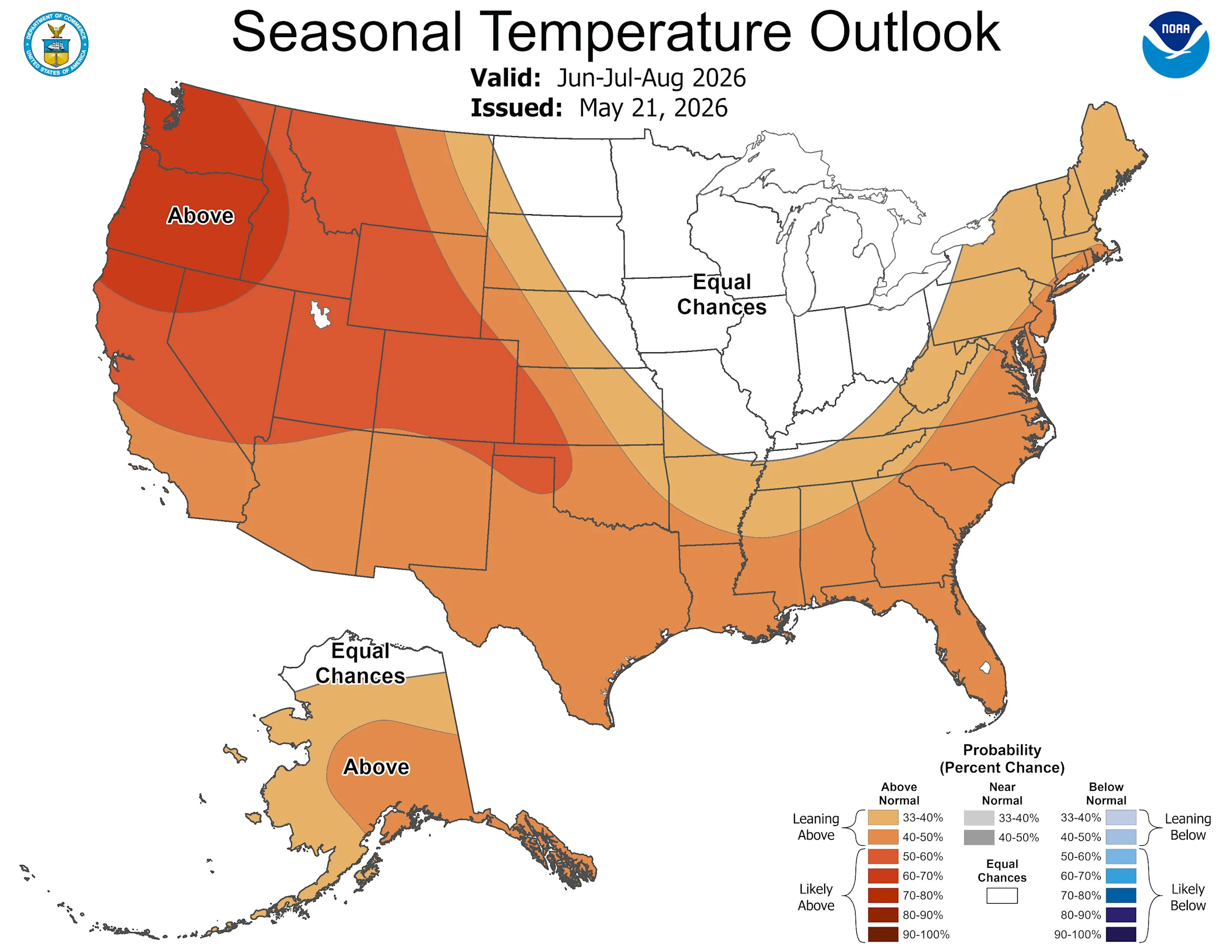
Orange and red are the colors of the season on the new summer forecast map.

Indeed, the forecast released May 21 by NOAA's Climate Prediction Center shows that widespread above-average temperatures are expected across much of the U.S., with the exception of the Great Lakes and Upper Midwest.

According to the forecast from NOAA, the June-July-August temperature outlook "favors above-normal temperatures throughout the West, much of the Great Plains, Lower Mississippi Valley, and East." Specifically, the highest forecast confidence for above-normal temperatures is across the Pacific Northwest, NOAA said.

Above-normal temperatures are also favored for a majority of Alaska.

Private forecaster AccuWeather's summer forecast is in agreement with NOAA's forecast: "A hot summer is predicted across most of the contiguous United States in 2026, with almost no areas expected to have temperatures below the historical average for the season," AccuWeather meteorologist said Brian Lada in a recent online forecast.

Keep in mind that NOAA’s official outlook doesn’t predict exact temperatures – it gives probabilities of above-normal or below-normal temperatures. But those probabilities are elevated across most of the U.S., meaning higher odds of frequent heat waves and above-average seasonal temperatures.

As for where the worst of the heat is expected, according to AccuWeather, that should focus across parts of California, Idaho, Montana, Nevada, Oregon, Utah, Washington and Wyoming, fueling a widespread fire threat.

“Northwest and Great Basin wildfires can be destructive this summer, along with impressive heat waves and increasing drought conditions,” AccuWeather meteorologist Brandon Buckingham said.

NOAA said that the Northwest states of Oregon and Washington are in the zone of highest predicted heat, which is typical for an El Niño summer.

The heat will not be limited to the West. AccuWeather is also predicting the number of 90-degree days to be near or above the historical average in Boston, Chicago, New York City and Philadelphia.

Will the Midwest be spared the worst of the heat? Maybe.

On the map, the Midwest is mostly white. What does this mean? "Areas depicted in white and labeled 'Equal-Chances' or 'EC' are regions where climate signals are weak, and so there are equal chances for either above-, near- or below-normal seasonal temperatures," NOAA explains.

Thus, the Midwest faces an uncertain summer, temperature-wise: "Equal chances of below, near, or above-normal temperatures are forecast for the Midwest, where a more variable temperature pattern is expected this summer," NOAA meteorologist Brad Pugh said in an online forecast.

Later in the summer and into the early fall, according to NOAA, "the outlook slightly favors below-normal temperatures for parts of the Midwest based on El Niño influences."

More: NOAA's hurricane forecast includes El Niño and a surprising twist

According to AccuWeather's Lada, El Niño is expected to develop early in the summer and will have a growing influence on the tropics and the broader weather pattern across the United States through the rest of 2026.

A developing El Niño should help boost hurricane activity in the eastern Pacific while keeping the Atlantic season below average overall, forecasters announced this week.

According to NOAA, given the increasing chance of a strong El Niño by next winter, above-normal temperature probabilities were increased to more than 50% across the northern tier of the contiguous U.S., from the Pacific Northwest east to the northern Great Plains, during the December 2026 to February 2027 period.

This article originally appeared on USA TODAY: Your official summer forecast is here. How hot will it get?