yahoo Press
Two More Oil Supertankers Exit Hormuz to Help Push Up Flows
Images
1 / 6
2 / 6

3 / 6

4 / 6
5 / 6
6 / 6
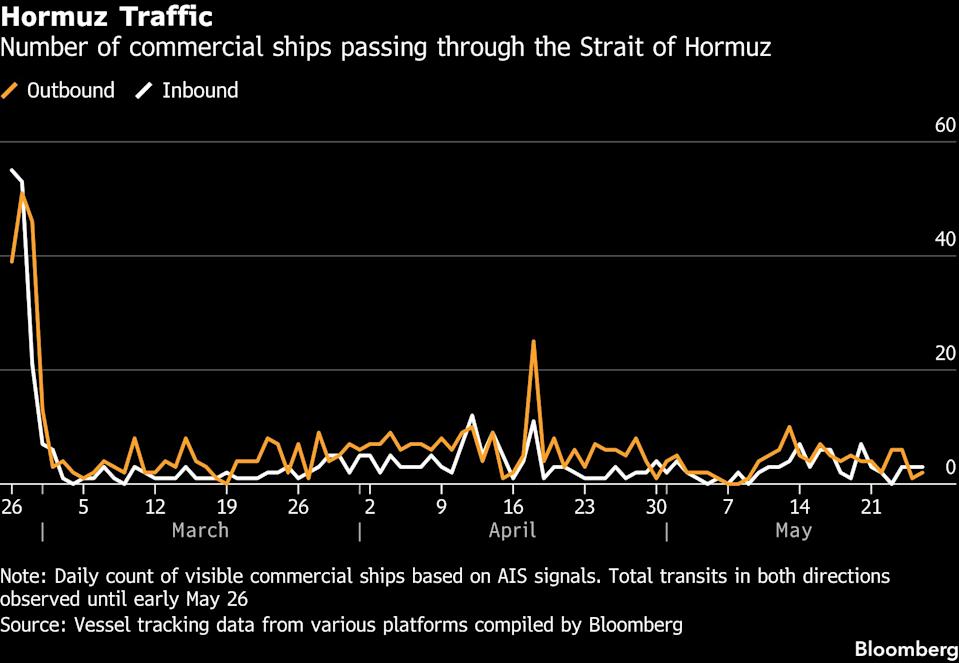
(Bloomberg) -- Commercial shipping through the Strait of Hormuz gained modest momentum over the past 24 hours as at least two non-Iranian supertankers exited the Persian Gulf, the latest mini-flurry in energy flows transiting the vital waterway.

Most Read from Bloomberg

Iran’s Khamenei Says No Going Back for Middle East Rocked by War

US Strikes Targets in Iran Even as Trump Hails Progress on Deal

Russia Tells US to Evacuate Its Diplomats and Citizens From Kyiv

Putin Signs Law on Use of Army to Aid Russians Detained Abroad

These AI Gurus Are Charging Wall Street Banks $25,000 a Day

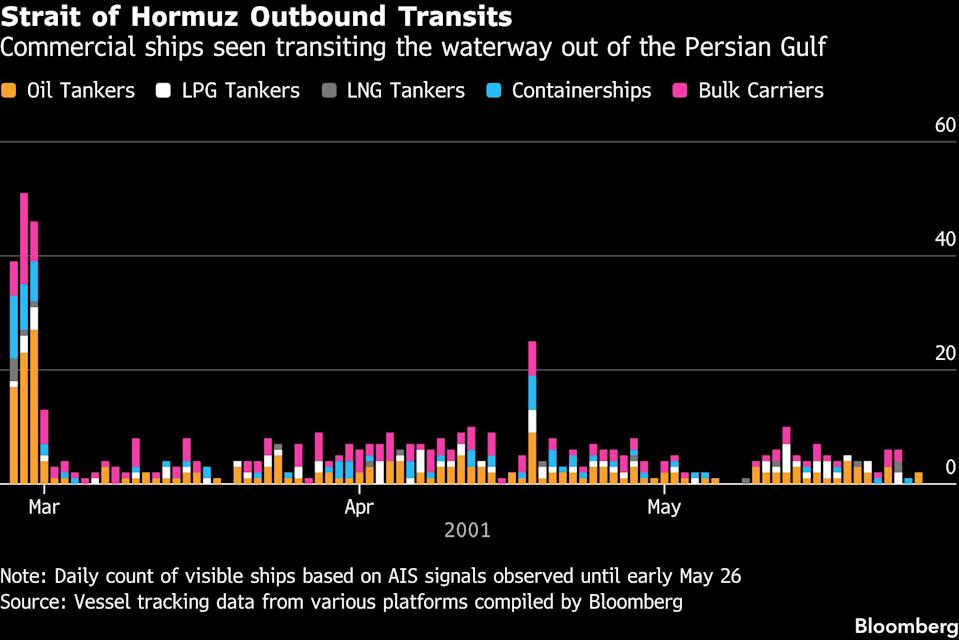
The Singapore-linked Eagle Veracruz and Greek-owned Nissos Keros were both seen having crossed Hormuz early on Tuesday, according to vessel-tracking data compiled by Bloomberg. In total, five ships were seen crossing Hormuz in either direction, the data show.

It’s the first time in a week that four million barrels of unsanctioned crude have been seen crossing the waterway, with ships leaving in bunches and then lower volumes passing in subsequent days. So while Tuesday’s number is high, it may be offset by a decline in the coming days. The two tankers were carrying crude from Saudi Arabia and the United Arab Emirates respectively.

US Central Command dismissed suggestions that US forces had resumed helping vessel crossings, labeling “recent media reporting” that the Navy had restarted escorting or assisting commercial traffic during transits through the strait as “false.”

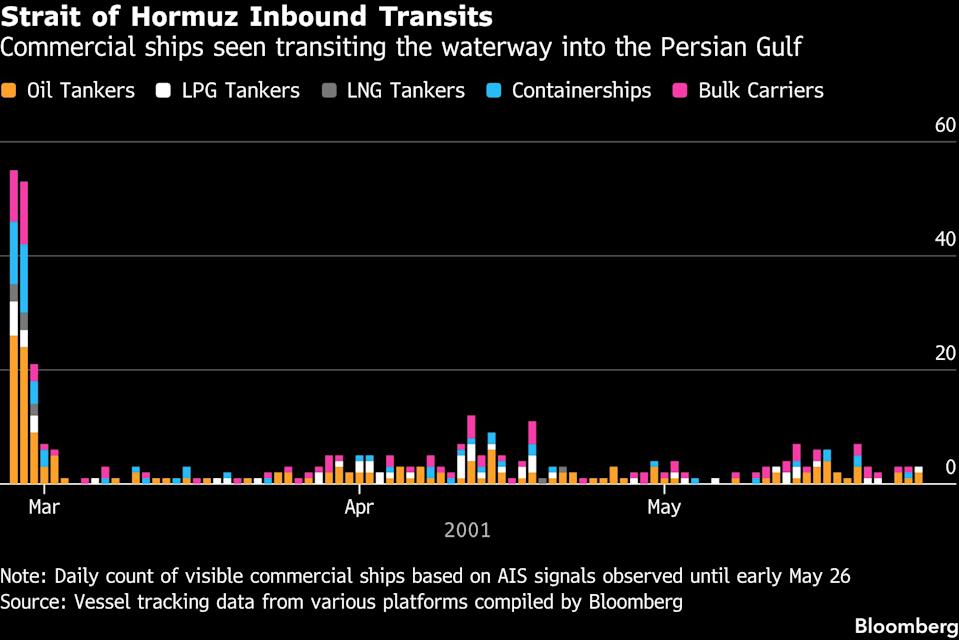
Inbound traffic also picked up Tuesday morning with three vessel transits recorded, according to the ship-tracking data. In previous days, a steady stream of flows emerged, with an average of six ships a day crossing over Saturday, Sunday and Monday.

The traffic follows a relatively active weekend. Alongside the supertanker Eagle Verona departing with Iraqi crude, Saturday’s energy outflows featured a Singapore-linked tanker carrying Qatari naphtha to Japan. An Iran-linked fuel carrier and three bulk carriers also set sail.

Sunday’s outbound traffic was led by the liquefied natural gas carriers Fuwairit and Al Rayyan, which departed alongside two Iran-linked liquefied petroleum gas carriers and two bulkers. Meanwhile, inbound traffic for the day included a Greek supertanker, an Iranian fuel tanker, and a bulk carrier.

By Monday, the pattern shifted slightly as a Singapore-linked container ship headed out, while an Iranian fuel tanker, a container ship, and a bulker made their way into the Gulf.

The shift in shipping flows coincided with fresh military exchanges between the US and Iran near the strait overnight. Washington said that US forces launched preemptive strikes into southern Iran to neutralize missile platforms and naval mine-deploying vessels, while Tehran said that its Revolutionary Guard fired at an American F-35 jet and several drones for violating Iranian airspace.

Widespread interference with signals on the industry’s Automatic Identification System continues to cloud the picture, making independent verification of ship traffic difficult. As a result, transit counts may later be revised upward when vessels reappear further from high-risk waters.

The US naval presence may also be distorting the observations. Iran-linked vessels entering or leaving the Gulf could be switching off AIS signals to avoid detection, making it harder to track flows in real time.

Even before the US barred movement to and from Iranian ports, it was common for Iran-linked vessels to “go dark” when approaching Hormuz. Signals were often not restored until well into the Strait of Malacca — around 13 days’ sailing from Iran’s Kharg Island.

NOTES:

Because vessels can move without transmitting their location until they’re well away from Hormuz, automated positioning signals were compiled over a large area covering the Gulf of Oman, the Arabian Sea and the Red Sea to detect those that may have departed or entered the Persian Gulf.

When potential transits are identified, signal histories are examined to determine whether the movement appears genuine or is the result of spoofing — where electronic interference can falsify the apparent position of a ship.

Some transits may not have been detected if vessels’ transponders haven’t been switched back on. Iran-linked oil tankers often steam from the Persian Gulf without broadcasting signals until they reach the Strait of Malacca about 10 days after passing Fujairah in the UAE. Other ships may be adopting similar tactics and won’t show up on tracking screens for many days.

This tracker will be published during heightened tensions involving Iran, and aims to capture traffic for all classes of commercial shipping.

Please note that the Hormuz Tracker now includes an NSUB sign-up option. The manual code is NI HORMUZTRAK.

(Updates fourth paragraph with US denying that it’s assisting transits.)

Most Read from Bloomberg Businessweek

How Barnes & Noble Became Private Equity’s Most Radical Retail Experiment

America Can’t Produce Enough Honey

ICE Raids Did Lasting Damage to American Businesses

Courts Are Swamped With AI-Powered Do-It-Yourself Lawsuits

Blame YouTube, Not Just Trump, for the End of Colbert’s Late Show

©2026 Bloomberg L.P.