Press
Britain's rudest chalk figure gets a glow-up to stop it fading in the rain
Images
1 / 12

2 / 12
3 / 12
4 / 12
5 / 12
6 / 12

7 / 12

8 / 12
9 / 12
10 / 12
11 / 12

12 / 12
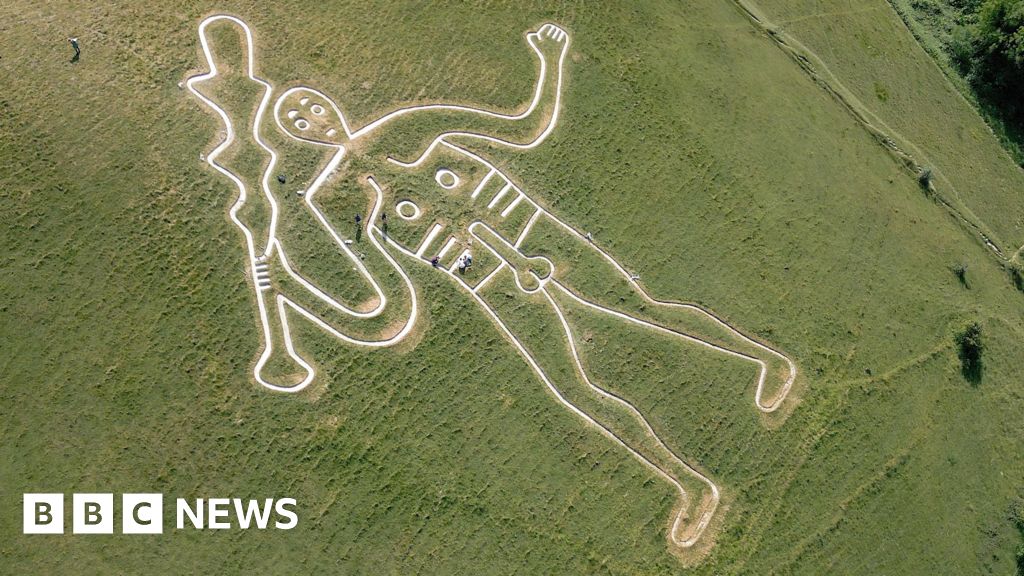
For centuries, the Cerne Abbas Giant has been hard to miss.

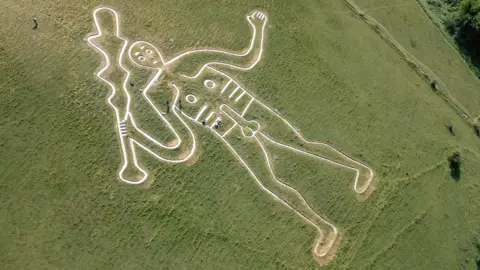
The 55-metre chalk figure, cut into a hillside near the village of Cerne Abbas in Dorset, shows a naked, club-wielding man whose outline has made him one of the UK's most instantly recognisable historic landmarks.

But the National Trust, which owns and manages the site, says changing weather patterns are making it harder to keep the Giant prominent on the hillside.

National Trust staff and volunteers will this week pack tonnes of new chalk onto the figure to restore the crisp whiteness of his outline.

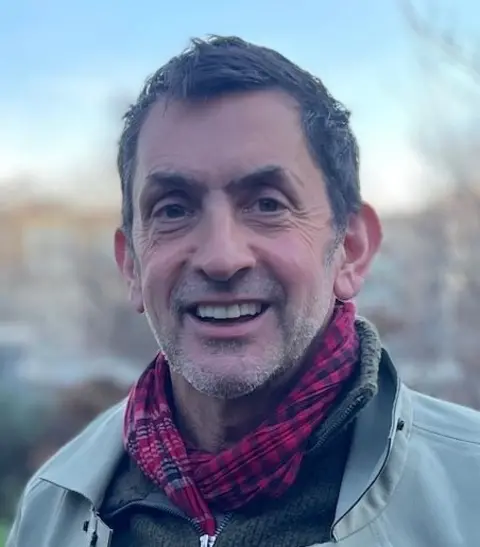
Luke Dawson, a National Trust ranger who helps look after the site, says heavier winter rains are washing chalk from the slope more quickly, while mild, damp conditions give algae more chance to grow.

He says this wetter weather has been having "a dulling effect" on the Giant's outline, leaving it greener and less distinct between maintenance work.

The Trust is cautious about attributing the changes directly to climate change at a single site.

"It's one of these things we cannot really prove," says Dawson. "It is more just observation of what we are seeing up there."

The charity has cared for the Giant since 1920. Its rangers and volunteers keep the outline defined by rechalking the figure every decade or so to protect it from weeds and erosion. And between chalking it uses sheep to keep the grass short.

But the Trust says that coupled with heavier winter rains, the frequent dry spells in summer, mean the grass grows back more slowly and can leave the chalk edges more exposed and vulnerable to erosion.

The world is now about 1.4C warmer on average than in the late 19th Century, largely because of human activities such as burning fossil fuels.

The Met Office says the UK's climate is already notably different from even just a few decades ago and it expects the trend towards warmer wetter winters and hotter drier summers to continue.

On Thursday, it published a new report which warns there is an almost nine in ten chance the world will see a new record temperature within the next five years.

National Trust says these changes mean the Giant may need more frequent attention than every decade to ensure he does not lose his defining features.

His latest makeover has come after just seven years.

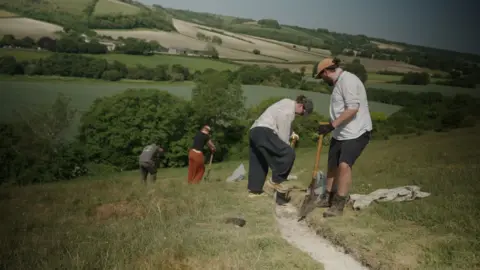
The rechalking could take up to 15 days to complete. Around 300 National Trust staff and volunteers will be involved, carrying about 17 tonnes of fresh chalk up the steep hillside, which in places has a gradient of roughly one in three.

The work is physically demanding, especially in the exceptional heat the UK has experienced in recent days. The old chalk is carefully dug out before fresh material is packed into the Giant's outline by hand - a process the Trust says has changed little for generations.

"It's how we have kept him visible for centuries," says National Trust ranger Luke Dawson.

Chole Baugh and her boyfriend, Joe Ford, are working on the left shin of the Giant. They won the opportunity to help with the project in a National Trust lottery.

"We did not know it was going to be one of the hottest days of the year," laughs Baugh.  "It has really made me think of all the people that have worked to do this over hundreds of years."

This work comes just months after public donations helped the National Trust raise £330,000 to acquire 138 hectares (341 acres) of additional land around the Giant. The newly protected area includes species-rich chalk grassland, important archaeological records and habitat for rare wildlife, including the endangered Duke of Burgundy butterfly.

The National Trust says the purchase will allow it to care not just for the figure itself, but for the wider landscape in which it sits - improving access, restoring habitats and supporting further research.

The Giant's naked, club-wielding form has fuelled centuries of speculation - "a real ding-dong" according to local historian Ian Denness. Some argued he was an ancient fertility figure, others a Roman Hercules, or even a later satire of Oliver Cromwell.

But scientific analysis of sediments published by the National Trust in 2021 suggested the figure was probably first cut in the late Saxon period, between around 700 and 1100AD - much later than the prehistoric or Roman origins once imagined.

However, this finding has not settled the question of his significance.

In 2024, research from the University of Oxford argued that although the Giant was not of Roman origin he was carved to represent Hercules, and speculated he may have been a meeting point for West Saxon armies fighting invaders.

The researchers suggested monks at nearby Cerne Abbey later co-opted him as Saint Eadwold, a local hermit-saint associated with the area.

Sign up for our Future Earth newsletter to keep up with the latest climate and environment stories with the BBC's Justin Rowlatt. Outside the UK? Sign up to our international newsletter here.

The combined effects of a heat dome and climate change have brought extreme warmth to western Europe.

Jane Cullen and Lorna Taylor want £10,000 to get the sculpture installed on the Solomon Islands.

The project will defend 570 properties on an unprotected stretch of waterfront in Poole town centre.

An industry report suggests that the net-zero economy is already established and employs more than 105,000 people.

Hugh Schofield reports from Paris as a heat dome settled over Western Europe bringing temperatures above the average for May.