Press
'A World Cup for them not us': Fans' anger at US travel bans and visa restrictions
Images
1 / 12

2 / 12

3 / 12
4 / 12

5 / 12
6 / 12
7 / 12

8 / 12

9 / 12

10 / 12

11 / 12
12 / 12
When Iraq's football team qualified for the World Cup at the end of March, Abdulla Adnan bought tickets for his country's matches against Norway and France, which will be played in the US cities of Boston and Philadelphia this month.

"To go to a match, a stadium, a crowd, cheering, and see my team - that is worth the world to me," he says. "It's a feeling that no other feeling can compare to." This is only the second time Iraq has qualified for the World Cup - the first was in 1986.

But getting a visa is proving difficult.

And Adnan is not alone. Fans from more than a quarter of the countries taking part in the World Cup are facing travel bans, tighter restrictions or high visa rejection rates, analysis of travel data by the BBC World Service shows.

However, Iraq is not on Trump's travel ban list, so in Adnan's case, the obstacle was an unexpected one.

After the start of the US-Israel war with Iran, the US suspended routine consular services in Iraq due to concerns about security in the region. This means there is nowhere in the country where Adnan and other Iraqi fans can get visas, as they have to attend an in-person interview.

So Adnan travelled to neighbouring Jordan to try to get a visa at the US embassy there. But when he arrived for his appointment, staff told him that because he wasn't a Jordanian citizen, that embassy could not give him a visa.

The tickets for the match and the trip to Jordan cost him about $1,800 (£1,300).

Adnan considered applying for visa in Turkey, but the as the process could take up to two weeks, he decided that he couldn't spend that much time away from home. He has given up on trying to get a visa.

Fans from several countries have told the BBC World Service that other obstacles are also causing widespread anger and upset.

One of the barriers is President Trump's list with bans and greater restrictions on visas for certain countries, including four competing at the World Cup - Haiti, Iran, Senegal and Ivory Coast. This means their citizens are barred from receiving the type of visitor visa that US authorities recommend for fans.

Strict immigration policies and a clampdown on undocumented migrants were a key part of Trump's re-election campaign in 2024. US authorities say their system needs to be rigorous due to the challenges they face in managing the huge flow of people that cross the country's borders.

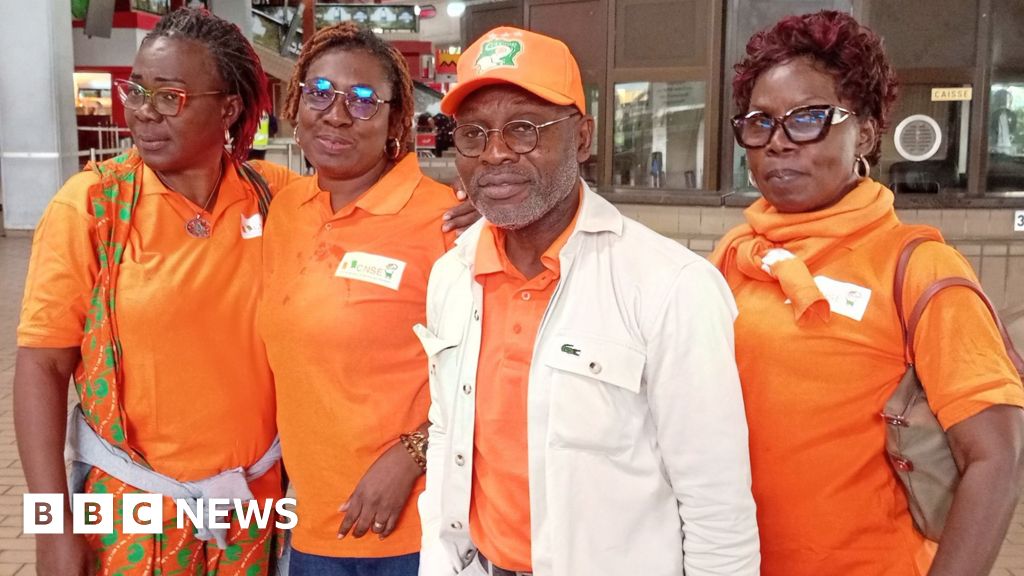
Julien Kouadio Adonis from the Ivory Coast's fan association, the National Committee for the Support of the Elephants says: "It's a form of segregation that doesn't dare speak its name, but the proof is there.

"No European country has faced this kind of restriction. Why Africa?"

His association normally sends a group of fans to the World Cup but decided not to bother even trying to go to the US because of the regulations.

Although he is relieved they will avoid what he called "exorbitant" ticket prices, Adonis believes a country that doesn't want to welcome supporters from qualifying teams shouldn't be allowed to host the World Cup.

"Football is a spectacle and a spectacle needs people watching," he says.

Forty-two generally wealthier countries benefit from a visa waiver programme, where applications are made online through the US's Electronic System for Travel Authorization (Esta). This costs about $40 (£30). There are no African countries on this list.

The visa that the US recommends for World Cup fans who need one costs $185 (£137) and applicants must attend an in-person interview. The State Department says they must demonstrate "your intent to depart the United States after your trip, and/ or your ability to pay all costs of the trip".

However, in May the US announced it would drop the requirement for deposits of up to $15,000 (£11,000) for people from World Cup qualifying countries Algeria, Cape Verde, Ivory Coast, Senegal and Tunisia, provided they have valid World Cup tickets. Supporters from Senegal and Ivory Coast had to secure visas before December, after which the restrictions began.

Seneglese fan Aliou Ngom has been to the last two World Cups in Qatar and Russia. For him, one of the highlights of the tournament is seeing "cultures coming together from all over the world".

A training camp in the US for Senegal's women's basketball team was cancelled last year when several players were denied a visa, and like Adonis, Ngom thought there was little point him applying for a visa as fan.

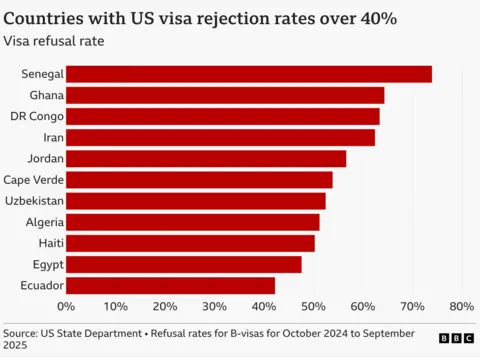
BBC analysis of US State Department data found that the visa rejection rate for citizens of 11 of the 48 countries that have qualified for the World Cup was higher than 40%. This includes applicants of all kinds, not just World Cup hopefuls.

That compares to an average rejection rate for B1 business and B2 tourist visa applications – the type recommended for fans going to the tournament - from all countries of 34%.

The data covers the year from October 2024 to the end of September 2025, so does not take in football fans who applied in the last eight months. The 11 countries are Ecuador, Egypt, Haiti, Algeria, Uzbekistan, Cape Verde, Jordan, Iran, Democratic Republic of the Congo, Ghana and Senegal.

With a high rejection rate, it is hard for fans from these countries to know whether to risk spending a lot of money on match tickets before applying for a visa, which they might not get.

If they do buy tickets directly from Fifa, they can resell them on the Fifa website for a fee if they need and can use the Fifa Pass system to speed up the visa application process.

"Fifa Pass is a positive step because it tries to move ticket holders into priority visa interview appointments," says Celine Atallah, who runs an immigration law firm based near Boston in Massachusetts.

But she adds that while it makes the process faster, it doesn't make it any more likely a visa will be approved.

"The visa system is the invisible gatekeeper of the World Cup," Atallah says. "Fifa can sell a ticket, but the US government decides who gets a visa, and CBP [Customs and Border Protection] decides who actually enters."

Even with a visa, anyone travelling to the US is not guaranteed entry on arrival, as border officials can still turn people away.

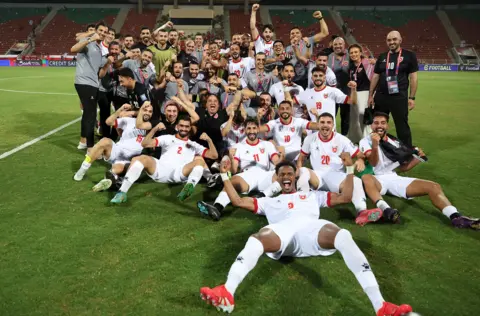
Abu Kass is the head of the football fan association for Jordan, a country where 57% of visa applications for the US were refused in the year to the end of September 2025.

"They've been rejecting people over the past three to four months," he says, adding that he doesn't know of a single supporter who has received a visa. The Jordanian supporters association in the US told the BBC it only knew of one Jordanian fan who had received a visa.

Kass says he took more than 42 documents with him to his visa appointment in the Jordanian capital Amman, where his application was rejected. The US does not give a reason when it refuses a visa.

"This World Cup is not ours," says Kass. "It's not for Arabs this World Cup, it's for them. If the head of the fan association was refused, who will be accepted?"

A State Department spokesman told the BBC that the administration was "prepared to welcome visitors from around the globe for the largest and greatest Fifa World Cup in history" and that "most overseas fans did not need to use Fifa Pass because they are nationals of Canada or one of the 42 countries that qualify for visa-free travel" or already held a visa.

It said that in every case "we will take the time necessary to ensure an applicant does not pose a risk to the safety and security of the United States" and that "we adjudicate each visa application on a case-by-case basis after rigorous review and thorough vetting to determine whether the individual is eligible under US law".

The Department of Homeland Security is concerned about people remaining in the country after visas have expired and says there were more than 538,000 "overstay events" between October 2023 and September 2024. The Pew Research Center estimates that in 2023, before President Trump's crackdown on undocumented migrants, there were 14 million immigrants living illegally in the US.

Countries that hosted the last four World Cups set up special visa systems for fans, although approval for travel documents was still not guaranteed.

Canada and Mexico are joint hosts of the tournament, but 78 of the 104 matches, including the final, will be played in cities across the US.

Canada and Mexico's own immigration and visa schemes differ from those in the US. Neither have issued travel bans for specific countries, although Canada, like the US, has recently put entry restrictions on countries affected by the recent Ebola outbreak in Africa, which includes World Cup qualifiers Democratic Republic of the Congo.

Canada requires people to submit biometric data for visa applications and there are two countries that qualified for the World Cup, Iran and Cape Verde, where Canada does not have any facilities where people can be scanned.

Canada does not break down visa refusal rates by visa type or country but it's overall rate for 2025 was 54%.

Mexico does not publish visa refusal data. It requires applicants to apply in-person at an embassy or consulate. Of the countries that qualified for the World Cup there are eight - Cape Verde, Democratic Republic of the Congo, Ivory Coast, Senegal, Uzbekistan, Bosnia and Herzegovina, Tunisia and Iraq - where Mexico does not have a diplomatic presence for people to go to.

Additional reporting by BBC News Afrique

Get the lowdown on every team at the 2026 World Cup. Here we take a closer look at debutants Jordan.

Get the lowdown on every team at the 2026 World Cup. Here we take a closer look at Iraq.

Get the lowdown on every team at the 2026 World Cup. Here we take a closer look at Senegal.

The bill to fund immigration agencies has been delayed by opposition to Trump's
'anti-weaponisation fund'.

The state claims health violations at a centre that is a focal point for sometimes violent protests.