yahoo Press
Live updates: GOP senators report yelling in closed-door meeting with Trump
Images
1 / 12

2 / 12

3 / 12
4 / 12
5 / 12

6 / 12
7 / 12
8 / 12
9 / 12
10 / 12

11 / 12

12 / 12
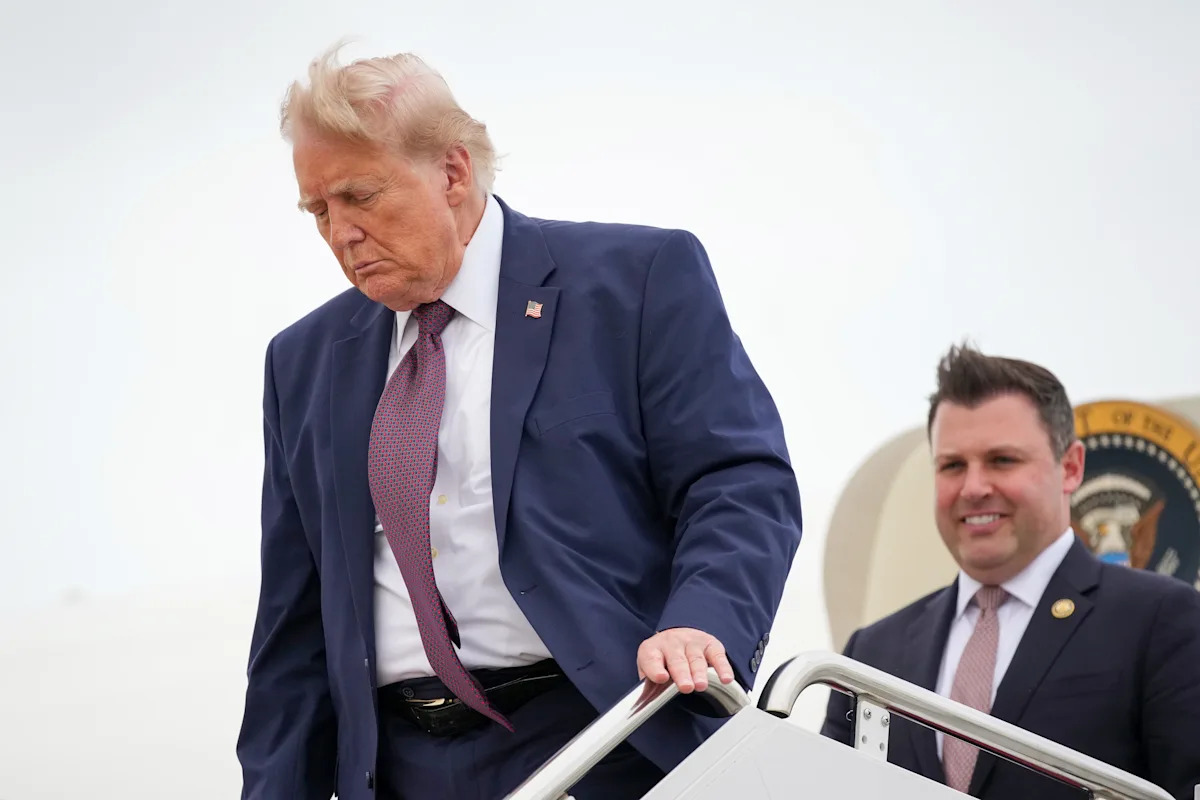
WASHINGTON – President Donald Trump abruptly canceled a signing ceremony for landmark housing affordability legislation Wednesday, saying he wanted Republicans in Congress to pass a major election reform bill first.

A couple hours later, Trump arrived at Capitol Hill for a previously scheduled lunch with Republican senators.

Addressing whether the SAVE America Act, a bill that affects voter registration laws, is more important than the housing bill, he said: "Every election is important. They want a lot of communists to come in."

The housing bill, which passed the Senate and House of Representatives by large, bipartisan margins this week, was a significant – and rare – victory on Capitol Hill. Lawmakers and experts called it a sweeping "first step" in tackling the nation's housing crunch.

If Congress remains in session, the housing bill can become law without the president's signature 10 days after it was presented to him.

Still, stalling the bill's enactment will likely enrage elements of both parties. Trump and Senate Republicans have clashed on a number of issues recently, from the Iran war to the filibuster.

Subscribe to On Politics: Stay ahead of the midterms and Capitol Hill drama with our daily political newsletter.

Sen. Catherine Cortez Masto, D-Nevada, urged Trump to consider all of the hard work of lawmakers from both sides of the aisle who put their party allegiances aside for the common good of all Americans to help fund affordable housing.

"It’s like lasagna, there are several ingredients, and it doesn't always come out the same," said Cortez Masto, adding that the housing legislation has widespread provisions that help those from rural and tribal areas afford housing and even the manufacturing companies building them.

The challenge now, Cortez Masto said, is to get Trump to think about Americans who desperately need housing.

"Now, Mr. President, it's time to think beyond yourself and sign the bill," Cortez Masto said.

-Terry Collins

Sen. Raphael Warnock, D-Georgia, said the housing bill would have helped make sure that when a home goes on the market, a family would buy it instead of "some out-of-state corporate landlord."

The bill bans institutional investors, such as private equity or specialized real estate funds, from purchasing certain single-family homes.

"It will end the racket where hedge fund owners and billionaires are buying up houses so that they can profit while others are shut out of the market or have to pay higher and higher prices," said Sen. Chris Van Hollen, D-Maryland.

-Erin Mansfield

Rep. Maxine Waters, a Democrat from California who championed the housing bill, slammed Trump’s decision not to sign the bipartisan bill as akin to "slapping hardworking American families in the face."

"Where it has previously proven too difficult, Congress has found compromise in the shared goal of putting the needs of our communities first," Waters said. "We know the president doesn’t care about affordability. We know he loves inflation, and unfortunately he doesn’t care about housing."

– Erin Mansfield

Republican lawmakers had a closed-door meeting with Trump that ran for more than an hour.

Emerging, Sen John Cornyn, R-Texas, said, "I listened."

Asked if he asked questions of the president, Cornyn said: "No, there wasn’t really an opportunity. He spoke for an hour and 15 minutes."

Sen. Roger Marshall of Kansas said "voices were raised" over the Senate's war powers vote Tuesday, which, while not binding, called for Trump to end the war in Iran. Four Republicans joined Democrats in passing it.

It was "very much like a hospital board meeting" with a bunch of doctors "yelling at each other," said Marshall, who's an obstetrician.

Sen. Ted Cruz of Texas called it a "spirited" discussion.

Sen. James Justice, R-West Virginia, said Trump and Sen. Bill Cassidy, R-Louisiana, "are both really, really passionate in what they think." Justice said Trump believes officials were wrapping up the peace accord with Iran but that reports about the Senate vote hurt those talks.

"Those moves hurt the country," Justice said, but that it was "heartwarming" to see Trump’s compassion for senators. "Naturally, there was a little exchange between Bill Cassidy and the president and everything, and they harbor bad feelings. Maybe that’s fair. Maybe not. I wish we move on in the world. But that wasn’t the issue today."

Justice said if reporters could have attended the meeting, they would seen Trump being very compassionate.

"His concerns are really genuine," Justice said. “He genuinely, really believes with all his soul that if we don’t straighten up our electoral process that will be terribly damaging to everybody as we go forward."

Trump told reporters after his Senate meeting that their talk went "great" and they’re proud of the Republican Party. He was flanked by Sens. Rick Scott of Florida and John Barasso of Wyoming.

"We like everybody, really, in the room. I don’t like a few people, but that’s OK," he said, drifting. "For the most part we have a really well unified party."

– Erin Mansfield

California Gov. Gavin Newsom called President Donald Trump "a sick man" for refusing to sign off on landmark housing affordability legislation until Congress passes the SAVE America Act election reform bill.

The governor took to social media on June 24, chastising the president for canceling the bipartisan housing reform package.

"Wow. Donald Trump is holding affordable housing hostage until Congress passes his voter suppression bill," Newsom said in a post on X. "He is literally delaying help for families struggling to afford a home in order to make it harder for married women and Black Americans to vote.

"He is a sick man!" the governor concluded.

Newsom's comments come more than a week after he said Trump's Justice Department is investigating him and his wife, Jennifer Siebel Newsom.

Additionally, Newsom's latest angst at Trump also comes two days after he and other California lawmakers announced to put a $11.25 billion housing affordability bond on the ballot in November. If approved, the bond will help fund large-scale construction of affordable housing and increase homeownership opportunities and programs for veterans.

Trump’s abrupt decision not to sign the 21st Century ROAD to Housing Act is an about-face from the night of June 23, when Press Secretary Karoline Leavitt called it "one of the most significant pieces of housing affordability legislation in American history."

"This bipartisan bill includes policies long championed by the President," Leavitt wrote. “It cuts unnecessary red tape, helps increase housing supply, and limits the ability of large institutional investors to purchase single-family homes."

She called the bill signing "another promise made, promise kept."

– Erin Mansfield

Trump has long pushed for Congress to approve election-law legislation to restrict mail-in voting and require identification and proof of citizenship for voters.

He’s urged the Senate to abolish the filibuster, which allows a minority of at least 41 lawmakers to block legislation like the SAVE America Act.

He has signed 20 bills into law since last March after repeatedly threatening that he wouldn’t sign any other legislation until the election bill was approved.

"I, as President, will not sign other Bills until this is passed," Trump said on social media on March 8.

Since then, new statutes signed by Trump include major bills such as funding for the Department of Homeland Security and another for rural broadband access.

But others had narrower subject areas, including the Gerald E. Connolly Esophageal Cancer Awareness Act of 2025, named for the late House Democrat from Virginia.

Several Senate Republicans weren’t happy that Trump blew up signing the housing bill at the eleventh hour.

“We’ve got to get our act together and stop surprising people,” said retiring Sen. Thom Tillis, R-North Carolina. “It makes no sense.”

Sen. John Cornyn, R-Texas, said he couldn’t think of a precedent of such a thing happening. He called it “sort of inexplicable.”

“Ultimately, what I think the president wants to do is eliminate the filibuster,” he said. “And there’s not the votes to do that.

“At some point we’ve got to deal with reality,” he added.

Sen. John Kennedy, R-Louisiana, said he’d be “really sad” if Trump ultimately vetoed the housing bill because of the SAVE debacle.

“You’d see a grown man cry,” he said, referring to himself.

At the same time, Kennedy said it was the prerogative of the president, his close ally, to set other legislative priorities.

Senate Republicans are discussing a number of creative ways to potentially pass the SAVE America Act.

One of them, which Kennedy said he supports, would include attaching its renewal to a key government spy law.

“I will stand on one leg and bark like a dog if that’s what it takes to get this passed,” he said of SAVE.

The housing bill is called the 21st Century ROAD to Housing Act. It’s a bipartisan law that supporters designed to increase the number of homes built in the United States. Housing advocates have long said that low housing supply keeps real estate prices too high for many Americans to afford homes.

The bill targets the cost of construction, regulatory red tape, zoning restrictions, and banking hurdles. The bill also modernizes programs through the Department of Housing and Urban Development, or HUD.

– Erin Mansfield

Trump made his announcement while Republican leaders in both chambers were busy doing other things. Senate Majority Leader John Thune, R-South Dakota, who was scheduled to be at the bill signing, was on the Senate floor speaking about abortion. As he left the chamber, he said he'd just learned of the scheduling change.

"At this point, I don’t have any observations about that," he told reporters.

House Speaker Mike Johnson, R-Louisiana, was in the middle of a press conference. He said he had spoken with the president for 20 minutes earlier in the day and understood the White House's urgency about wanting to pass voting reforms.

"The president believes in election integrity," Johnson said. "That is the top priority."

Several iterations of the SAVE America Act have made their way through the 119th Congress. The main piece of legislation, which Trump has placed atop his Capitol Hill agenda, would require documentary proof of citizenship to vote and instruct states to turn over voter rolls to the Department of Homeland Security, among other changes. It would also create barriers to registration. Voting rights advocates have expressed concern that the bill would potentially disenfranchise millions of voters.

Politically, Trump's attempt to shove the bill through Congress has created a major wedge between the White House and Republicans, especially in the Senate. Democrats, meanwhile, have rejoiced in the GOP family drama.

"Seeing Trump come to the Capitol today to meet Senate Republicans is like watching a clown car pulling up to the circus," Senate Minority Leader Chuck Schumer, D-New York, said on the Senate floor. "Republicans are wringing each other's necks."

The Safeguard American Voter Eligibility, or SAVE America, Act is legislation that would require people to provide proof of American citizenship to register to vote in federal elections and to show a government-issued photo ID to cast their ballots.

It would also place new rules on mail-in voting, requiring Americans to send in a copy of their ID when both requesting and submitting their ballot.

Republicans have argued the legislation is needed to safeguard elections and prevent noncitizens from voting, something data shows is rare. Meanwhile, Democrats and voting rights groups contend the legislation would disenfranchise millions of Americans by making it harder to register to vote and cast ballots.

For example, if the bill fully passes, millions of married people whose names on their birth certificates or passports don't match their names on other forms of identification could face extra hurdles to register to vote and cast their ballots, according to the Brennan Center for Justice, a nonpartisan law and policy institute.

Under current laws, many Americans need to present some form of identification to register to vote. The act would require Americans to show additional documents that prove their citizenship, such as a passport or a birth certificate.

– Terry Collins

This article originally appeared on USA TODAY: Trump cancels housing bill signing, calls for SAVE America Act passage