huffpost Press
Trump Threatens New Trade War And Canada’s Carney Says Sure, Bring It On
Images
1 / 4

2 / 4
3 / 4

4 / 4
WASHINGTON – Six months after starting a real war he cannot figure out how to get out of, President Donald Trump has started another, potentially equally disastrous conflict: a trade war with America’s neighbor and second-largest partner.

And just as Iran is showing little interest in helping Trump out of his bind by agreeing to a face-saving deal that would let him claim victory, Canadian Prime Minister Mark Carney is uninterested in letting Trump back away from the fight he began within weeks of returning to office.

Indeed, when Trump declared that he would impose even more tariffs on Canadian goods starting in January – two months after the midterm elections – Carney upped the ante and said no: His retaliatory tariffs would begin the day after Labor Day, the traditional start of the fall election campaign season.

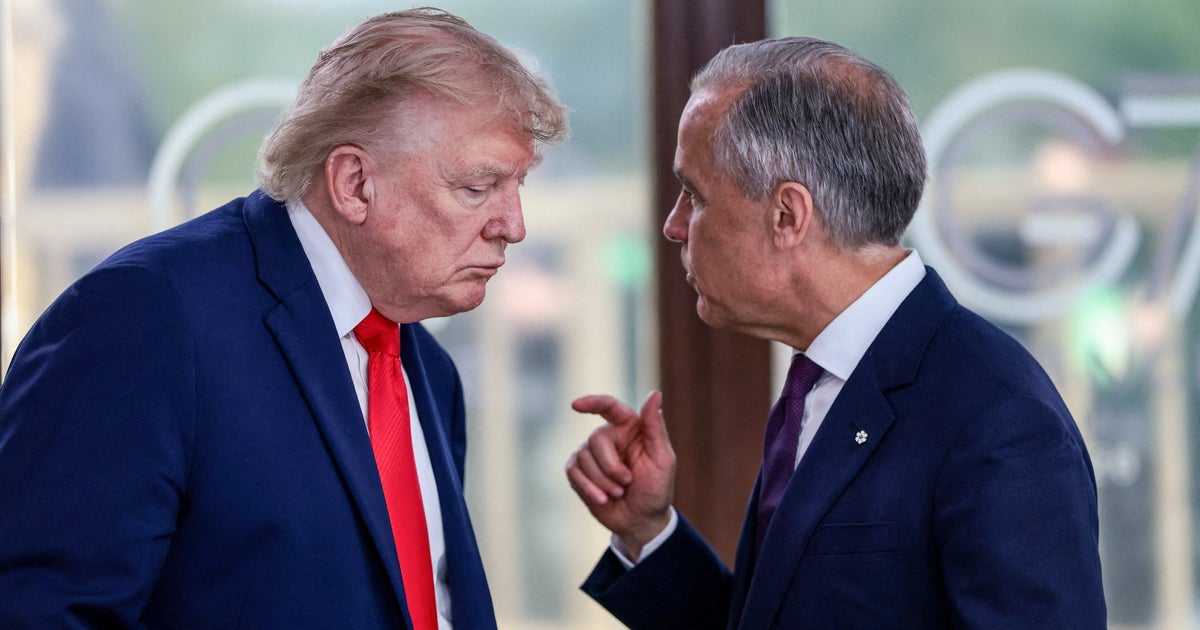
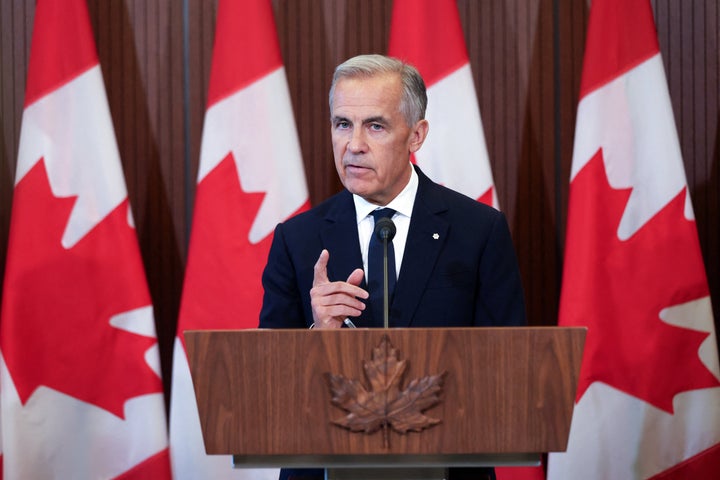
“You’re at war when you’re attacked, and we got attacked,” Carney said in a weekend press conference explaining why he broke off trade negotiations. He then said out loud what many U.S. allies have believed for two years: that the United States under Trump is no longer a trustworthy partner. “We recognize that sometimes its signature was written in pencil.”

Trump’s new tariffs on a hodgepodge of goods from Canada will raise prices for U.S. consumers even further in the run-up to the November elections, while Canadian tariffs will hurt U.S. exporters who count on that business. Trump has also upped his volume of insults against Canada, claiming, for example, that he will rename Lake Ontario as Lake America.

Scott Lincicome, a trade analyst at the Cato Institute, said Trump chose to tangle with someone whose country is fully behind him. “He’s a smart guy and it helps a lot that Canadians overwhelmingly hate Trump and will endure significant trade war pain to fight him.”

Carney is not the first leader to say no to Trump. Mexican President Claudia Sheinbaum has rejected Trump’s demand to let him use U.S. troops against suspected drug dealers in Mexico, criticized the weapons pipeline that sees high-powered guns enter her nation illegally from the U.S. and stood up for Cuba as Trump effectively imposed a blockade — but has done these things relatively quietly. Danish Prime Minister Mette Frederiksen has similarly refused to countenance Trump’s demand that her nation turn over Greenland.

Italian Prime Minister Giorgia Meloni essentially called Trump a liar when he claimed she had begged to be photographed with him, while French President Emmanuel Macron chastised Trump for constantly saying contradictory things about Iran, even advising him to remain silent once in a while.

Carney ― whose doctorate in economics and former directorship at two central banks stand in stark contrast with Trump’s casino-bankrupting history in business ― is the first leader of a close ally to confront Trump head-on in a major dispute.

At that press conference, he pointed out a fact that has gotten glossed over in virtually all discussion of Trump’s tariffs against Canada since he retook office: They violate the 2020 congressionally approved free trade update that Trump continually boasted about at the time.

“That’s the thing: We have a deal with the Americans. It’s called CUSMA,” he said, referring to what the U.S. calls the United States-Mexico-Canada Agreement, essentially a renaming of the 1994 North American Free Trade Agreement. “We have side letters that clarify behavior in steel, in aluminum, in autos. All of those are being violated, day in, day out.”

Trump does not, in his public comments, explain how Canada is cheating the United States under a trade agreement that he himself negotiated and signed. His White House press office said he is permitted under the agreement to impose tariffs on Canada to address emergencies and national security concerns, although it is unclear how Canada is causing either.

As with so many other things, Trump’s decision to act against Canada is rooted in his profound ignorance, in this case his longstanding inability to understand how international trade works. For decades, Trump has claimed, falsely, that countries that sell more products to the United States than buy from the U.S. are “ripping off” Americans. He further conflates trade deficits with the U.S. budget deficit.

Trump’s first-term national security adviser, John Bolton, who, like many of Trump’s critics, has been criminally prosecuted by Trump’s Department of Justice, said the true workings of trade and tariffs were explained to Trump by experts in his own administration. “Many times,” he said.

Trump nevertheless repeated his falsehood again on Wednesday in a podcast appearance.

“We lose $60 billion a year, and really more than that, $60 billion a year with Canada,” he told former Fox News host Glenn Beck.

That view ignores the reality that Americans use and benefit from lumber, aluminum, maple syrup and other products they pay for. The trade imbalance, according to economists, is as meaningful as a typical family’s “trade deficit” each year with their neighborhood grocery store.

Carney, in his news conference, told reporters that even by that metric, Trump is wrong because he fails to include services provided to Canadians by U.S. companies that generate a net trade surplus for the United States. He further pointed out that much of the imports coming from Canada are natural gas, electricity and the heavy crude needed by many Texas refineries.

“I don’t think they want us to stop sending any of that energy,” he said.

That Carney has emerged as Trump’s biggest antagonist among traditional allies is perhaps unsurprising, given that his Liberal Party unexpectedly retained power in 2025 thanks to anti-Trump backlash among the Canadian populace after he returned to office and began talking about annexing Canada as the 51st state.

Carney provided a hint of where he stood in his speech at the World Economic Forum in Davos, Switzerland, early this year.

“If great powers abandon even the pretense of rules and values for the unhindered pursuit of their power and interests, the gains from transactionalism will become harder to replicate,” he warned, clearly referring to the United States without ever mentioning Trump by name. “Hegemons cannot continually monetize their relationships.”

The end result of Trump’s tariff attacks and Carney’s retaliation is that residents in both countries will suffer, Bolton said.

“This is just going to hurt both economies. Trump raises taxes on Americans and Carney retaliates by raising taxes on Canadians,” he said.

By entering your email and clicking Sign Up, you're agreeing to let us send you customized marketing messages about us and our advertising partners. You are also agreeing to our Terms of Service and Privacy Policy.