yahoo Press
Physicists trap a single antimatter particle for a month
Images
1 / 6

2 / 6

3 / 6
4 / 6

5 / 6

6 / 6
You can't hold antimatter in your hand or even in a regular laboratory apparatus. As soon as antimatter meets matter, the two tend to annihilate each other. This makes studying antimatter tricky. But now physicists have managed to trap a single subatomic particle of the stuff for months at a time in a way that allows them to study its quantum states.

Further investigations using the trap might reveal the secret of why the world around us is made of matter and not antimatter, when things could have presumably gone either way.

Every normal particle of matter has an antimatter counterpart with equal mass but opposite charge. To build their trap, physicists started with atoms of sodium 22, a radioactive isotope with a half-life of about two and a half years. When one of these atoms decays, it emits a positron—the antimatter counterpart of the electron.

Sign up for Today in Science, a free daily newsletter from Scientific American and join a community of science-loving readers.

"The big challenge is to persuade these positrons to slow down and then capture them," says Gerald Gabrielse, a physicist at Northwestern University, who oversaw the project. The team reported its achievement on Wednesday in Physical Review Letters.

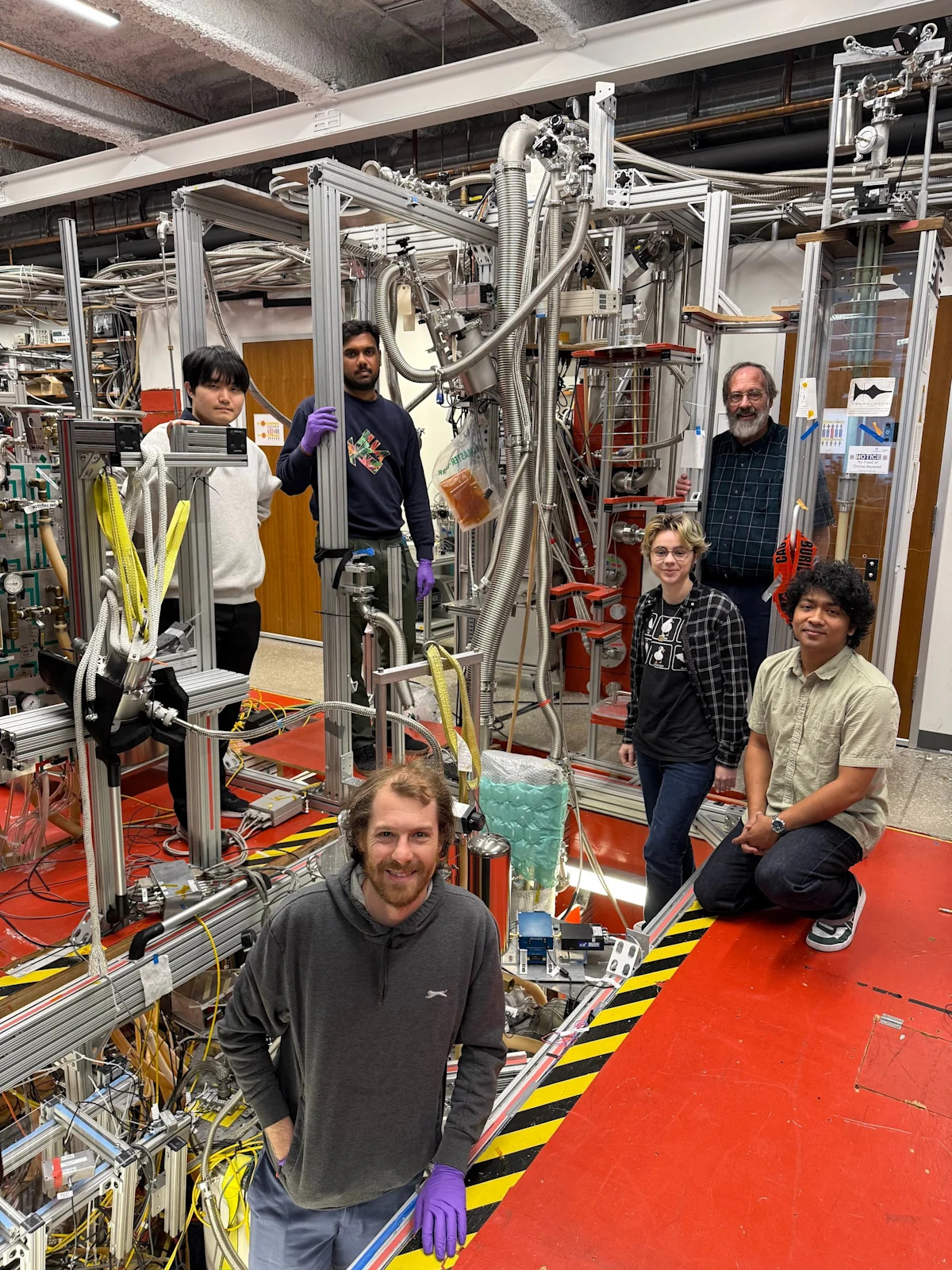
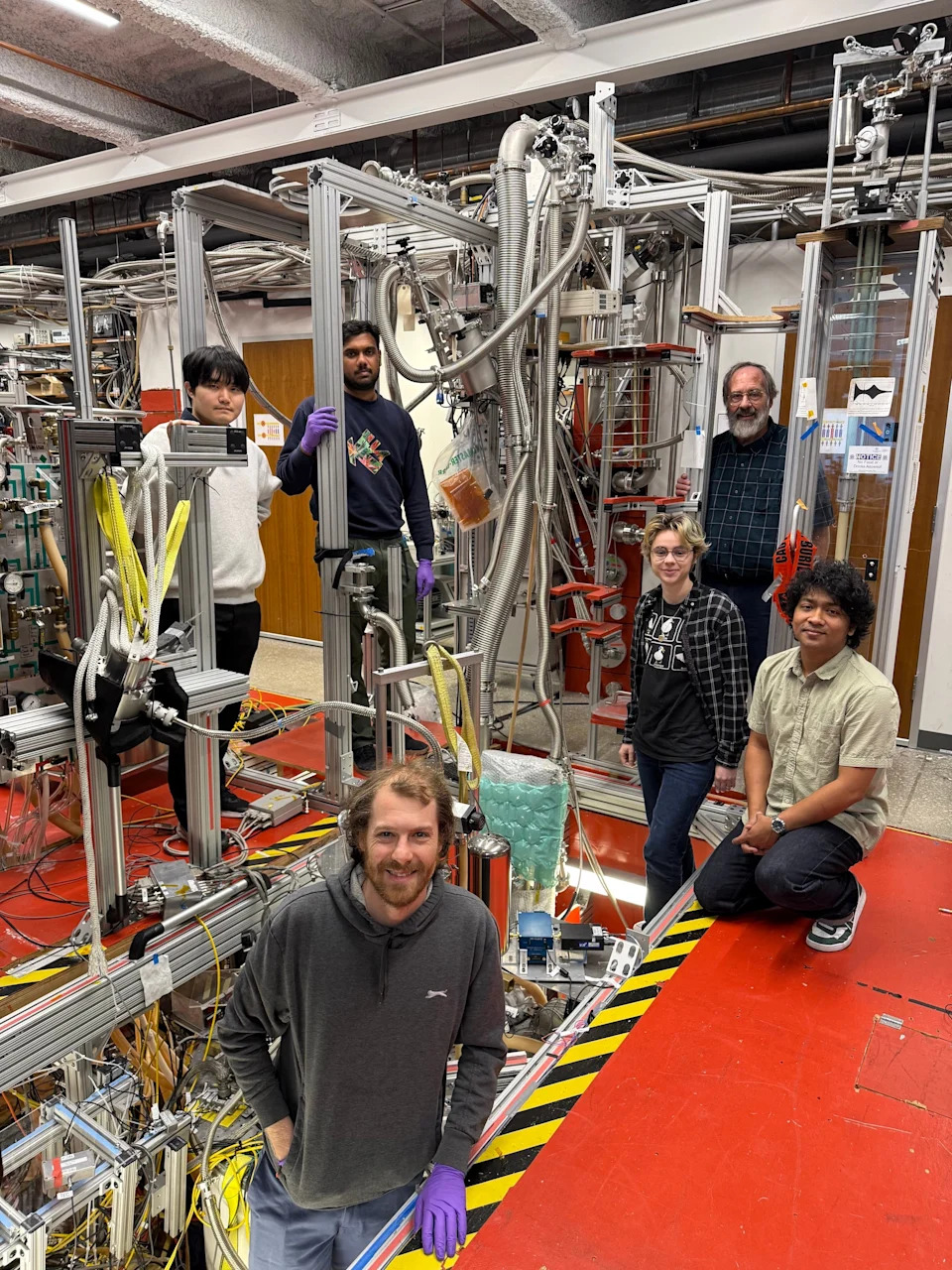
Gerald Gabrielse (top right) and his team in the lab where they trapped a positron particle for a month.

Gerald Gabrielse

The first step is to send the positrons through the crystal lattice of a sliver of cold tungsten. As the particles go pinballing through the material, they slow down and lose energy. "Every time they bang into something, there's a chance of annihilation, but it doesn't always happen," Gabrielse says. "If they make it to the end, they get popped out."

Next, the physicists steer the positrons along a channel using electromagnetic fields. Eventually the particles end up in a vacuum, just three tenths of a degree Celsius above absolute zero, trapped by an electric field on top and bottom and a magnetic field on the sides. "If you want to hold on to antimatter, you have to hold it in a container without walls," Gabrielse says.

This method allowed the researchers to isolate and study a solitary, lone positron for a month—and could let them do so indefinitely.

The researchers intend to use their trap to make precise measurements of the positron's magnetic moment—basically the strength and orientation of its magnetic field. To do this, they must determine two things: the energy needed to flip the direction of the positron's spin and the energy needed to make it jump from its ground state to its first excited state.

Using a similar trap setup, Gabrielse and his team have already measured the magnetic moment of an electron to a precision of one part in 10 trillion. Taking the equivalent measurement for a positron will allow them to make a crucial comparison. "We're looking to see if they have an exactly opposite magnetic moment," Gabrielse says. That's the prediction of the Standard Model of particle physics. If the two have different values, however, this could help explain why our universe is made of matter instead of antimatter.

Just after the Big Bang, scientists think there were roughly equal amounts of the two. Most of the matter and antimatter must have annihilated, but a small excess of matter was somehow left over to seed the stars and planets we see. The magnetic moment measurement is just one of many realms where physicists are seeking differences between matter and antimatter to account for this profound discrepancy.

"Turn every particle to its antiparticle, look at physics through a mirror (flipping left and right) and press the 'rewind button' to reverse the flow of time," says Roni Harnik, a theoretical physicist at the Fermi National Accelerator Laboratory in Batavia, Ill., who was not involved in the project. "Our most basic theories say that physics stays the same."

If it turns out things are different—that the positron, for instance, has a different magnetic moment than the electron—then we'd have a hint about how matter won out.

"This is an exciting development," Harnik says, "that will enable us to test a basic symmetry."