Press
Colombian president purges National Museum of works promoting ‘communism’
Images
1 / 3

2 / 3

3 / 3
Far-right President Abelardo de la Espriella says he will wage a ‘counterrevolution’ against cultural institutions.

Save

Share

Colombian President Abelardo de la Espriella has announced he is spearheading a cultural “counterrevolution” that includes removing dozens of exhibits from the National Museum, drawing protests and comparisons to United States President Donald Trump.

De la Espriella, a conservative Trump ally, said last week that he wants to prevent cultural institutions from being taken over by what he calls “atheist social communism”.

Since then, exhibits have been taken down that once addressed the history of social movements, including feminist and LGBTQ activism, and Colombia’s political violence.

The changes have sparked protests by civil rights groups, artists and students who have accused the government of censorship and warned that it could erase important parts of the country’s history.

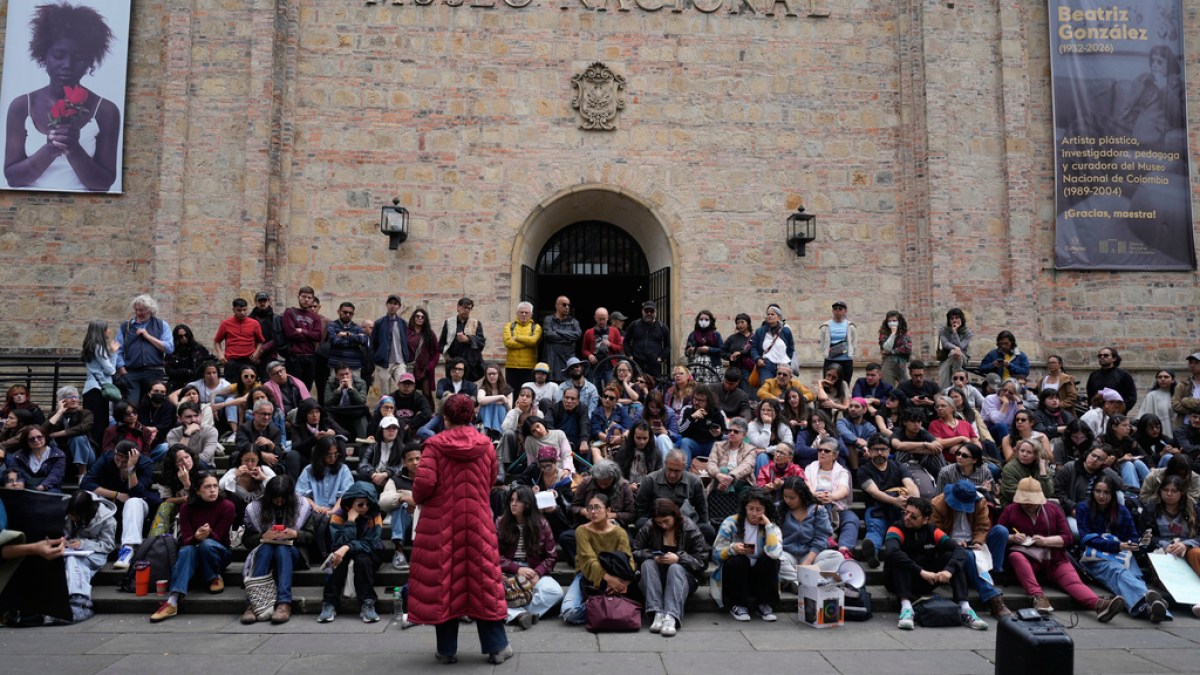
Dozens of demonstrators gathered on Wednesday outside the National Museum in downtown Bogota as riot police guarded its entrance.

“I find it outrageous that they want to erase part of our history,” said Azul Riascos, a history student.

He said the government was promoting a vision of Colombia as exclusively white, Catholic and Spanish-speaking. That image, he explained, excluded Black, Indigenous and LGBTQ communities.

Gimena Sanchez-Garzoli, director for the Andes at the Washington Office on Latin America, a research and advocacy organisation, said the Colombian government’s approach reflects a broader trend among Trump allies who are copying US political narratives and strategies.

Trump has been fiercely critical of Washington museums, particularly those tied to the Smithsonian Institution.

The White House released a report in July branding leaders of the Smithsonian’s National Museum of American History as radical activists and ordered signs installed outside the museum telling visitors that some exhibits are inaccurate.

Nearly three months later, those signs still haven’t been installed. The museum’s director, Anthea Hartig, told Congress that the White House report “does not fairly or accurately characterise the full body of work at the museum”.

Sanchez-Garzoli said Trump’s cooperation with allied Latin American governments on security and counternarcotics efforts also has an ideological dimension.

“These are imported narratives about terrorism and about being ‘woke’,” anthropologist Arturo Sanabria said during Wednesday’s protest, describing the Colombian government’s approach as a form of neocolonial intervention.

Colombia’s Culture Minister Paola Holguin said the government was reviewing and redesigning exhibitions and curatorial practices at other museums overseen by her ministry.

Colombia’s Ministry of Foreign Affairs also renamed a courtyard previously honouring an Indigenous leader, describing the change as part of the president’s campaign against “woke” ideology.

“The government is making serious efforts in a cultural battle that probably doesn’t exist,” political scientist Estefania Cardozo said outside the museum. “It is inventing one to erase identities that cannot be erased because they already exist.”