yahoo Press
World’s chief alien hunter: They exist... but don’t look anything like ET
Images
1 / 13
2 / 13

3 / 13

4 / 13

5 / 13

6 / 13
7 / 13

8 / 13

9 / 13
10 / 13

11 / 13

12 / 13

13 / 13
Are aliens real? The question has animated conspiracy theorists for decades and enthralled at least one former president of the United States. In a recent interview, Barack Obama became the first American president to affirm a belief in the existence of extraterrestrial life, but insisted that it was not being stored inside the top-secret Area 51 military base in Nevada.

For Bill Diamond, the president and chief executive of the Search for Extraterrestrial Intelligence Institute (Seti) in California, Obama’s beliefs are hardly radical. Seti is the world’s leading research organisation dedicated to the scientific search for life beyond our planet – and Diamond insists that aliens are out there.

“Oh yes,” says the 69-year-old scientist. “I do believe aliens are real. Definitely… It is one of the questions we ask if you want to get a job at Seti. If you don’t believe in aliens, there’s probably no point having a job with us.” Diamond’s job involves overseeing teams of scientists working on various projects and sifting through torrents of data from radio telescopes, searching for patterns that nature alone cannot explain.

Diamond is careful, though, to draw distinctions in what he means by aliens. He is not talking about flying saucers and abductions. “Life is probably very common in the universe,” he says. “It’s when you start talking about complex organisms, intelligence and then, ultimately, technology that it becomes a different matter.

“The conditions that would allow for [aliens] to exist, which are mostly time and evolution, are probably not going to be as common as the conditions that allow just basic cellular life to emerge. But statistically speaking, there will be many examples of intelligent and ultimately technological life on other worlds.”

So if they do exist, what will they look like? Public imagination of aliens in film and fiction are of little men flying through our skies in spaceships and etching elaborate patterns into wheat fields. Diamond smiles at the cliché. Reality, he believes, is both less theatrical and far harder to picture.

“It’s very hard for us to imagine what aliens would be like,” he says, but points to the biodiversity of our own planet which may offer clues. Aliens may even be similar to creatures like jellyfish, he suggests. “We have jellyfish that, from my point of view, are pretty extraordinary looking, a bit like aliens – and various sea creatures and birds and reptiles and mammals and so forth.” On Earth alone, evolution has produced creatures that seem almost otherworldly. Octopuses with nervous systems that extend into their arms, whales capable of complex communication. If such diversity exists under one sky, perhaps it’s not so difficult to imagine stranger things still under another.

The same physical laws apply everywhere, Diamond notes. Gravity, chemistry and energy behave the same way across the known universe. This does not mean that aliens would look human but it does mean that they would be shaped by similar constraints. “They will obviously be shaped by their environment. A bigger planet than Earth is going to have a stronger gravitational field that’s going to require an organism that is capable of withstanding that gravitational pull so likely to be a more robust physical species. A planet slightly smaller would have a lower gravitational field that might allow for more spindly, less structurally solid beings.”

So if aliens do exist, how would they get in touch? Diamond is clear about what he does not expect. “I think crop circles are rather unlikely,” he says. “If you’re an advanced civilisation, and you are able to be here in some capacity, having a presence or impact on our planet and you wanted to get our attention or have the technology to visit Earth in some direct or impactful way, you have technology far beyond our ability to imagine.”

Such a civilisation would not stumble upon us. It would already know we were here. It would have studied our atmosphere, our radio signals. It would understand our level of technology and, almost certainly, our languages, Diamond says.

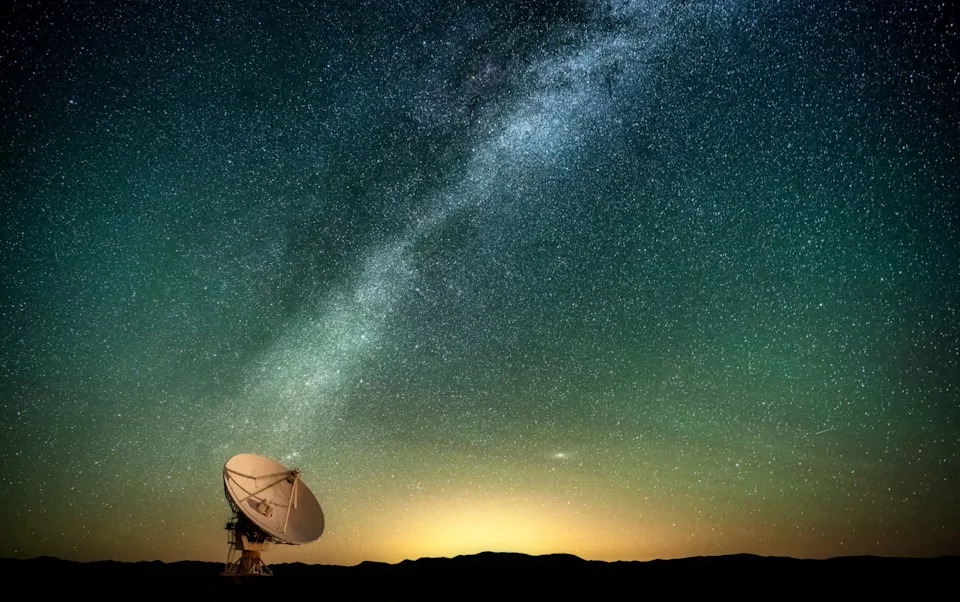
Instead, he believes that contact is far more likely to come as a signal. “First contact is most certainly going to be an observation of a phenomena that nature doesn’t produce, that we can say that’s technology,” he says. “Certainly, if an advanced civilisation wanted to get in touch or contact us, radio transmission would be one of the most efficient and effective ways.”

However, he jokes that even if aliens could contact us, they might not want to. “There is a joke amongst some researchers,” he says. “When alien spacecraft fly by the Earth, they lock the doors.”

At Seti, Diamond describes three ways that scientists search for life. The first is “in situ” exploration, sending instruments directly to a place of interest. Nasa’s Perseverance rover is currently exploring Mars to determine whether life exists or once existed there. That approach, for now, is limited to our own solar system. The second is remote observation. The James Webb Space Telescope can examine the atmospheres of distant planets up to around 1,000 light years away. The third is the search for extraterrestrial intelligence itself, though Diamond prefers a more precise description. What Seti is really seeking, he says, is extraterrestrial technology, something that acts as a proxy for life and intelligence.

So, when might all of this happen? “A Seti discovery could happen tomorrow, it might not happen for a thousand years, we don’t know,” Diamond says. “But one of the things we also say in this business is that the probability for finding life beyond Earth if you don’t look for it is zero.”

The challenge, he explains, is scale. If a signal was sent from Alpha Centauri, the closest star system to our solar system, it would only take four years to get here. Yet if an alien civilisation 1,000 light years away sent a message today, it would not reach us for 10 centuries. If we replied, our response would take just as long. Therefore, any exchange would unfold across generations rather than lifetimes.

That does not dampen his optimism. Humanity has been technologically capable for barely a century. In that time, we have gone from inventing radio to building space telescopes that can study worlds hundreds of light years away. Given enough time, our reach will expand.

A confirmed detection would be historic. Diamond and his colleagues are already thinking about what it would mean. What will that discovery do to humanity as we know it? Change it for the better, Diamond hopes.

“Whatever the nature of the discovery, almost certainly it will have an impact on us,” he says. “How will it impact religious beliefs and how will it impact governments and international diplomacy?”

For a man who spends his days contemplating vast distances and civilisations he may never see, the conclusion is strikingly human. “I hope we will be excited by the news and not threatened by it. Maybe people would finally realise we are all on this one planet as one little island and in this together so it might be smart for us to co-operate instead of fighting with each other.”

Try full access to The Telegraph free today. Unlock their award-winning website and essential news app, plus useful tools and expert guides for your money, health and holidays.